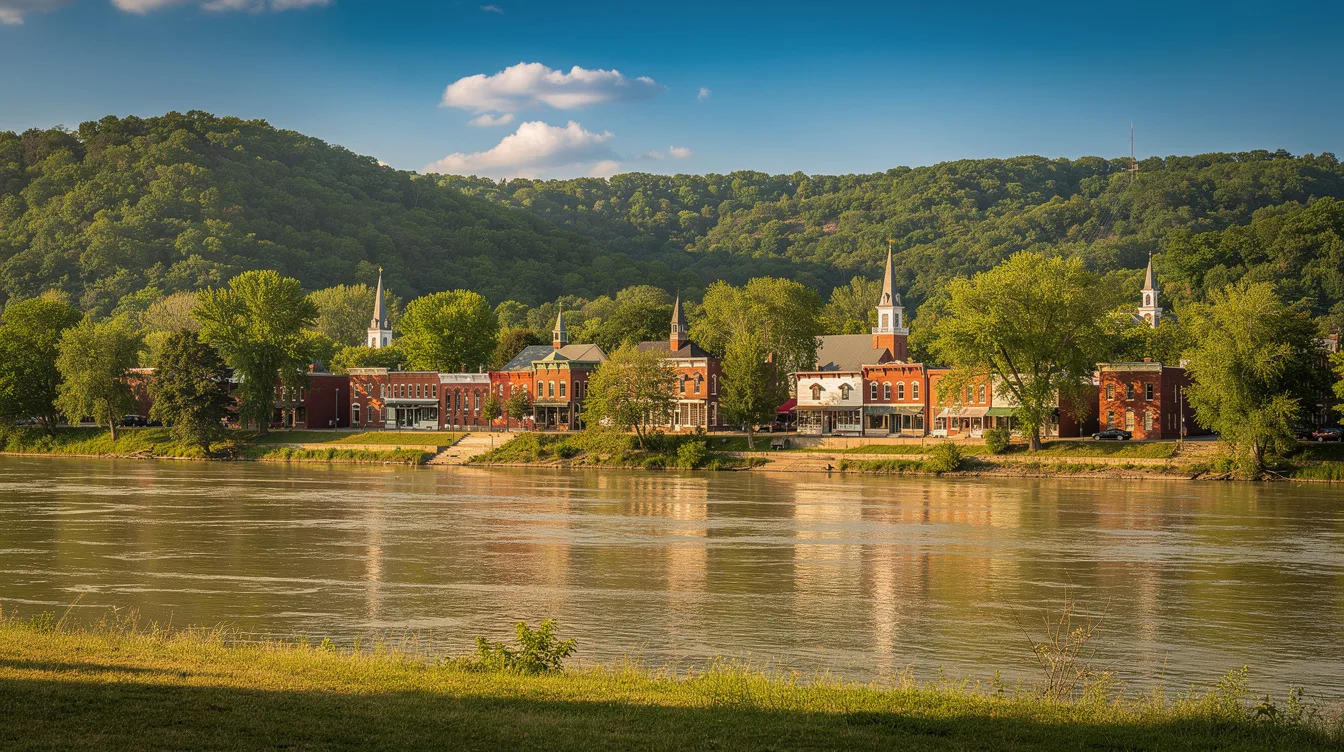
Most Midwestern river towns lost their old buildings to fire, flood, or a parking lot. Madison, on the north bank of the Ohio River in southeast Indiana, kept more than 1,700 of them.
They stand inside a historic district that runs 133 blocks, one of the largest continuous urban National Historic Landmark districts in the country. And almost nobody outside Indiana brings it up.
That is the odd part. A town of 12,357 people at the 2020 census holds a downtown that would be a protected showpiece anywhere else.
A downtown nobody got around to tearing down
Walk Main Street and the density does the work. Houses, storefronts, churches, and public buildings run in one unbroken stretch, not saved as fragments between newer blocks.
Because the old core stayed compact, you can see most of it on foot. You’ll park once and leave the car where it is.
But this isn’t a museum street. The old fronts hold small independent shops, galleries, and cafes that people here actually use.
Why a town this small got this rich
Madison was established in 1809 and named for President James Madison. The money came later, and it came off the water.
Farm exports moved out by boat through the 19th century, and the port paid for the brick and stone you’re looking at today. That’s the whole reason the architecture is this good.
Then came the Madison and Indianapolis Railroad, one of the first rail lines west of the Allegheny Mountains. This was a crossroads before most of the Midwest had one.
Kentucky sits directly across the river. And that closeness gave Madison a role in the history of the Underground Railroad.
How far is Madison from Louisville?
About 46 miles, which makes this a clean one or two night trip. Cincinnati is 70.2 miles out, close enough that you arrive with the whole day still in front of you.
Madison is the seat of Jefferson County, so it has more civic buildings than a town this size usually keeps. But it still shuts down early, and that’s part of the appeal.
The hills behind town do the other half of the work
Clifty Falls State Park sits right next door, with trails, deep ravines, waterfalls, and long views over the Ohio valley. The drop-off happens fast once you leave the river flats.
But time it outside the freeze. The park is at its best from spring through fall, and ice takes the pleasure out of a gorge trail.
The waterfront itself is flatter and easier. You walk, you watch barges push downstream, and the far bank stays green.
July belongs to the hydroplanes
Every July the Madison Regatta puts hydroplane racing on the Ohio, with the Indiana Governor’s Cup as the headline. The town’s quiet flips for a weekend.
And it is loud. Engine noise carries across open water in a way it never does on a closed track.
September brings the other date worth planning around, the Chautauqua Festival of Art, held annually. Two very different crowds, and neither one lingers.
When is the best time to visit?
Spring through fall, with the shoulder weeks giving you the same streets and fewer people. It’s busy in July, and close to empty on a weekday in May.
Skip deep winter unless the architecture is the only reason you’re coming. The buildings don’t care about the weather, but the trails do.
One house explains all the others
Lanier Mansion State Historic Site is the Greek Revival home tied to Madison’s boom years. Stand in front of it and the rest of the district starts to make sense.
From there it’s a short walk back down to the river. The scale drops, the porches get plainer, and the same century keeps repeating itself block after block.
You can see the whole downtown in an afternoon, and that’s exactly the problem. Most people driving between Louisville and Cincinnati never think to stop, and the town stays quiet because of it.