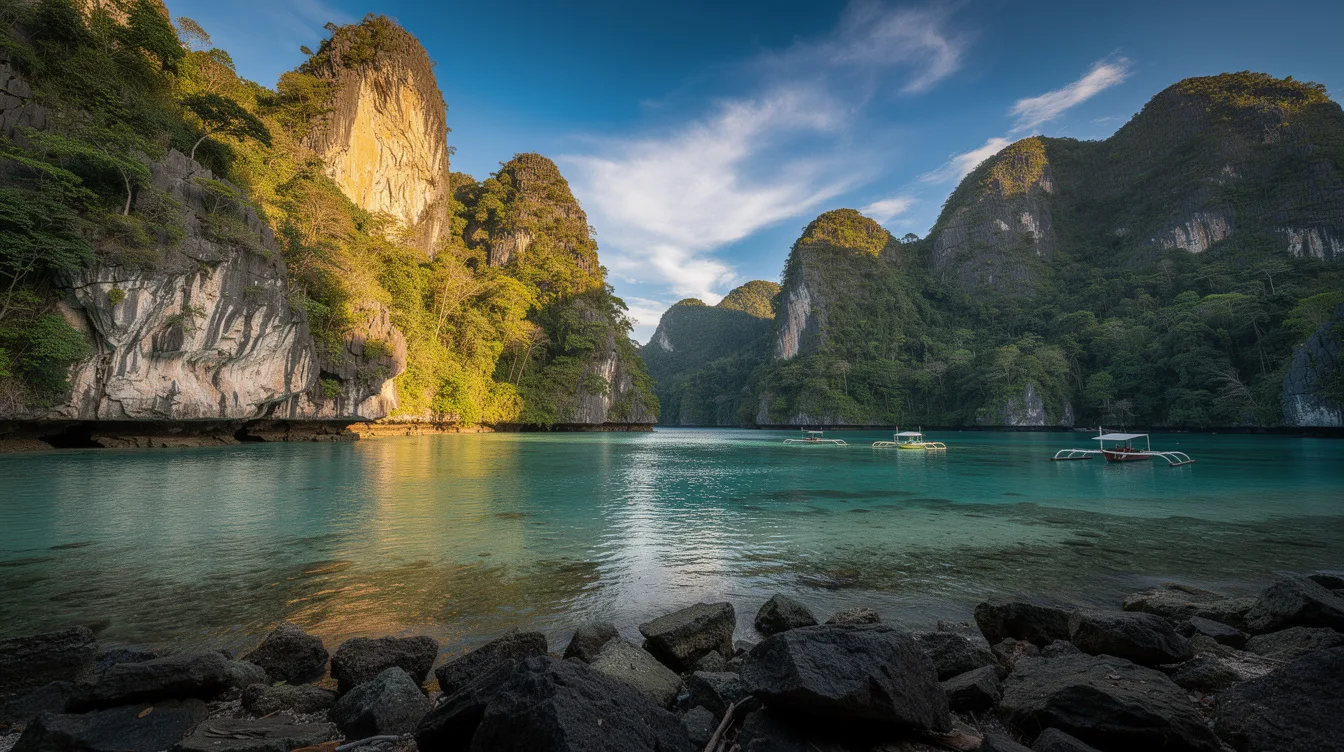
El Nido is a Philippine coastal town where the useful part comes first: a direct flight from Manila takes about 1 hour 30 minutes. Then the hard-edged limestone and water-filled passages of the Bacuit Archipelago take over.
You don’t come for town itself. El Nido is compact, busy, and built around departures, so it works best as a launch point for the sea rather than an all-day destination.
Big Lagoon is why the flight feels short
The town is the gateway to the Bacuit Archipelago, a spread of islands reached by bangka boat. Its calling cards are steep limestone cliffs, pale beaches, and Big Lagoon and Small Lagoon, where the rock narrows the view until water seems to be the only way forward.
And that’s the point of arriving by boat. You can watch the shore fall away, feel the salt on your arms, then slip into a lagoon where the cliffs make every engine sound briefly seem too loud.
Tour A is the iconic first-day route because it combines Big Lagoon, Small Lagoon, Secret Lagoon, Shimizu Island, and Seven Commandos. It’s popular, certainly, but kayak time gives you a slower angle on the karst walls and gets you away from the cluster of boats.
Choose boat days, then leave room for weather
If you have 3 nights and 4 days, use two days for major boat trips, save one for a beach, and keep some flexibility. The sea decides more than your itinerary does, especially outside the calmer part of the year.
But don’t try to make every hour count. Tour C is the better companion to Tour A if you want more dramatic cliffs, remote-feeling coves, beaches, and snorkeling rather than a repeat of the lagoons.
Bring a dry bag, water shoes, a mask that fits, and reef-safe sunscreen. You’ll be stepping between boat decks, shallow water, and sand, so the glamorous packing list is less useful than gear you can rinse off.
Nacpan and Las Cabañas solve the no-boat day
Nacpan Beach, north of town, is the reset button after an early boat departure. Its long stretch of golden sand feels quieter than central El Nido, so it’s the place to trade departure times for a scooter or tricycle ride and a slower afternoon.
And Las Cabañas, also called Maremegmeg, is the easier choice on arrival day or after a tour. Go for sunset, when the light softens and there’s no pressure to make a ferry, catch a kayak slot, or squeeze another stop into the day.
El Nido Town remains the most practical base because morning tours leave from there and dinner is close at hand. It’s lively, but it can be noisy and dense. Corong Corong has a more relaxed feel and better sunset appeal, while Nacpan trades convenience for calm.
November through May gives you the better odds
November to May is generally the most reliable period for calm seas, island-hopping, and underwater visibility. December through February is more comfortable in temperature, but it’s also busier, which means you should book lodging and transfers ahead.
March through May stays dry but gets hot. From June to October, rain and rougher water can cancel boat outings, though crowds thin and some accommodations cost less. You can still go, but build in flexible days rather than treating the schedule as fixed.
Carry Philippine pesos. Access fees, small shops, and island areas don’t always handle cards well. And if you need to work online, choose a hotel with recent Wi-Fi reviews and keep a second mobile connection ready.
Coron is close enough to extend the trip
A direct flight to El Nido/Lio is the convenient option, though usually the pricier one. Flying to Puerto Princesa and continuing by van is the lower-cost route, but the road journey generally takes 5 to 6 hours.
From there, Coron makes a natural continuation. The El Nido to Coron ferry usually takes 4 to 5 hours, depending on the sea, and Coron adds enclosed lakes, snorkeling, and World War II Japanese wreck diving.
Don’t book an international flight for the same day as that ferry. By the time the boat reaches shore, the limestone is fading into the evening haze, and El Nido’s harbor is finally quieter than it was at breakfast.