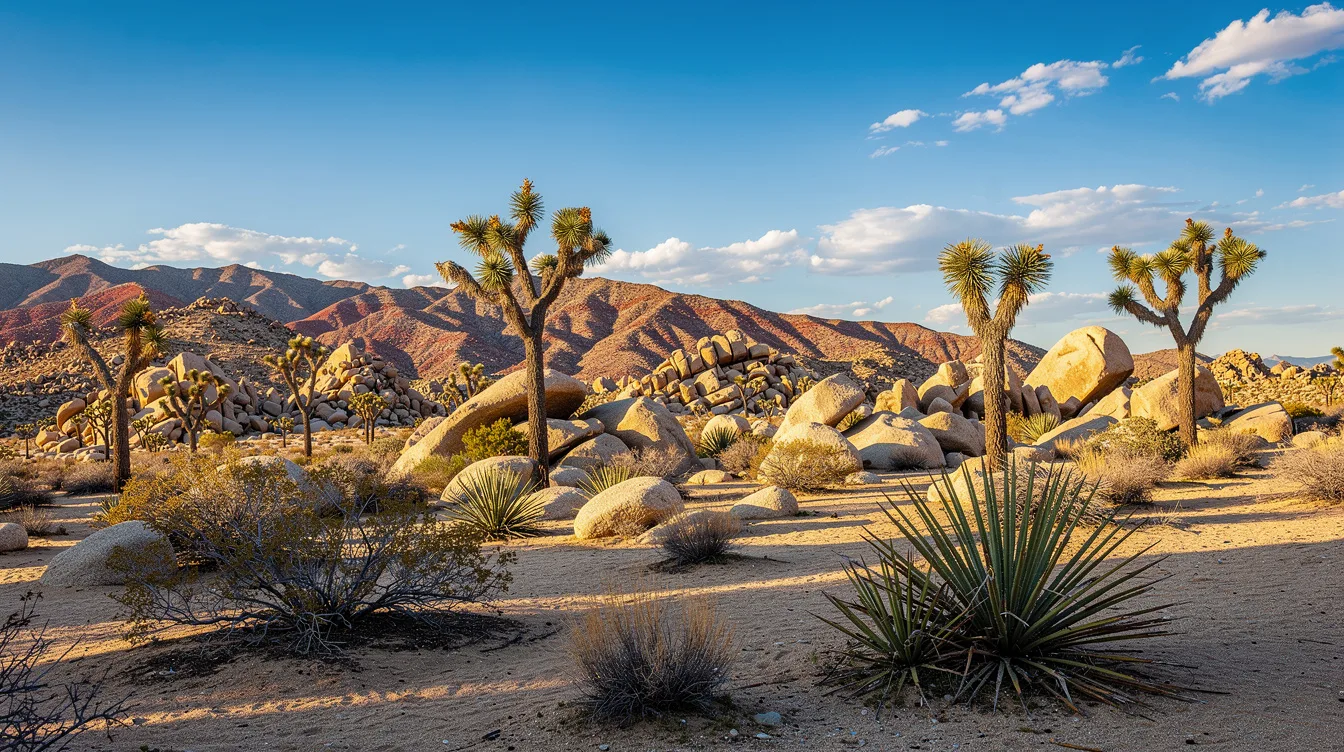
Joshua Tree National Park brings the Mojave and Colorado deserts together in one dry, strangely theatrical corner of Southern California. Since 1994, when it became a national park, the meeting point has given visitors a reason to look twice at every ridge and yucca.
The Mojave sits higher and runs relatively cooler. The Colorado Desert lies lower, hotter, and drier, so a drive through the park can feel like crossing into a different mood without ever leaving the same broad desert.
Two deserts, one very good reason to slow down
Near the community of Joshua Tree in San Bernardino County, the park begins with the kind of spare scenery that makes a crowded itinerary feel foolish. You should leave room to pull over, walk a little, and let the silence do some work.
And the title’s promise is real: the Mojave and Colorado deserts meet here. That collision explains the park’s shifting plant life, open flats, and granite formations, which can look almost sculpted in the hard afternoon light.
The Joshua trees belong to the Mojave side. They are yuccas, not conventional trees, and their dark green, blade-like leaves turn each branch into a spiky silhouette against the sky.
But don’t expect a tidy border between ecosystems. The appeal is the transition itself, where the terrain changes gradually and you notice the difference only after the road has carried you through it.
Joshua trees are stranger up close
A Joshua tree, formally known as Yucca brevifolia, can reach 49 feet tall. Its branches seem improvised, as if each one chose a new direction after arguing with the wind.
You’ll see them among granite boulders and open desert ground, especially in the park’s higher Mojave areas. Their shape is the point. Photographs flatten the scale, while standing beneath one makes its rough trunk and sharp leaves feel unexpectedly physical.
And there’s a limit worth respecting: those leaves taper to sharp points. This is not a place to rush through in sandals while looking only at your phone.
The species grows in parts of California, Arizona, Nevada, Utah, and northwestern Mexico. Here, though, it gives the park its identity, even when a granite pile or a broad empty plain steals your attention.
Granite, dark skies, and a park that rewards patience
Granite formations make Joshua Tree a serious climbing and bouldering destination, with more than 400 formations and roughly 8,000 listed climbing routes. Even if you don’t climb, the rock gives short walks a satisfying sense of scale.
Try places such as Barker Dam, Hidden Valley, Ryan Mountain, Skull Rock, Forty-nine Palms, or Lost Palms. You should choose according to your energy and the heat, because the desert doesn’t care how ambitious your morning plan sounded.
Keys View looks over the Coachella Valley and the Salton Sea. On clear days, it also reaches toward the San Jacinto and San Gorgonio mountains, though haze can blunt the view. That’s the trade-off with big desert vistas.
But nighttime may be the stronger argument. The park is an International Dark Sky Park, so a moonless night away from busy villages and parking areas can bring out the Milky Way. The air cools, the rock turns black, and headlights become rare.
Getting there takes a car and some restraint
The park is about 139.8 miles east of Los Angeles and near Palm Springs. Palm Springs International Airport is the closest airport mentioned in the notes, but once you arrive, a car is close to essential.
You can enter from the West Entrance near Joshua Tree Village, the North Entrance at Twentynine Palms, or the South Entrance near Cottonwood Spring via I-10. Public transportation is limited, which keeps the park independent-minded but makes casual planning harder.
And download maps before you enter. Mobile coverage is uneven, services are limited, and GPS can suggest sandy or impassable routes. Bring plenty of water, enough fuel, and tires you trust.
October through May is the comfortable window for most visitors. Summer heat can become dangerous, with sudden thunderstorms possible, so early starts matter. On busy Fridays, Saturdays, and Sundays, arrive before 8 a.
M. If you can.
Pets face strict limits and can’t join you on trails or in the backcountry. Buy an entry pass online ahead of time during busy periods, since entrances don’t accept cash.
By the time the stars appear over the yuccas and granite, the day’s heat has left the ground. The desert is quiet again, though the Joshua trees still look as if they have somewhere to be.