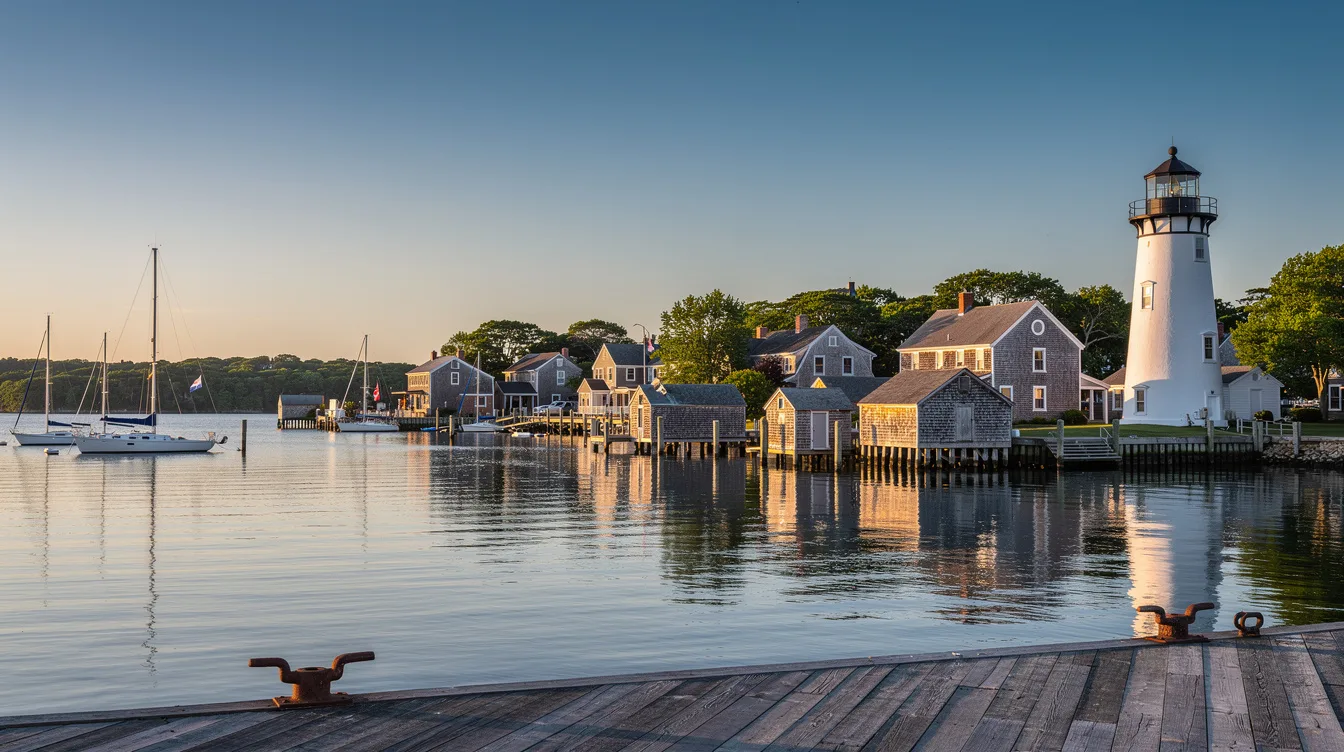
Edgartown played Amity when Jaws filmed here in 1975, and the match still makes sense from the harbor. White captain’s houses face the water, boats press into a compact inlet, and the streets can feel improbably composed. You don’t need a shark fin to recognize the setting.
The town is on the eastern side of Martha’s Vineyard, Massachusetts, with 5,168 residents counted in 2020. Summer brings the island’s tourist and boating season, so the sidewalks fill up. But Edgartown keeps a more polished, quieter mood than some busier Vineyard towns.
The Amity setting is still in plain view
Edgartown was the main filming location for Amity, the fictional town at the center of the 1975 film. That matters because this isn’t a place that has pasted a movie story onto an unrelated waterfront. The harbor, historic buildings, and village scale are the reason the location worked.
You can still see landmarks and buildings used in the movie around town. And the best way to approach them is on foot, without treating every clapboard facade like a museum label. The appeal is that daily island life still moves through the same streets.
The harbor has summer yachts and working movement, but it isn’t a big-city marina. Salt air catches around the channel, gulls cut over the masts, and the white houses hold their ground behind it. Edgartown Harbor Light marks the entrance at the end of North Water Street.
Whaling money shaped the streets long before cameras arrived
Edgartown was settled in 1642 and incorporated in 1671. It became a major whaling port during the 1800s, which explains the substantial homes built by captains and other prosperous residents. You can feel that old ambition in the town’s careful proportions.
Water Street has many of those captain’s homes on both sides. Some have widow’s walks high above the roofline, though the romantic story about wives watching for returning ships has little supporting evidence. But the structures still give the harbor a watchful look.
The whaling industry declined as cheaper alternatives took hold. That history is visible without turning Edgartown into a period set, because the village is still used for shopping, meals, cycling, and sailing. It’s historic, but not frozen.
South Beach gives the town its rougher edge
South Beach is the counterweight to the tidy harbor. This is a crashing ocean beach along the island’s southern shore, and you can reach it from Edgartown center by driving or taking the bus for about 2.5 miles. The Atlantic changes the mood fast.
Near Katama, the beach can be crowded in summer. Go farther west toward Edgartown Great Pond and Oyster Pond, and it is often less busy. You’ll trade convenience for more room, which is a sensible deal on a summer island.
And don’t expect the calm harbor experience here. Wind, broad sand, and breaking water make South Beach feel exposed. That’s exactly why it earns the trip after a morning among boutiques and historic streets.
Chappaquiddick is close, though it feels separate
Chappaquiddick Island is part of Edgartown and sits across Edgartown Harbor and Katama Bay from the town center. A ferry connects it to the village waterfront.
Cape Poge Wildlife Refuge and the Cape Poge Light are on Chappaquiddick, while Wasque Reservation lies along its south shore. The island is sometimes connected to the rest of Martha’s Vineyard by a barrier beach, but storms can breach it. Geography here doesn’t always hold still.
Edgartown also includes Felix Neck Wildlife Sanctuary and part of Manuel F. Correllus State Forest. But don’t try to pack every natural area into one afternoon.
The better choice is to pair one with the harbor and leave time for the ferry ride back.
Getting to Edgartown takes a little planning
You reach Martha’s Vineyard by boat or plane. The year-round car ferry from Woods Hole on Cape Cod arrives at Vineyard Haven or Oak Bluffs, then buses, taxis, rideshares, and seasonal direct passenger ferries connect travelers onward to Edgartown.
Martha’s Vineyard Airport, identified by the code MVY, is in West Tisbury. That makes air travel possible, but it doesn’t erase the island’s logistics. You’ll still need to choose how you want to move between the airport, ferry ports, and town.
Summer is the season when Edgartown’s tourist and nautical activity is most apparent. It can be busy, especially around Katama, yet the harbor still has quieter margins if you slow down. By the time the last light slips across the masts, the film set disappears and the town is simply itself again.