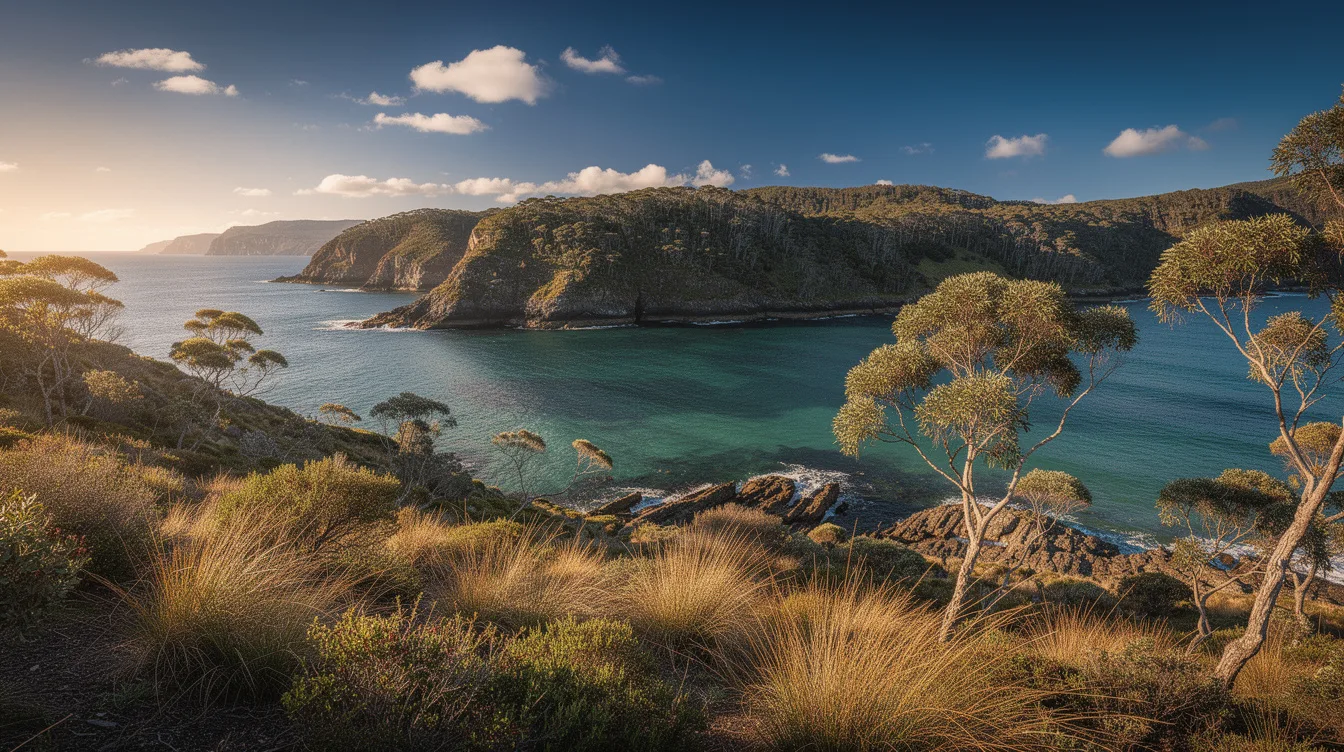
Bruny Island is where Tasmania’s bird list stops feeling theoretical. This island south of Hobart holds all 12 of Tasmania’s endemic bird species, so you can spend a day looking at the water and still understand why serious birders come here.
But Bruny isn’t a quiet little refuge designed around binoculars. It’s a working day trip with ferry queues, food stops, cliff roads, beaches, and weather that can turn sharp even in summer.
All 12 endemic birds, on one island
The headline matters because Bruny brings together every bird species found only in Tasmania. You don’t need to chase scattered corners of the state, which makes the island unusually rewarding if you want wildlife without building an entire vacation around it.
And the birding has real weight behind it. Bruny supports the world’s largest population of the endangered forty-spotted pardalote, a tiny bird whose presence gives an ordinary-looking patch of eucalyptus forest a reason to slow down.
The island also supports up to 240,000 breeding pairs of short-tailed shearwaters, also called Tasmanian muttonbirds. That scale changes the mood after dark, when the coast feels less like a scenic stop and more like a place with its own loud, winged schedule.
You should bring binoculars, but don’t treat the island as a checklist. The best moments are often small: a bird moving through dry forest, wind lifting off the sea cliffs, then the ferry horn carrying across the channel.
The Neck gives you the island in one glance
The Neck is the thin sandy isthmus linking North and South Bruny. From its lookout, you can see why the island feels divided between sheltered water and the more exposed coast, with Adventure Bay on one side and Isthmus Bay on the other.
But don’t mistake that view for the whole trip. Bruny stretches about 30 miles from end to end, and the distances between food stops, beaches, and South Bruny National Park make a car far more useful than optimism.
The eastern shore has Adventure Bay and its long beach. Farther south, Cloudy Bay and the cliffs around Cape Bruny feel rougher under a low sky, which is exactly the point if you came for weather rather than a polished resort mood.
And you can build a very good day around the island’s edible side. Oysters, cheese, honey, whisky, and chocolate are all part of the route, though stopping everywhere will leave little time for the coast.
Cape Bruny rewards the extra drive
Cape Bruny Lighthouse was first lit in 1838 and remained continuously staffed until automation in 1993. It is an Australian landmark with enough history to justify the detour, even if the wind makes you pull your jacket collar tight.
The lighthouse sits within South Bruny National Park, where coastal walks and the Labillardiere Peninsula can turn a quick visit into a full afternoon. Parts of the park require a Tasmanian parks pass, so check that before you commit to a longer walk.
But this isn’t a place to rush in bad weather. Winter is wetter and quieter, which suits atmospheric walks and travelers who prefer fewer people, but it can make the island feel more demanding than its easy ferry access suggests.
Can you visit Bruny Island in one day?
Yes, but two nights is the smarter choice if you want both birds and coastline. A full day can cover The Neck, local produce, Adventure Bay, and Cape Bruny, while an overnight stay leaves room for a wilderness cruise or a longer walk.
Summer brings penguin chances and crowds
December through February brings warmer weather and better odds of seeing little penguins. It’s also the busiest stretch, so you should reserve accommodation and experiences ahead rather than expecting the island to absorb last-minute plans.
And getting there is straightforward. Drive south from Hobart to Kettering, then take the vehicle ferry, which runs daily and takes roughly 20 minutes across the D’Entrecasteaux Channel.
There’s no public transport on Bruny, so bring or hire a car if you can. That limitation is inconvenient, but it also keeps the day from turning into a parade of tour buses at every beach pullout.
By the time the last ferry heads back toward Kettering, the salt air has cooled and the island’s roads grow quiet again. That’s when Bruny feels less like a Hobart excursion and more like a place the birds have claimed for themselves.