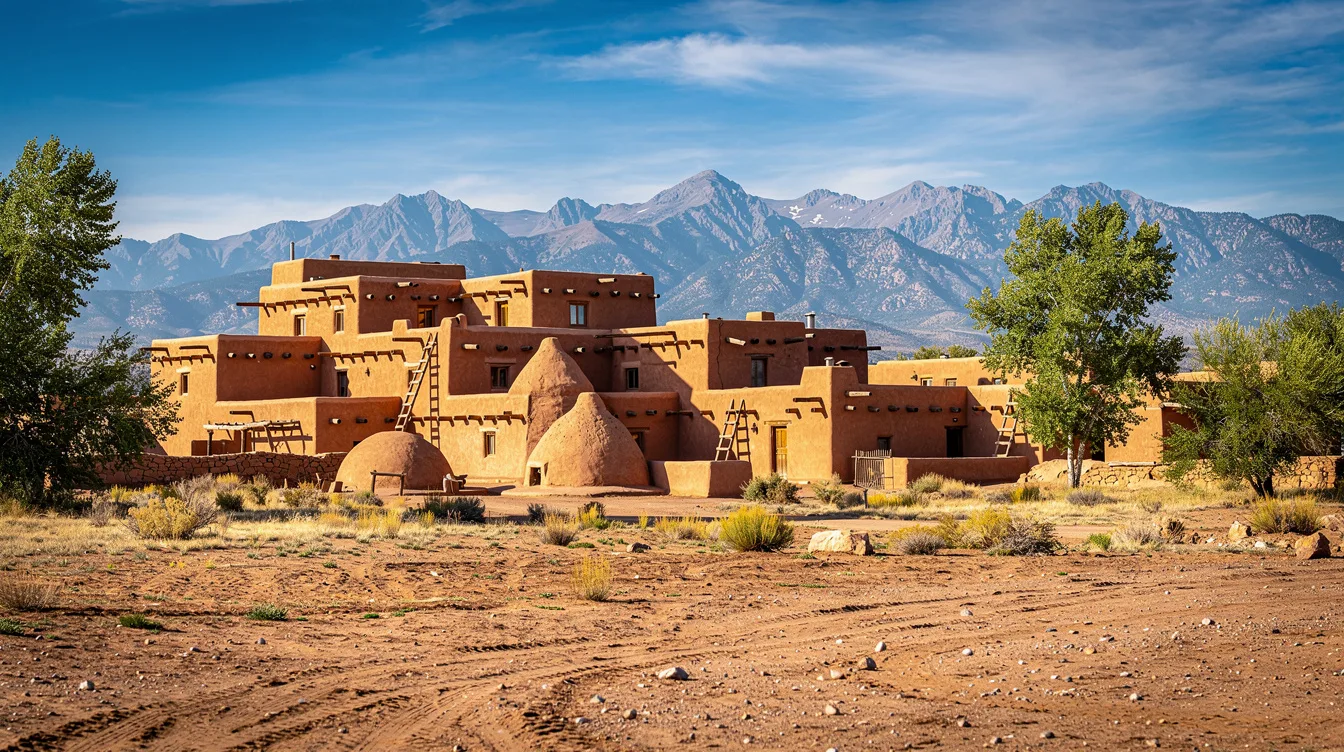
Taos sits about 68.4 miles north of Santa Fe, and the drive ends with more than a change of scenery. It brings you to a northern New Mexico town shaped by Pueblo culture, art, mountain weather, and the wide-open edge of the Rio Grande Gorge.
But the title’s promise belongs to Taos Pueblo. This adobe village is a UNESCO World Heritage site and among North America’s oldest continuously inhabited communities. You should approach it as a living community, not a backdrop for a hurried photo stop.
Taos Pueblo is the reason to slow down
Taos Pueblo makes the strongest case for putting Taos on your itinerary. Its adobe forms catch the hard Southwestern light in soft earthen tones, and the setting feels direct rather than staged because people still live here.
And that continuity changes the terms of a visit. Access can be limited during religious ceremonies, so you can’t treat the Pueblo like an attraction with guaranteed entry. Build flexibility into your day, and let the community’s schedule take priority.
The limitation is also the point. Taos Pueblo isn’t preserved behind glass, which is why it carries more weight than a museum reconstruction ever could. If you come expecting easy access at every moment, Taos may frustrate you.
If you come ready to pay attention, it stays with you.
Can you count on visiting Taos Pueblo?
No. Access may be restricted for religious ceremonies, so check conditions before you make the trip north from Santa Fe. That uncertainty is worth respecting, and it gives the place a welcome resistance to the usual travel checklist.
The town has art, chile, and an unruly horizon
Taos Plaza is the historic center, with shops, galleries, cafés, and traditional New Mexico architecture. You can spend an easy stretch here between bigger stops, especially if you want the town’s artistic side without arranging a full itinerary.
But Taos doesn’t feel polished into sameness. Its art-colony history sits alongside Tiwa/Pueblo heritage and Hispanic New Mexico culture, so the town’s appeal comes from overlap rather than one tidy identity. You’ll notice it in galleries, café windows, and the smell of red or green chile in the air.
San Francisco de Asís Mission Church in Ranchos de Taos is another adobe landmark, and it is widely photographed for good reason. Its broad earthen surfaces look especially compelling when the sun turns low. Still, photography is only part of what makes it worth seeing.
And don’t rush from landmark to landmark. Taos is most convincing when you leave room for an unplanned gallery, a coffee break, or a slow loop around the Plaza. It’s lively, but never in the way that demands you keep up.
Rio Grande Gorge brings the scale
Rio Grande Gorge Bridge is where Taos shifts from intimate adobe walls to an enormous cut in the earth. The bridge crosses above the Rio Grande canyon, with desert plateau and mountains spreading out around it. You can feel the wind and suddenly understand why the town’s horizons matter.
But this is not a gentle little overlook. The gorge’s scale can make even a crowded stop feel exposed, and that’s part of its pull. If you like places that make the Southwest seem bigger than your plans, put this high on the list.
Taos lies near Wheeler Peak, New Mexico’s highest summit, which helps explain the mountain presence that follows you around town. The region holds both arid space and high-country terrain. That contrast is Taos in one glance, although it never feels like a slogan.
Taos Ski Valley changes the pace
Taos Ski Valley is about 19.3 miles from town, and its demanding mountain terrain gives Taos a more athletic side. Skiers have a real reason to base themselves here. In summer, the same area is also known for hiking.
And you don’t have to ski to appreciate the shift. The road toward the mountains trades the town’s adobe rhythm for sharper terrain and cooler-looking slopes. Still, “nearby” doesn’t mean effortless, so plan the valley as its own outing rather than an afterthought.
Taos was founded in 1795, yet the older story remains the one you feel most strongly. The town has galleries and mountain pursuits, but its deepest impression comes from the living Pueblo community at its edge.
By the time you turn back toward Santa Fe, the adobe walls have faded into the dry light, and the mountains are still holding the horizon.