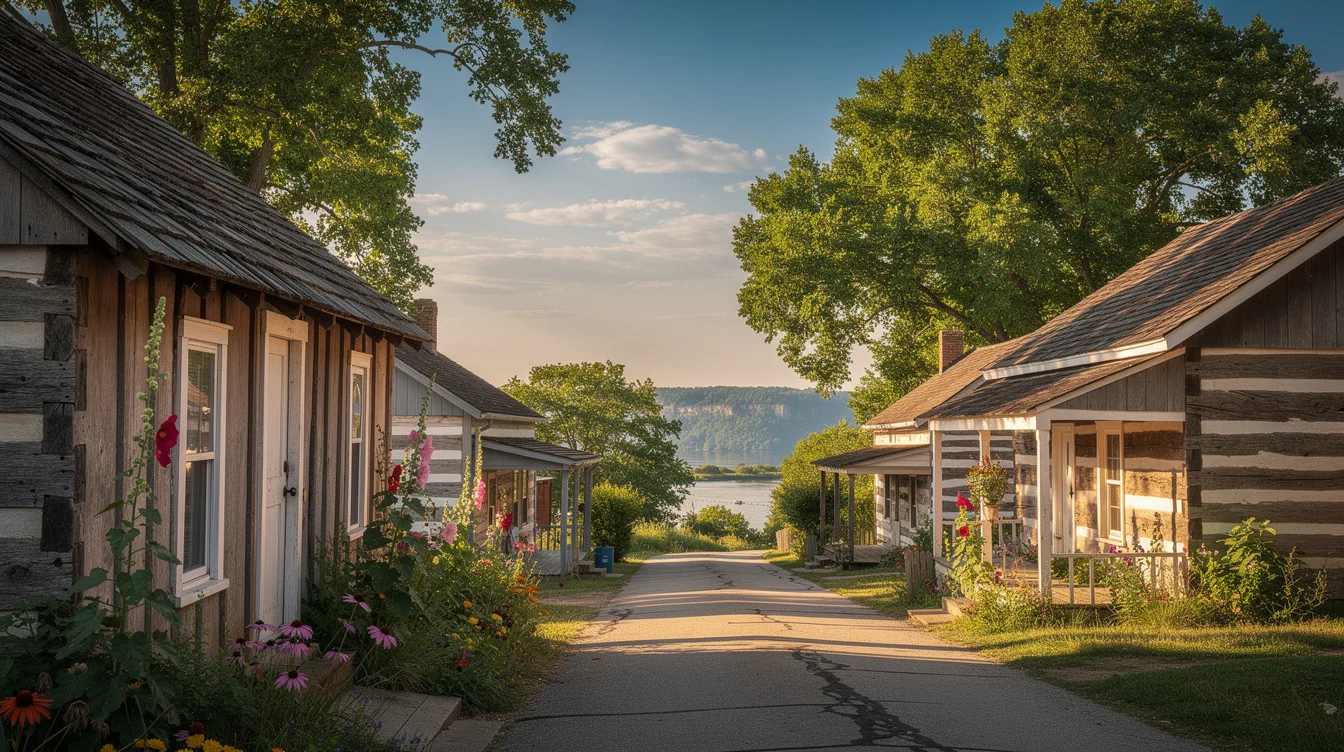
Ste. Genevieve was founded around 1735 by French Canadian settlers, and it remains Missouri’s oldest permanent European settlement. That claim could feel academic elsewhere.
Here, it leads directly to the reason you should go: the town preserves North America’s largest surviving collection of French colonial homes built with vertical logs.
You’re about 60-65 miles south of St. Louis when you arrive in southeastern Missouri. The drive is simple enough for a day trip.
The old houses are the reason to stop
The French colonial vertical-log houses give Ste. Genevieve its real distinction. Their construction is a regional building tradition, not a decorative theme added later.
And that makes the town more compelling than a standard historic stop. You aren’t coming for a single preserved room or a plaque. You’re coming to see a building style that has survived here in unusual concentration.
French colonial vertical-log homes are the title’s promise, and they deserve your full attention. Take your time with the structures rather than treating them as background for shops or lunch.
But don’t expect a recreated French village. Ste. Genevieve is a small Missouri city with working businesses, museums, inns, restaurants, and access to local wine country.
The history is visible, but the town isn’t frozen in place.
Start at the national park, then keep walking
Ste. Genevieve National Historical Park focuses on the area’s French colonial history and buildings. It’s the sensible first stop because it gives you context before you begin looking closely at the homes around town.
You’ll want that context. Vertical-log construction can sound technical on a phone screen, yet it becomes far more legible when you understand that this is the architectural feature that sets Ste. Genevieve apart in North America.
What historic houses can you visit?
The Felix Vallé House State Historic Site and the Bolduc House Museum are key historic-house visits in the central district. Put both on your list if the buildings are your main reason for coming.
And leave room to wander historic downtown between them. It is walkable, with museums, shops, restaurants, and inns, so you can let the day move at a slower pace without needing a complicated itinerary.
1785 explains why the town is where it is
Ste. Genevieve was relocated after a major Mississippi River flood in 1785. That detail changes the visit: the town’s French colonial story is also a river story, shaped by a practical decision after a serious disruption.
But the Mississippi shouldn’t become a vague backdrop. The town sits on its west bank, and the river helps explain both its southeastern Missouri setting and the settlement history that brought French Canadian settlers here around 1735.
If you like travel with a clear historical thread, this is the part that works. A flood forced a move, and the built record that remains gives the place more weight than a generic downtown walk.
A small city, not a museum set
Ste. Genevieve had 4,999 residents in the 2020 Census. That small scale suits visitors who prefer an afternoon of house museums and storefronts over a packed schedule, though it also means you should arrive with a purpose.
You can pronounce it “Saint JEN-uh-veev,” which helps when asking directions or making a reservation. More importantly, give the place enough time to answer the title’s promise on its own terms.
And the best detail is still the simplest one: old vertical logs remain, long after the 1785 flood changed its course.