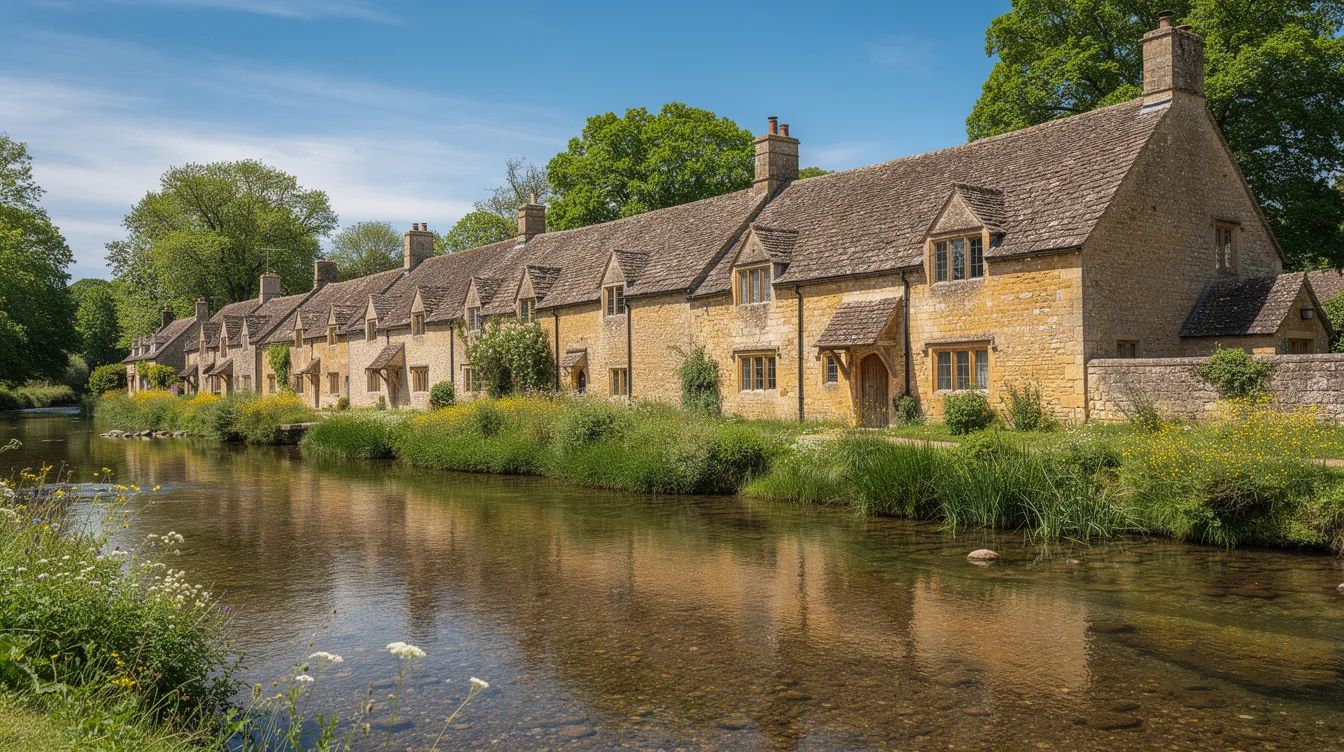
Bibury has a strange distinction: its best-known street appears inside some British passports. Arlington Row is printed on an inside cover, which makes this tiny Gloucestershire village feel less like a detour and more like a national calling card.
But the real place is quieter than the image suggests. It sits on the River Coln, 6 miles northeast of Cirencester, where narrow lanes force cars and visitors into the same small space.
Arlington Row earned its passport place
Arlington Row began around 1380 as a monastic wool store. In the 17th century, it became cottages for weavers, whose cloth went to nearby Arlington Mill.
That history explains the row’s compact shape. The stone cottages make the whole view read almost instantly from the road.
You can see why passport designers chose it. The cottages make a clean, memorable picture of rural England, but they are also private homes. Keep your voice low, stay on public paths, and don’t block a doorway for a photograph.
Rack Isle gives the village some breathing room
Beside the cottages, Rack Isle changes the mood. This wet meadow once held washed wool out to dry, and its marshy ground is now habitat for water voles, birds, dragonflies, and sometimes kingfishers.
But don’t expect a grand wilderness walk. Water surrounds the meadow on three sides, so this is a small pause between lanes, with reeds and damp grass softening the stone-heavy view.
The best short circuit runs from Arlington Row through Rack Isle, along riverside lanes, then toward St Mary’s Church. Most of the main route is level tarmac, though the bridge and some paths are narrow.
Can you visit without joining the traffic jam?
Yes, if you time it well. Early morning or late afternoon, outside weekends and school holidays, is the sensible choice because Bibury’s limited parking and tiny lanes clog quickly.
Free parking exists opposite Bibury Trout Farm and along the highway, though spaces are limited and neither area is managed by the National Trust. You should treat parking as part of the visit, not an afterthought.
And be realistic about scale. Bibury works best as a 45-90 minute stop on a Cotswolds drive, especially with Cirencester, Burford, or Bourton-on-the-Water on your route.
The village is better when you don’t rush it
Beyond the passport-famous row, Bibury Trout Farm and St Mary’s Church give you reasons to linger. The church is Grade I listed, and its churchyard has carved tombs and headstones from the 17th and 18th centuries.
But this isn’t an all-day attraction unless you want a slow walk and time near the Trout Farm. That’s a useful limit. Bibury rewards attention, not an overloaded itinerary.
The National Trust owns Arlington Row, yet the cottages remain homes. That tension is the whole visit: you are looking at a piece of public imagination while standing on someone’s residential street.
A small English image with real edges
The passport image makes Arlington Row seem fixed and empty. Bibury isn’t. Cars pass, visitors wait for a clear frame, and residents still need their lanes and front doors.
Come at the quiet edge of the day. The River Coln moves beside the road, the meadow holds its damp green, and Arlington Row looks less like a passport illustration than a street with people living on it.