Mesilla looks like a lunch stop beside Las Cruces, until you learn what happened here in 1861. During the Civil War, this small southern New Mexico town briefly became the capital of Confederate Arizona. That history gives its adobe streets an edge most roadside detours can’t match.
You’re in Doña Ana County, beside Las Cruces and about 37.3 miles from the Mexican border. Come for a few hours, not a rushed photo. The town’s Spanish, Mexican, Indigenous, and American influences are the real reason to slow down.
A Civil War capital in a town built for walking
Mesilla’s Confederate chapter was brief, and that’s precisely what makes it interesting. The town held that role during the Civil War, while the wider region sat between competing claims and loyalties. But this isn’t a battlefield stop with a single story attached.
You can walk its 19th-century streets and feel how history layers rather than lines up neatly. Adobe walls soften the light, while old buildings keep the village scale intimate. It’s historic, but it doesn’t feel sealed behind museum glass.
The Civil War story ran through the region. You don’t need a full afternoon of military history to understand the point: this quiet town stood close to events much larger than itself.
Mesilla Plaza is where the town still gathers
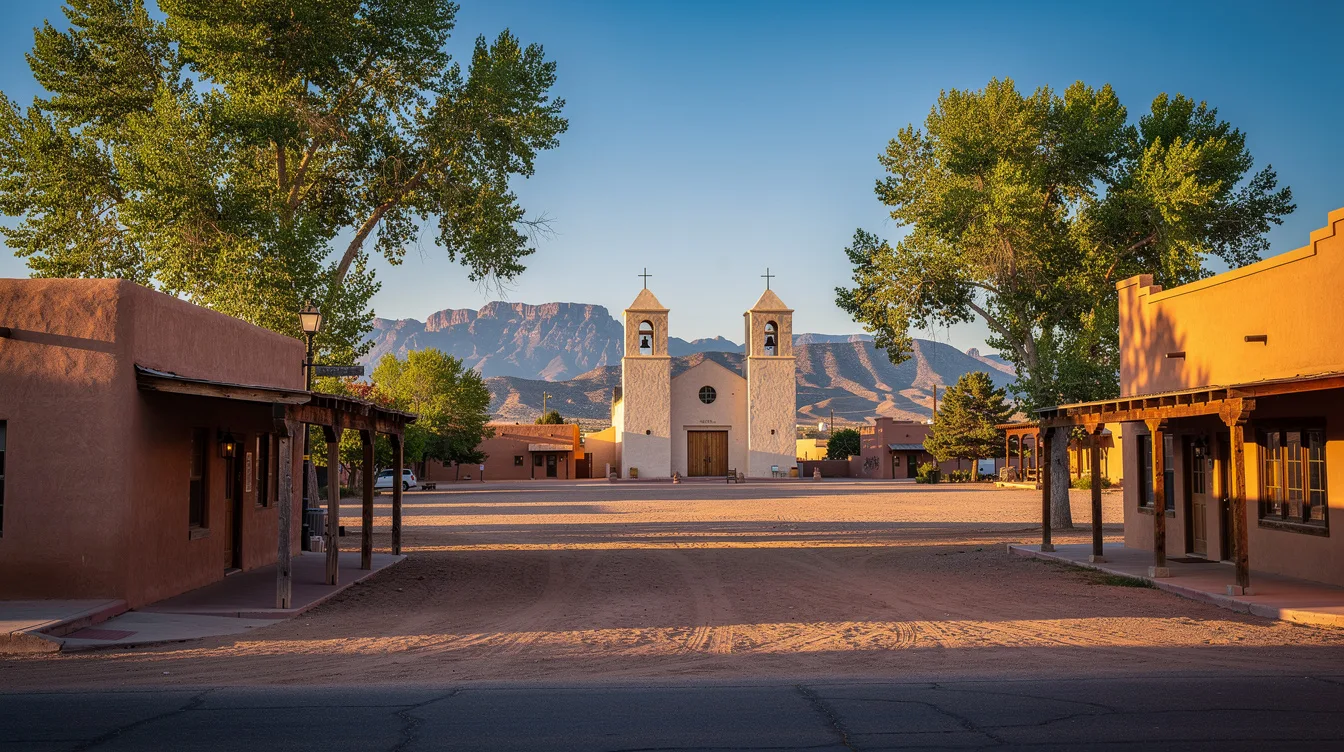
Mesilla Plaza is the center of the visit. Shops, galleries, and restaurants face the open square, so you can make your own pace. And because everything sits close together, you won’t spend the afternoon hunting for parking lots or landmarks.
This is the kind of plaza that makes you postpone the next stop. Sit awhile, watch people cross the square, then take another loop. It can feel visitor-friendly, but the compact layout keeps it from turning into a manufactured attraction.
You’ll see traditional buildings and streets that still carry a 19th-century atmosphere.
What should you see first?
Start at the plaza, then look toward the Basilica of San Albino. The church faces the square and gives the area a clear visual anchor. From there, the surrounding historic district makes more sense because you’re moving through a lived-in town rather than a set of isolated sights.
For current orientation, stop by the J. Paul Taylor Visitor Center at Town Hall, 2231 Avenida de Mesilla. It’s a practical first move if you want local information before choosing a restaurant or gallery.
Plan a short stop, then leave room for lunch
Mesilla works best as a break from Las Cruces, not an all-day campaign. Plan a few hours for the plaza, local shops, and a New Mexican lunch. And don’t over-schedule it, because the pleasure here comes from the pauses between stops.
New Mexican food belongs in the plan, especially if you’ve arrived hungry from Las Cruces. The details matter more than a long itinerary: adobe facades, a shaded table, and the low hum of a plaza that has seen several versions of the Southwest.
You can pair the town with the nearby city, then return when the light is lower and the streets feel calmer. That said, Mesilla is small. Travelers wanting big museums or a packed slate of attractions should treat it as a focused historic stop.
Early November brings a different kind of gathering
Visit in early November for Día de los Muertos. The timing matters because the plaza’s public life becomes part of the experience, not just a backdrop for browsing.
It’s a better reason to return than a vague promise of “fall color.” You’ll find a town already shaped by Mexican heritage, close to the border and still centered on its plaza. But expect a more communal mood than on an ordinary afternoon.
Mesilla doesn’t need to pretend its Confederate past is its whole identity. The stronger story is the contrast: a former wartime capital, a Mexican-American cultural center, and a small town where the plaza still sets the tempo.
By late afternoon, the adobe walls hold the last warm light, and the square grows quiet enough to hear your own footsteps.