
Composer & songwriter studio ideas for focused creativity work best when you give your music one clear landing place. I’ve made the mistake of treating a desk, a keyboard, and three loose cables like a studio. It wasn’t. Your room needs rhythm before your next chorus does.
- Anchor your music composer studio with one working wall
- Build The Three-Source Rule for home studio music
- Float your desk away from the wall when you can
- The Quiet Corner Method makes lyrics easier to hear
- Paint one moody wall, then leave the rest breathing
- Layer a rug under your keyboard zone
- Hang art that changes your ear, not just your feed
- Use The Two-Wood Rule to stop visual noise
- Can your composer room hold a listening chair?
- Hide cables with the Under-Desk River
- Choose soft drapes over bare blinds
- Make your instruments part of the room
- Go warm over gray for late-night writing
- Use shelves for scores, not random decor
- What should you spend on first?
- Frame the door with a no-phone landing zone
1Anchor your music composer studio with one working wall
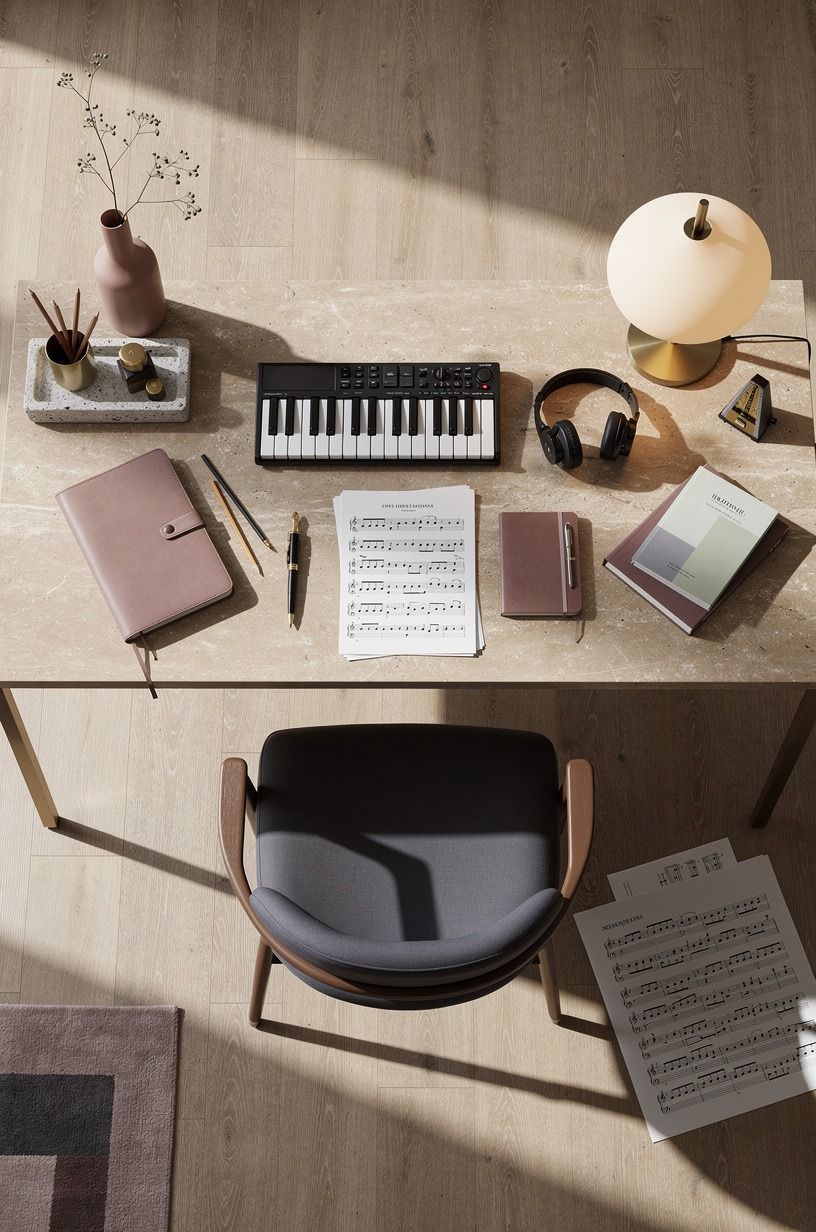
Choose one wall for your IKEA TONSTAD desk and keep your writing tools there, even if your room does double duty. You’ll focus faster when your notebook, interface, and headphones always meet in the same spot.
For your wall, try dusty rose with charcoal and brass against warm travertine. It keeps the room soft instead of clinical. I’d skip a stark white from the hardware shelf, because it can make black speakers look like office equipment.
A framed lyric sheet at a 57 to 60 in center height. A slim shelf. Your current song title on paper.
That’s enough.
Typical cost by tier (US averages):
2Build The Three-Source Rule for home studio music
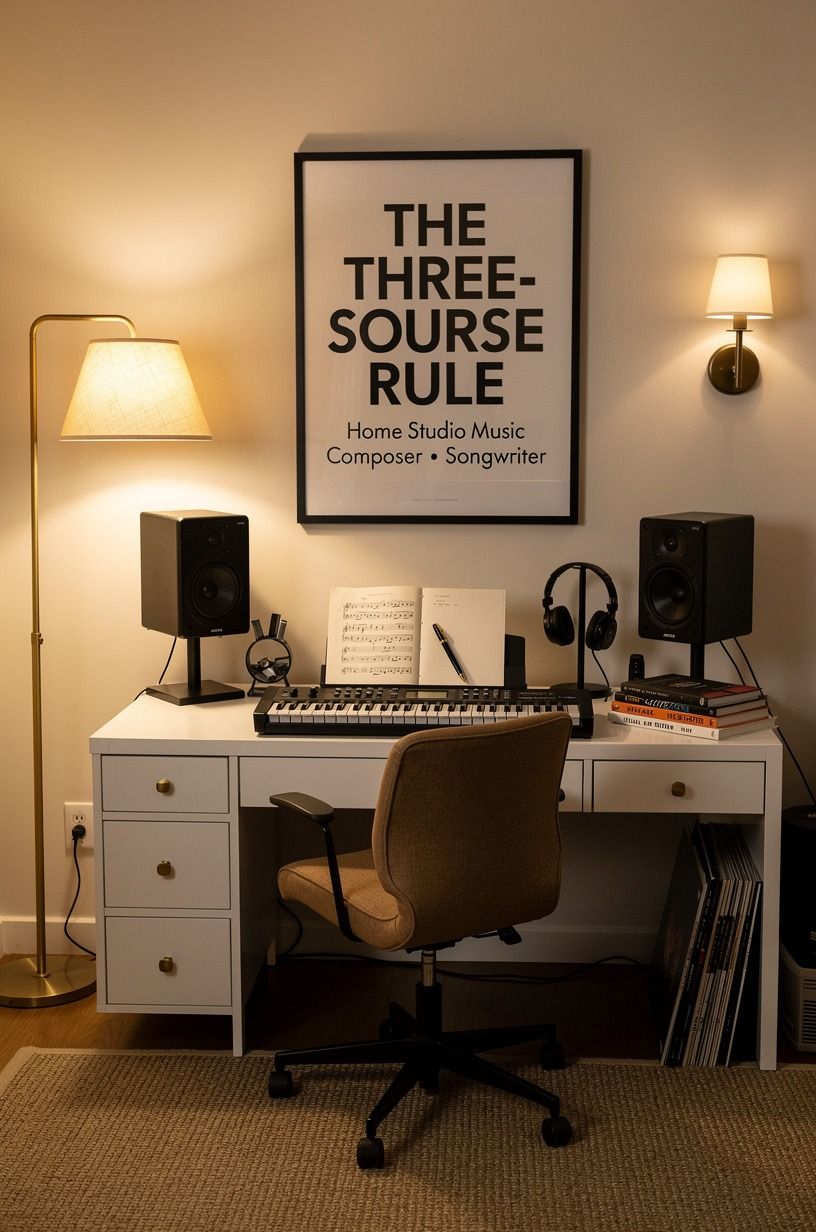
Your home studio music setup needs three sources of light: overhead, task, and ambient.
3Float your desk away from the wall when you can
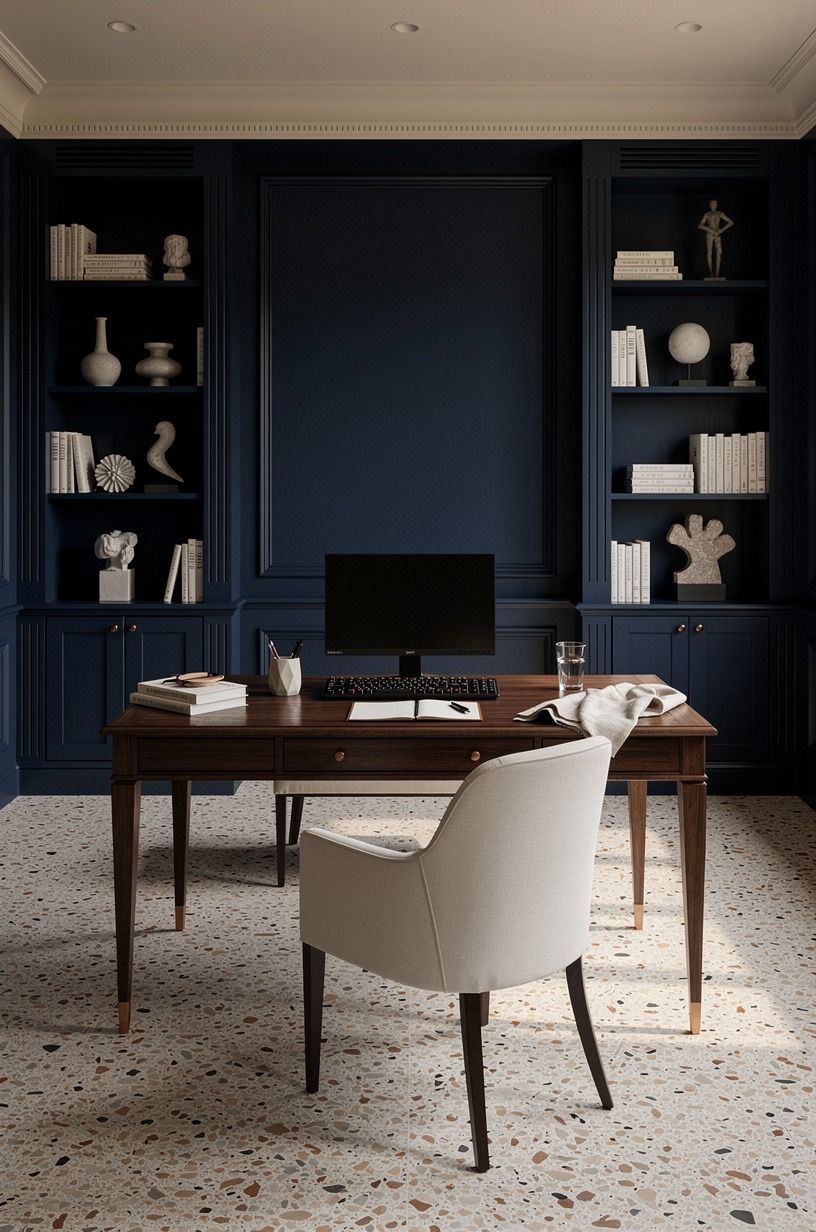
A desk against the wall is easy, but it isn’t always the best call for a composer room. If you have enough depth, float your Article Sven tan leather chair so you face into the room and can turn toward an instrument without scraping your knees.
I tried this in a narrow spare room and worried it would waste space. It did the opposite. You get a small path behind the chair, your cables disappear more cleanly, and the room feels more intentional.
Use an oversized-chip terrazzo desktop if you’re building one. It has visual weight without looking like a corporate boardroom.
4The Quiet Corner Method makes lyrics easier to hear
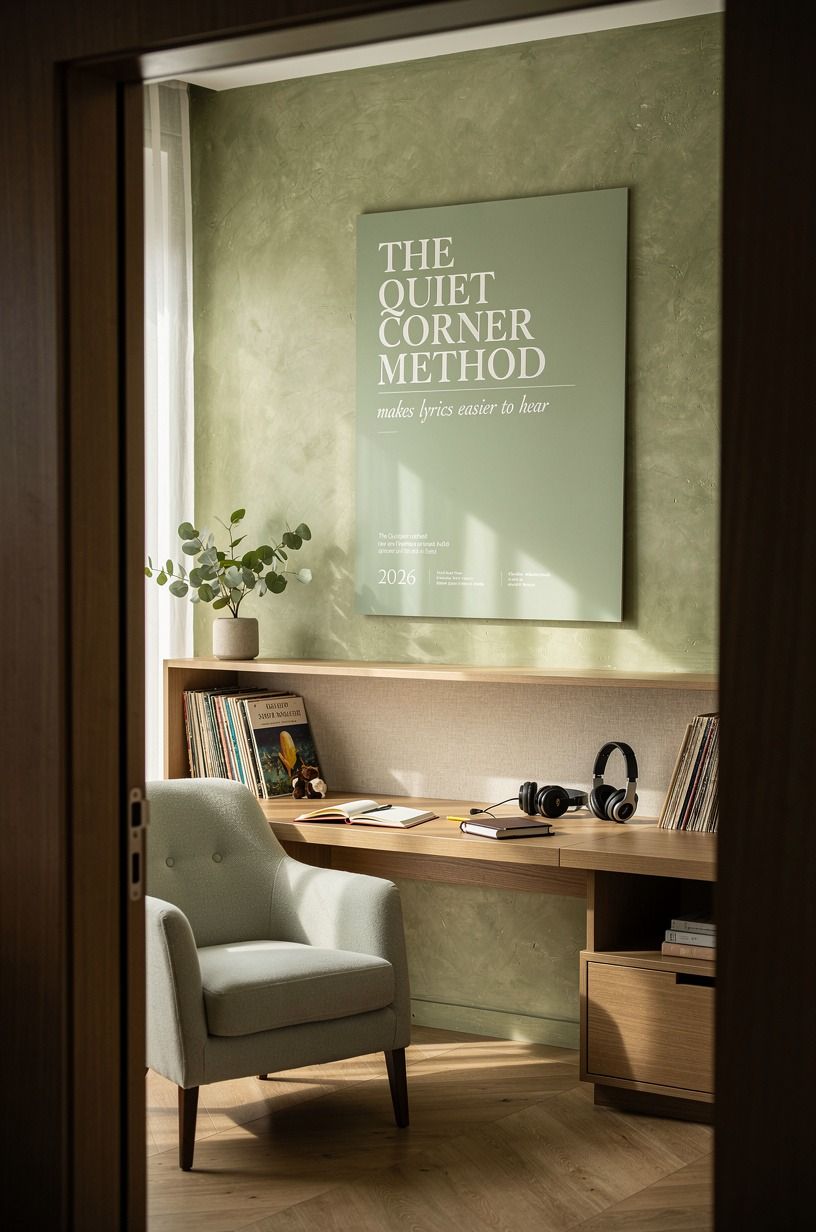
Put your writing chair in the calmest corner, not the prettiest corner.
5Paint one moody wall, then leave the rest breathing
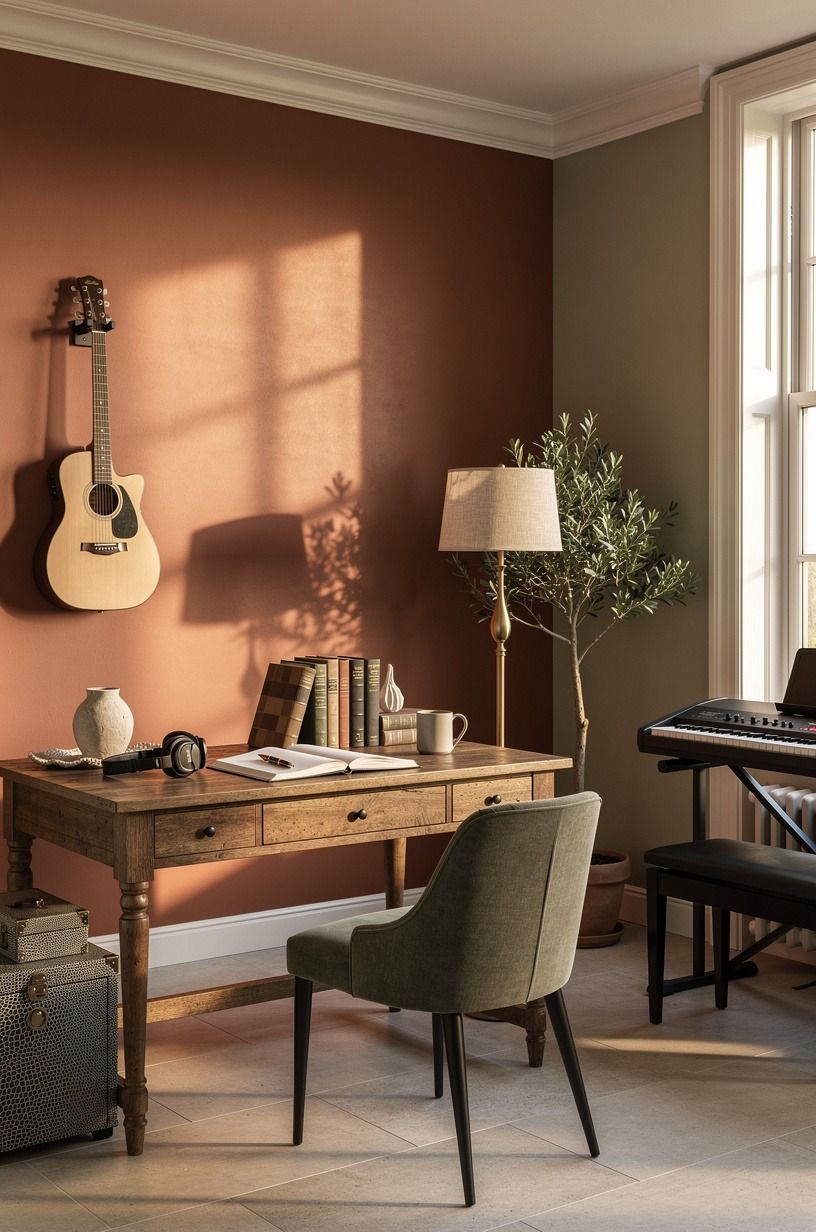
A full dark room can feel dramatic, but one wall is usually smarter in a small music studio. Try terracotta with stone and olive, then keep the other walls lighter so your equipment doesn’t disappear into a cave.
Your monitors look grounded against that earthy mix, especially beside shagreen accents and black metal. It’s calming without becoming sleepy. If your room faces north, this is warmer than a charcoal wall that goes muddy by afternoon.
You can pair that approach with studio apartment layout ideas if your studio shares space with your bed.
6Layer a rug under your keyboard zone
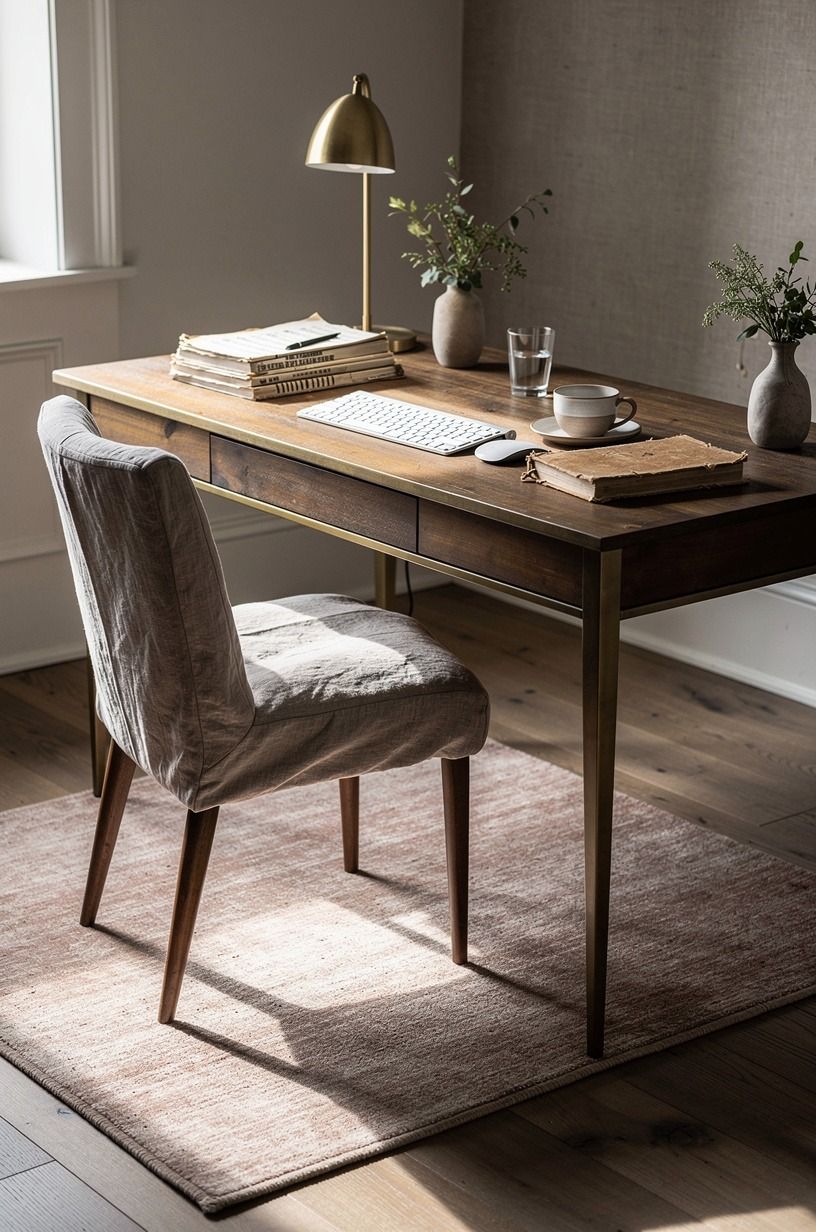
A rug gives your feet a place to land during long sessions, and it marks the studio zone without adding a wall.
7Hang art that changes your ear, not just your feed
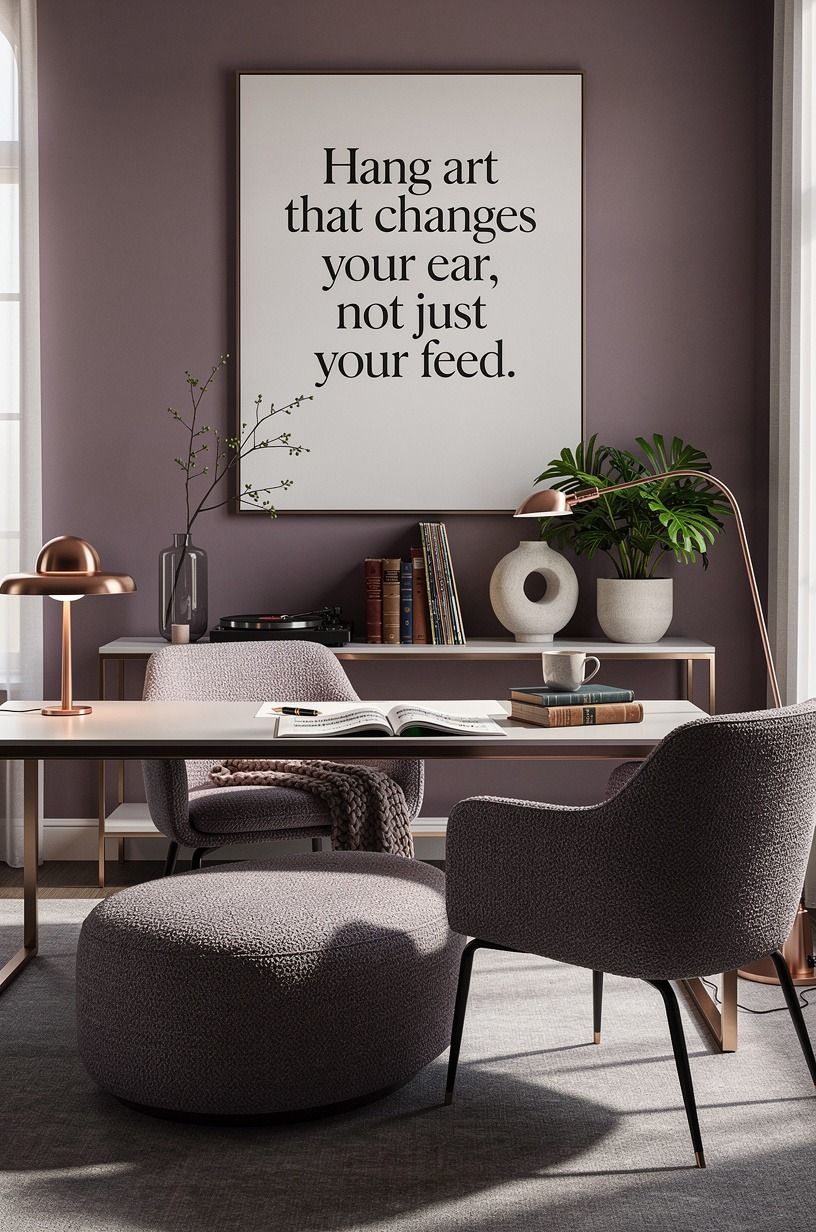
Use art that reminds you what kind of music you want to make. A concert poster, a handwritten lyric, or a black-and-white photo of a favorite venue gives your eyes somewhere useful to go when you’re stuck.
Hang each piece with its center around 57 to 60 in from the floor. Your art will feel connected to the room instead of stranded near the ceiling. An organic bouclé frame around a faded poster has more character than a row of generic music prints.
But keep it to three pieces. Your wall shouldn’t compete with your chord chart.
For a more handmade look, borrow the idea behind unglazed ceramic thrift vases and use one matte vessel for dried branches.
8Use The Two-Wood Rule to stop visual noise
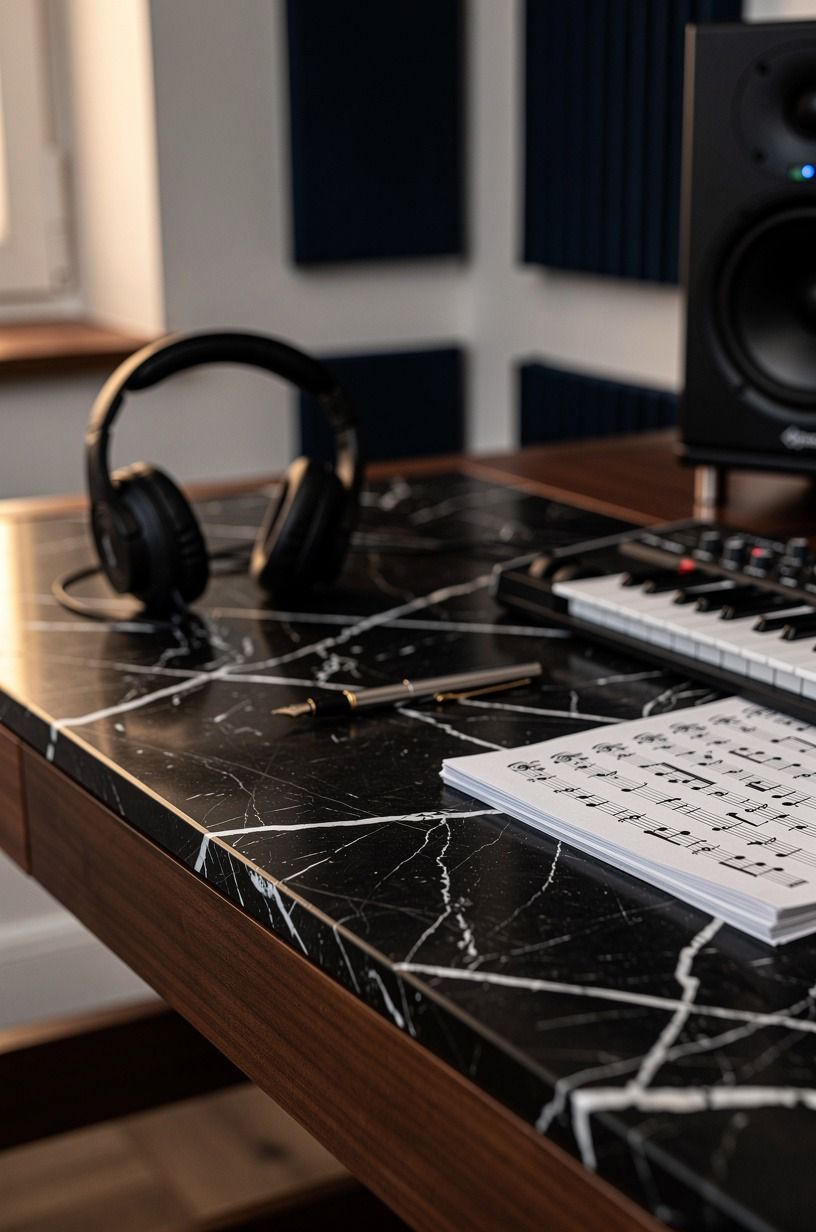
Pick two wood tones and quit there. One for the desk, one for the smaller pieces. Your studio will feel grounded instead of assembled from leftovers.
A walnut veneer keyboard stand with white oak shelving is my favorite pairing because the contrast reads deliberate. Add a third orange-toned wood, though, and your room starts looking like a waiting area from 2004.
Your instruments count as wood too. That’s the part people forget! Let the guitar finish be part of the palette before you buy a side table.

9Can your composer room hold a listening chair?
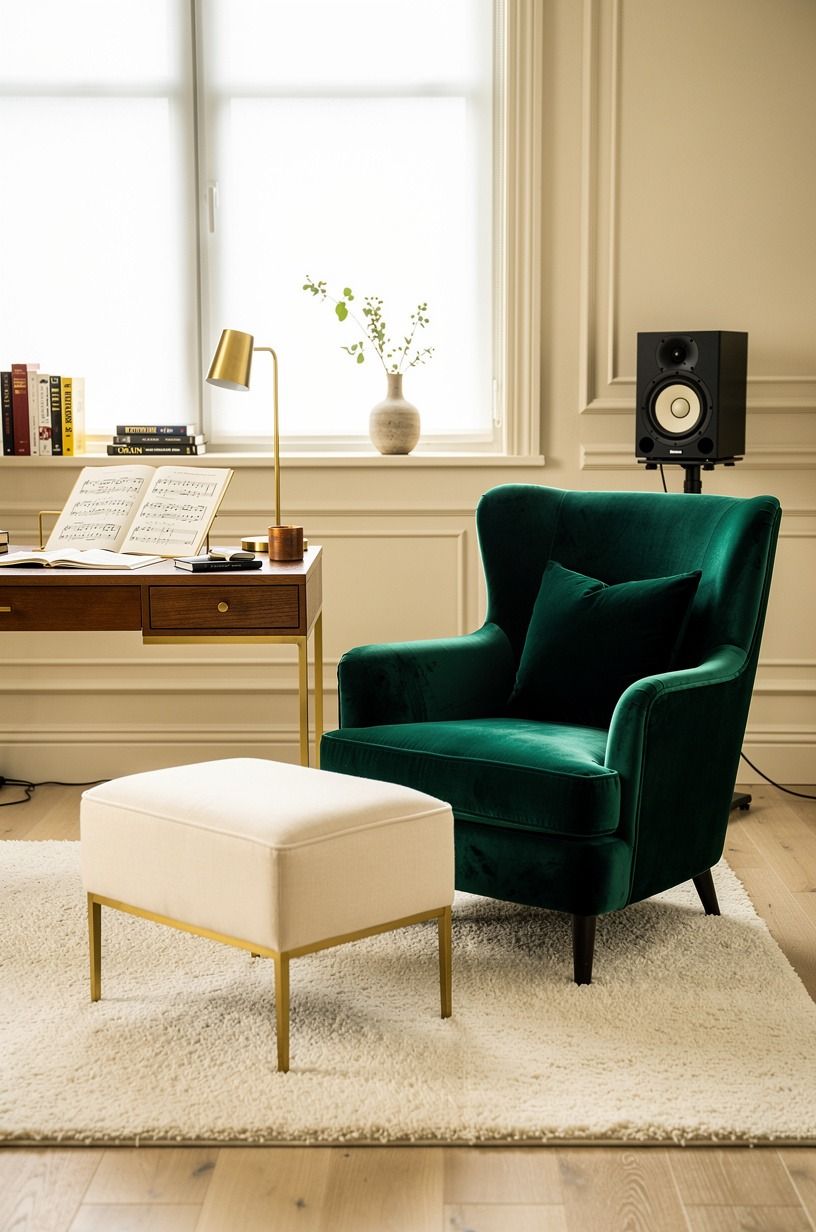
Yes, if the chair earns its footprint. A listening chair gives you a place to hear a demo without sitting at the same desk where you edited it, and that physical shift can change what you notice.
Try a compact CB2 bouclé accent chair with a small aged-bronze lamp beside it. Your chair doesn’t need to face the desk. Angle it toward the speakers, then keep a notebook nearby for the lyric you’ll catch on the second listen.
I’d avoid a bulky recliner. It’s comfortable, sure, but it swallows the room and encourages scrolling instead of listening.
10Hide cables with the Under-Desk River
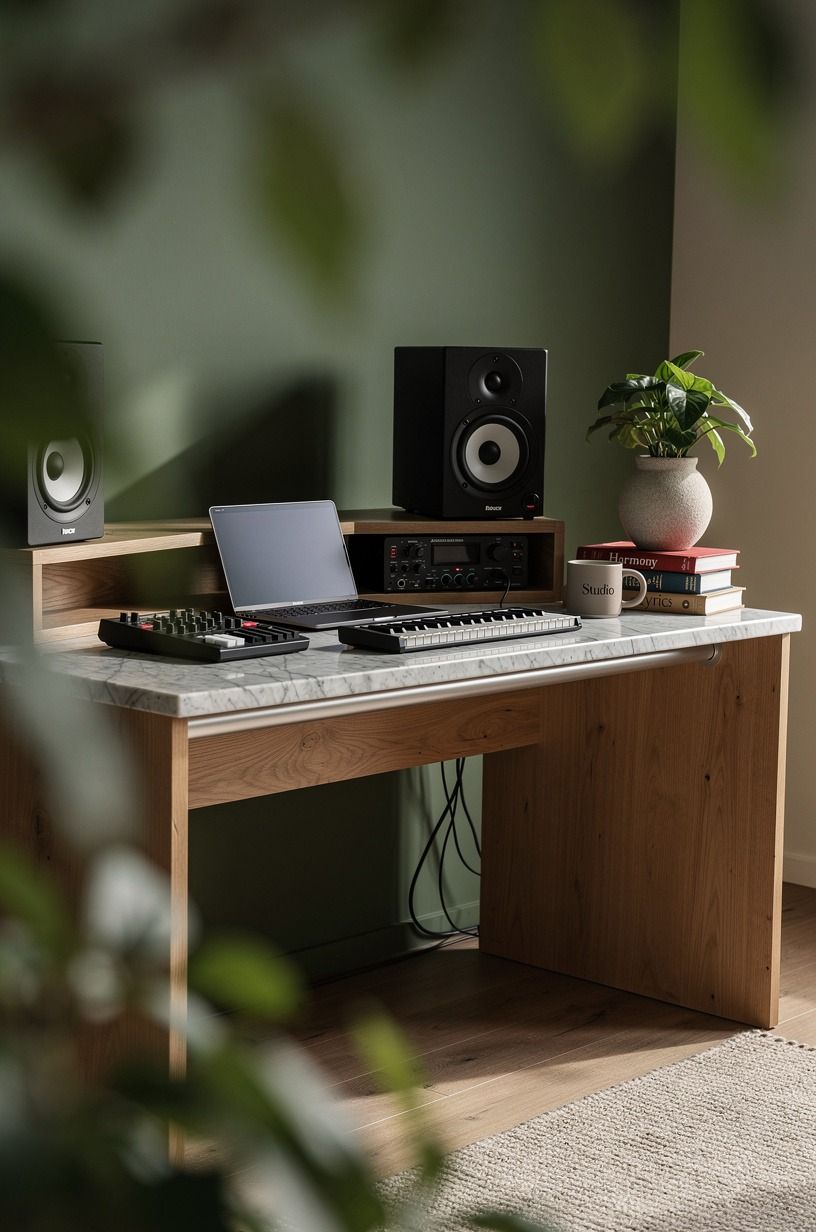
Run cables in one visible direction under the desk, then hide that line with a mounted tray and fabric sleeve. You’ll still reach what you need, but your feet won’t find a wire every time you turn toward the piano.
A felt cable tray under the back edge, black hook-and-loop ties, and one labeled power strip. Boring supplies. Huge relief.
Your studio can be warm and a little messy, but tangled cables read like unfinished business. And if you’re dividing one room into zones, this IKEA KALLAX setup gives you a useful visual boundary.
11Choose soft drapes over bare blinds
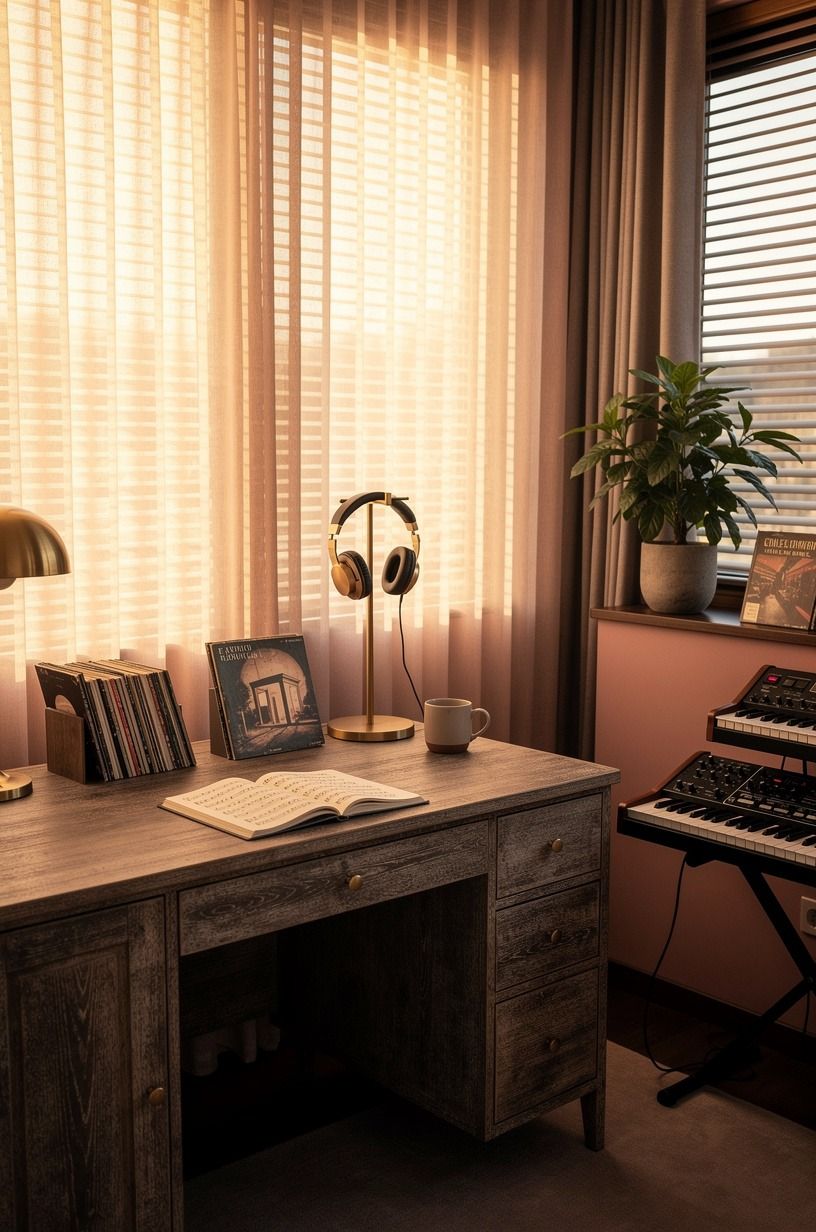
Curtains change the sound and the mood at once. Mount the rod 4 to 6 in above the window frame, take the panels to the floor, and your ceiling will seem higher than it is.
A pair of linen drapes typically costs $120 to $400, so this isn’t the cheapest move. Still, I’d spend here before buying another wall print. Reclaimed weathered teak nearby keeps the dusty-rose, charcoal, and brass palette grounded.
Your best color is oatmeal, mushroom, or washed clay. Bright white can feel cold beside a black microphone stand.
12Make your instruments part of the room
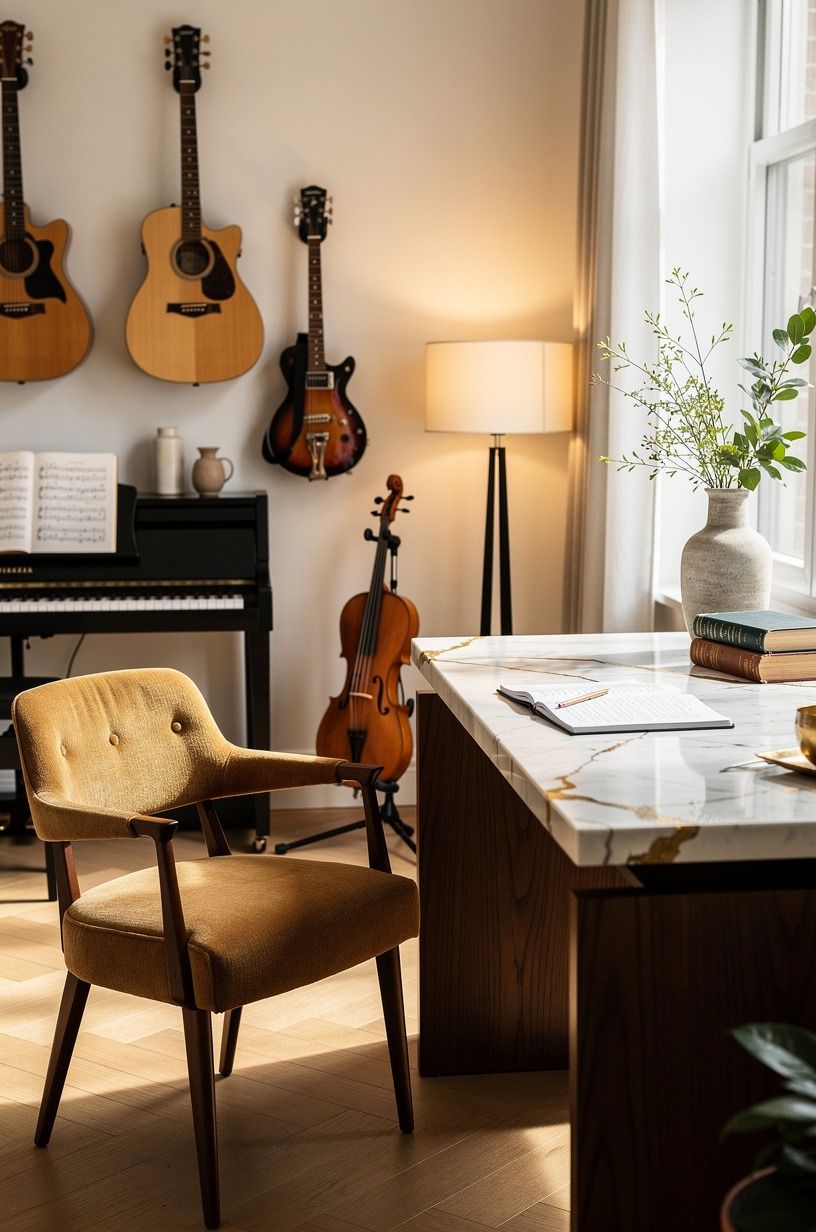
Let one or two instruments stay visible on purpose. A guitar on a wall hanger or a synth on a narrow stand says your room is used, not staged.
Use aged bronze wall hooks for a natural-finish guitar, or place a moog-style analog keyboard on a low console with room for a bench. Calacatta marble with gold veining gives the warm white, camel, and black palette a polished counterpoint.
Don’t display every instrument you own. The case-covered extras can live in a closet. Your favorite two should be the ones you reach for without thinking.
13Go warm over gray for late-night writing
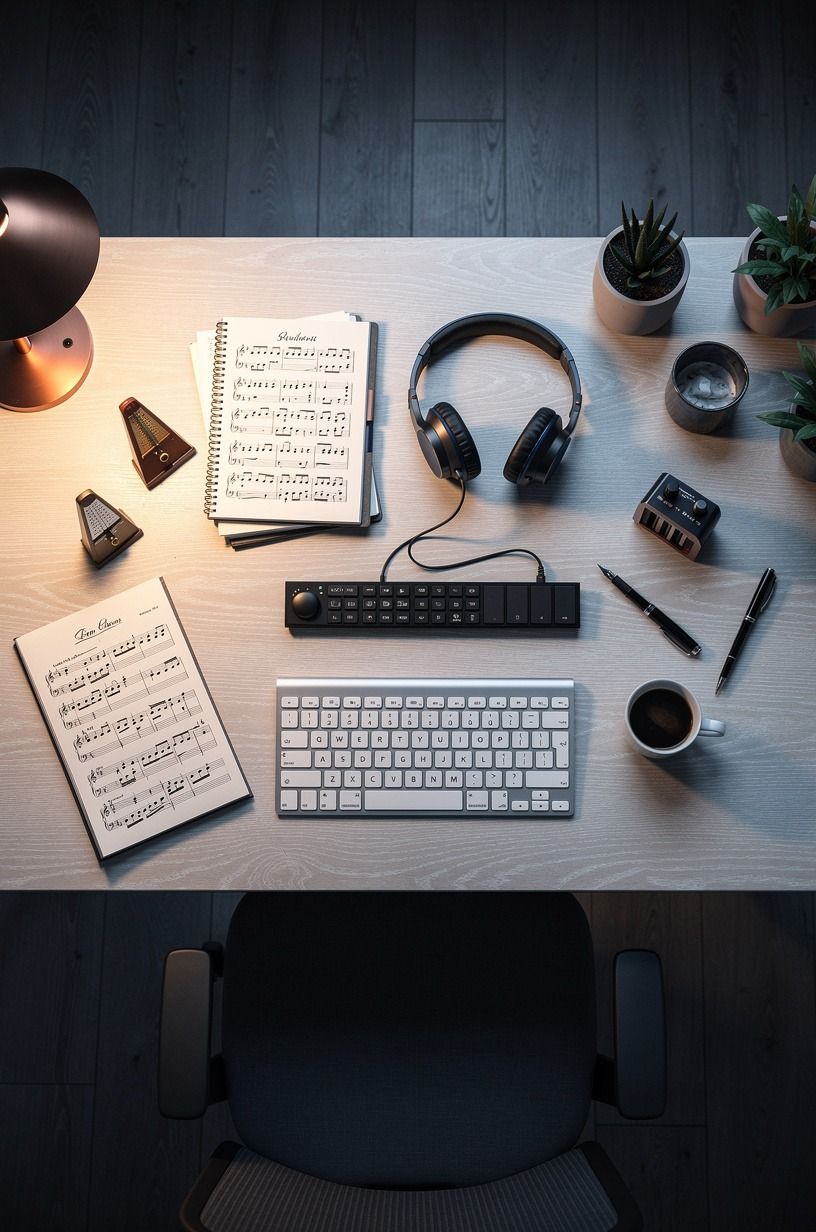
Try midnight blue with copper and ivory, plus cerused white oak for a softer late-night room.
14Use shelves for scores, not random decor
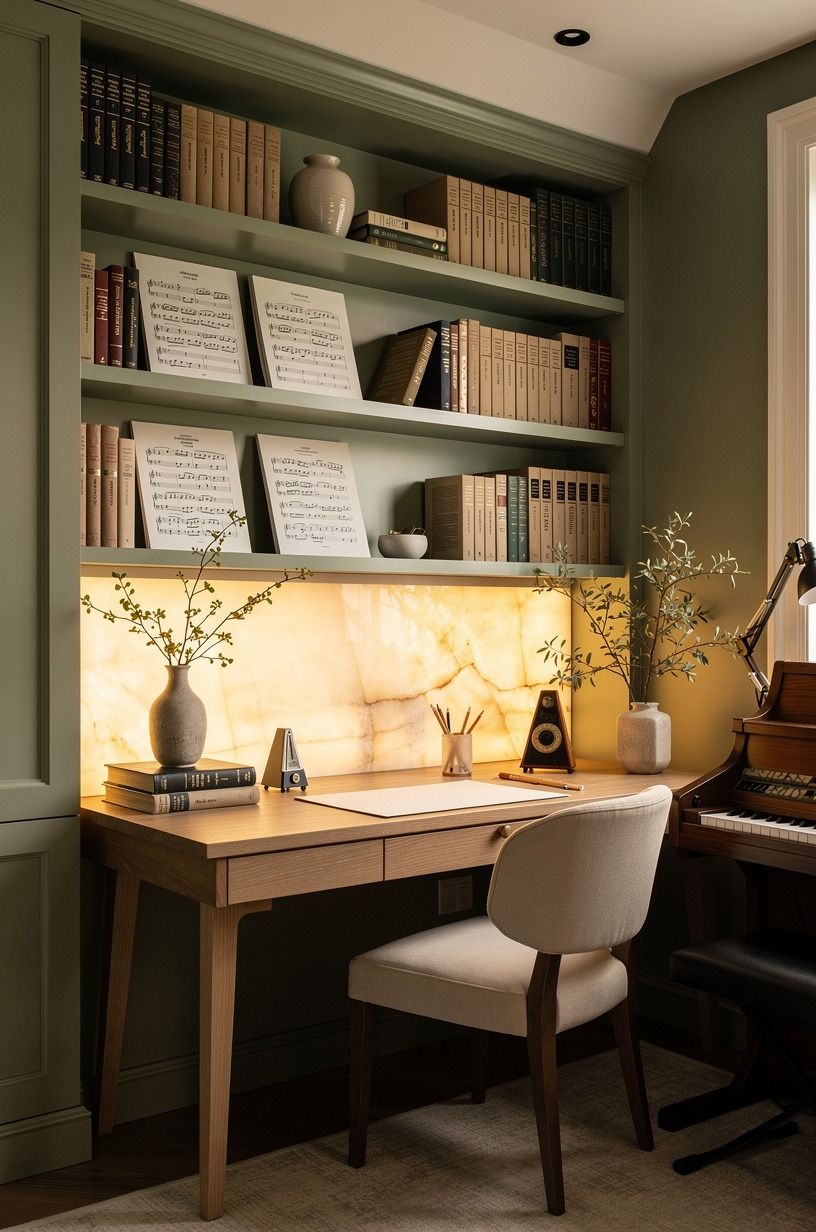
Open shelves should hold the things that prove you make music. Your notebooks, songbooks, headphones, and a few records can look personal without becoming clutter.
A IKEA KALLAX birch-effect unit works well because its cubes force you to edit. Put baskets in the lower row for cables and pedals, then keep the top row open for things you’ll touch weekly.
I’d skip stacks of tiny decorative objects. They gather dust, pull your eye in six directions, and don’t help you finish the song.
15What should you spend on first?
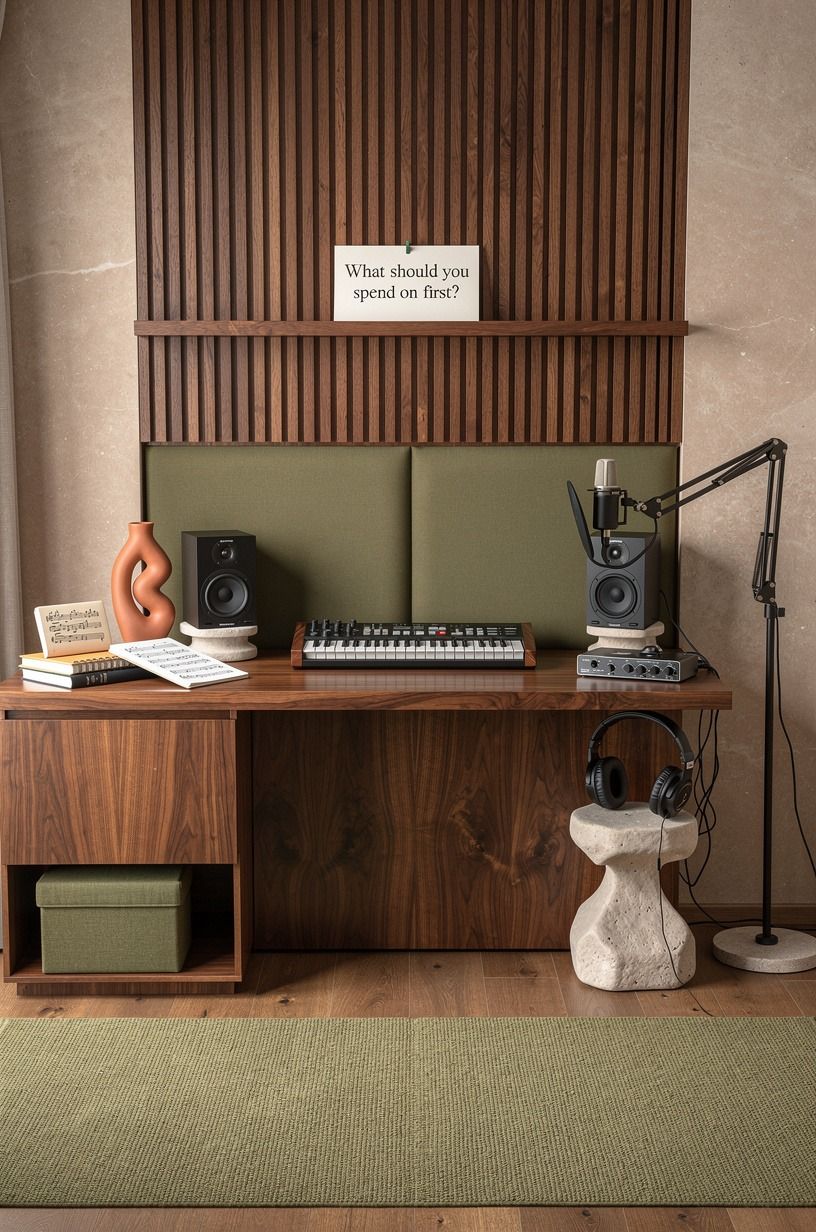
Spend first on the thing your body touches most: chair, desk height, or lighting.
16Frame the door with a no-phone landing zone
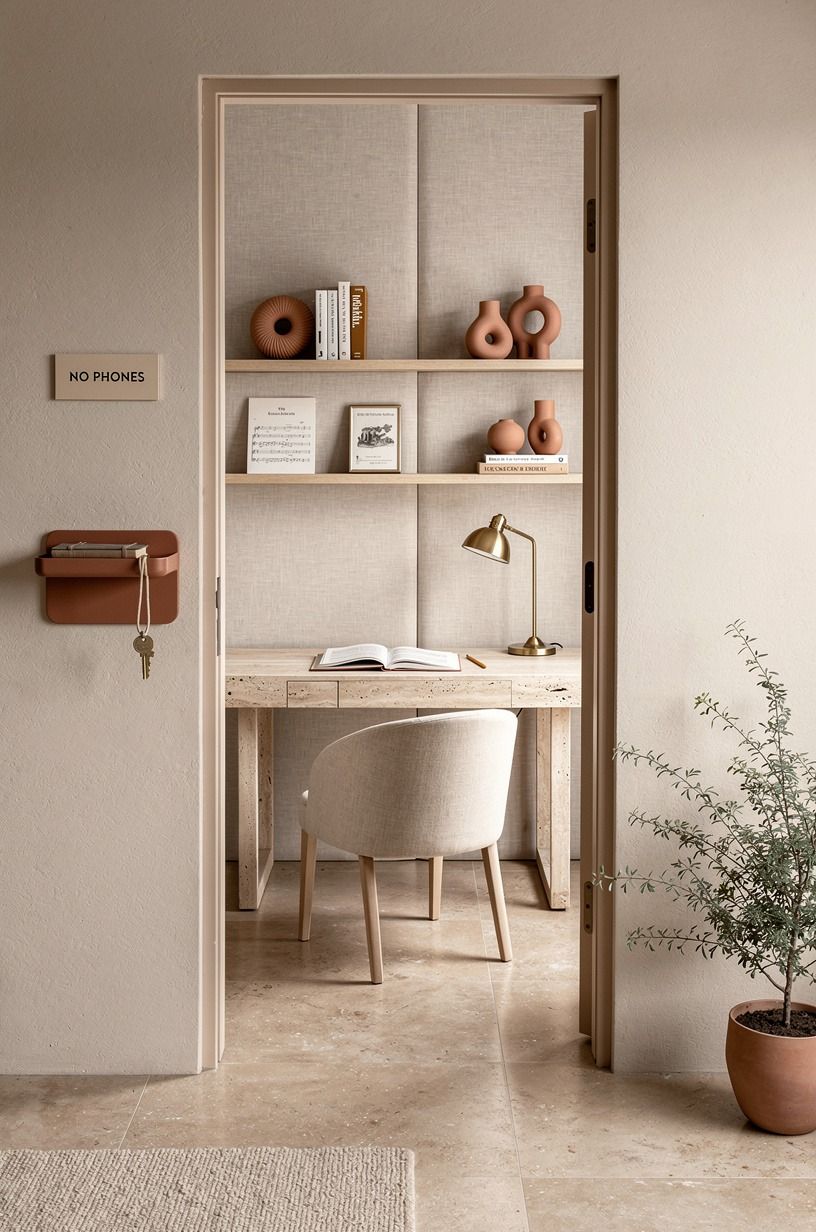
Put a slim tray, charging station, and basket near the studio door so your phone has somewhere else to live. You’ll get less tempted to check it every four minutes, which is harder than it sounds.
A cane webbing wall pocket can hold notebooks, while a small ceramic dish catches picks and keys. Your phone goes face down in the basket when you sit at the desk. That’s the rule.
But don’t turn this into a punishment. Your studio should feel peaceful, not strict. The point is to make starting easier.
Why focused studios are having a moment
I think people are tired of rooms that perform for a camera but don’t support a real evening. A composer studio is useful because it admits that creativity is physical.
You need somewhere to sit, somewhere to put the coffee, somewhere to hear a rough chorus twice without your laundry asking for attention. The room doesn’t need to be large.
It needs to make one activity feel welcome.
I’ve gone back and forth on whether a studio should look polished. My answer is yes, but not pristine.
The best rooms have a pencil mark on a lyric sheet, a wool rug that’s slightly flattened near the chair, and a guitar that stays out because somebody uses it. That lived-in evidence matters. It tells you that you’re allowed to make a mess before you make something good.
The expensive version can be refined, with custom cabinets and acoustic panels tucked into millwork. But a $200 to $800 refresh can be more effective if it fixes your real friction points: glare, poor seating, nowhere for notes, cables underfoot. I’d rather see you buy a solid lamp and move your desk than order decorative objects that never help you work.
And there’s a small emotional shift here. When you make a room for your music, you stop waiting for the ideal house, the ideal gear, or the ideal free weekend.
You sit down. You begin. A little corny, maybe.
Still true.
A Few Things Worth Answering
What is the best composer and songwriter studio idea for a small focused space?
The best choice is a single working wall with a compact desk and vertical storage. IKEA KALLAX birch-effect keeps notebooks and gear contained, while your chair can still move freely. Keep one instrument visible and let the rest stay stored.
Where can I buy composer and songwriter studio pieces on a budget?
Start with IKEA, Target Threshold, and Wayfair for desks, lamps, and storage. Facebook Marketplace and thrift stores are great for wood chairs and frames. Your best budget buy is usually a used solid-wood piece, not a new particleboard table.
How much does a composer and songwriter studio makeover cost?
A simple makeover usually costs about $200 to $800. Paint, textiles, art, and organization cover the most useful changes, while moving furniture and editing what you own cost nothing. Add lighting before you add decor.
Can I create a composer and songwriter studio on a budget?
Yes, and your cheapest improvements are often the most useful. A clearer work zone starts with moving the desk, hiding cables, and using art you already own. One warm lamp and a secondhand rug can do plenty.
Is a composer and songwriter studio worth it in a small space?
Yes, because a small room makes boundaries easier to maintain. One dedicated wall keeps your music gear from spreading across your whole home. Put the desk near daylight, then use vertical shelves instead of a wide cabinet.
Is a composer and songwriter studio a good idea for a rental?
Yes, especially with removable choices. No-damage layers include peel-and-stick hooks, tension-rod curtains, and plug-in lamps. You can also use a freestanding shelf as a divider, like the layout in this studio-to-two-room idea.
Where I’d Start First
If I had to pick one, I’d start with the three-source lighting plan. Your music can’t feel intimate under one harsh ceiling bulb, no matter how good the desk is. Pin this lighting plan for later and revisit small studio layout ideas.