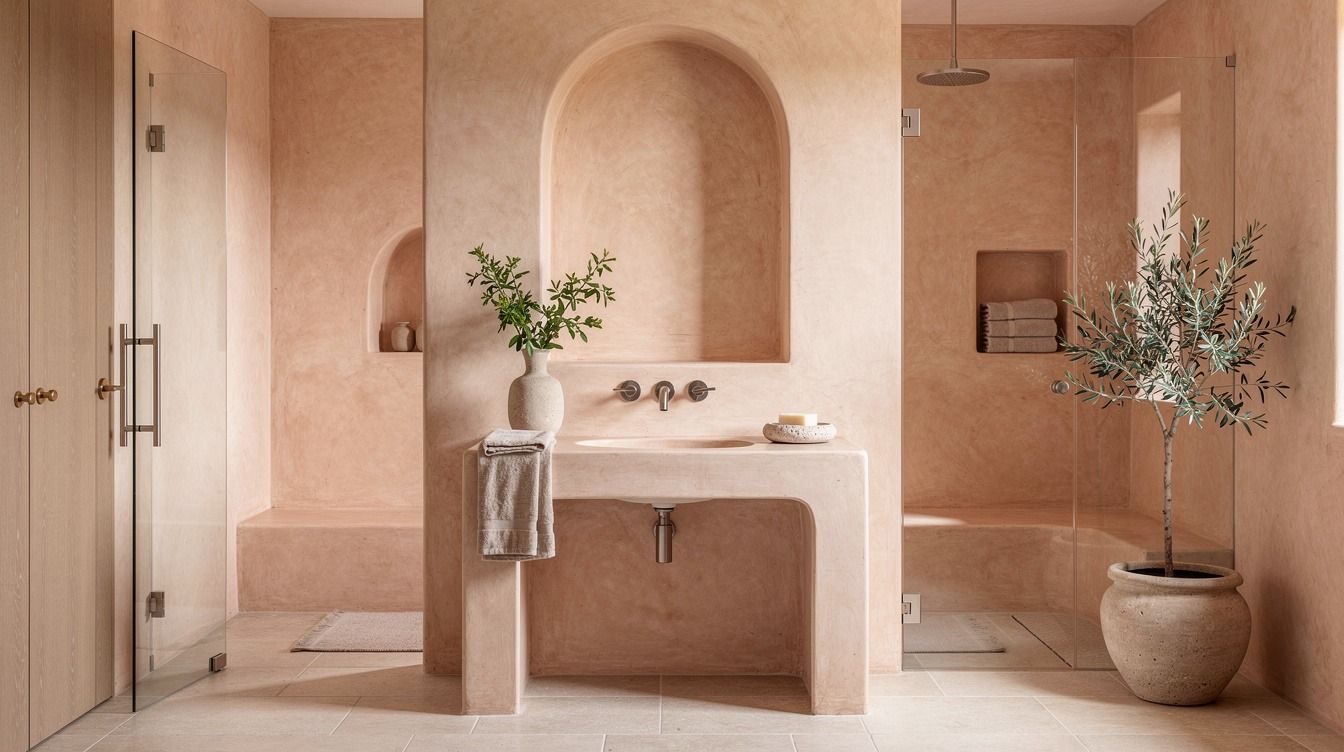
Modern Mediterranean bathroom style feels fresh when you keep the palette chalky, the stone imperfect, and the accents edited. I learned that after overdoing one bath with rope, blue tile, and too many “coastal” props. It looked like a restaurant powder room. You want warmth, not costume, and these 17 moves get you there.
- Warm the room with hand-troweled plaster
- Choose limestone tile with softly irregular edges
- Install an arched shower niche in microcement
- Pair aged brass fixtures with clean slab stone
- Float a warm oak vanity under vessel sinks
- Frame the mirror with a thin plaster arch (Why does this shape calm the room?)
- Lay zellige tile in one restrained stripe (The One-Stripe Rule)
- Mix ribbed glass with matte stone surfaces
- Bring in terracotta through a single accent wall
- Use rounded corners on the vanity and shower (The Soft-Edge Payoff)
- Hang woven pendants above a freestanding tub
- Layer cream towels with olive ceramic trays
- Run stone flooring into the shower seamlessly (The Continuous-Plane Move)
- Add blackened bronze hardware for modern contrast (Bronze over brass when the room feels flat)
- Style open shelves with clay and linen
- Choose a fluted travertine backsplash panel
- Finish with greenery in sculptural stone planters
1Warm the room with hand-troweled plaster
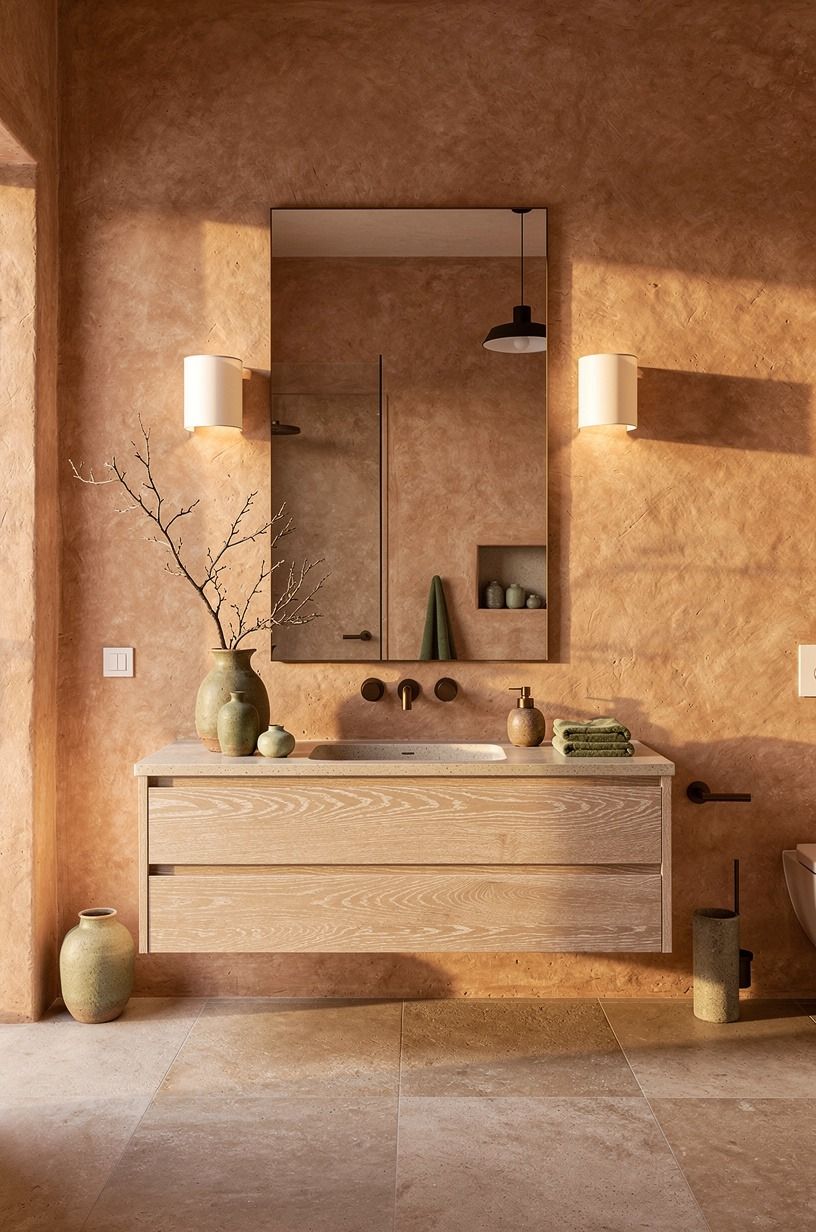
If you want a mediterranean modern bathroom to read warm from the doorway, start with the walls. Hand-troweled lime plaster gives you that soft, sun-baked depth flat paint can’t fake, especially when the room is shown as one balanced whole. I like Benjamin Moore Chestertown Buff HC-9 for the same family if full plaster isn’t in the budget, but the better move is still real texture because the light breaks across it in a quieter way.
Keep the finish matte and a little cloudy. That’s the point. In a room with centered symmetry, plaster stops the space from feeling too sharp or too new.
Your faucet, your mirror, even your toilet line will look better against it because the walls already carry some age. If you like that softened envelope, the warm restraint in these Mediterranean bedroom ideas is the same lesson carried into a larger room.
2Choose limestone tile with softly irregular edges
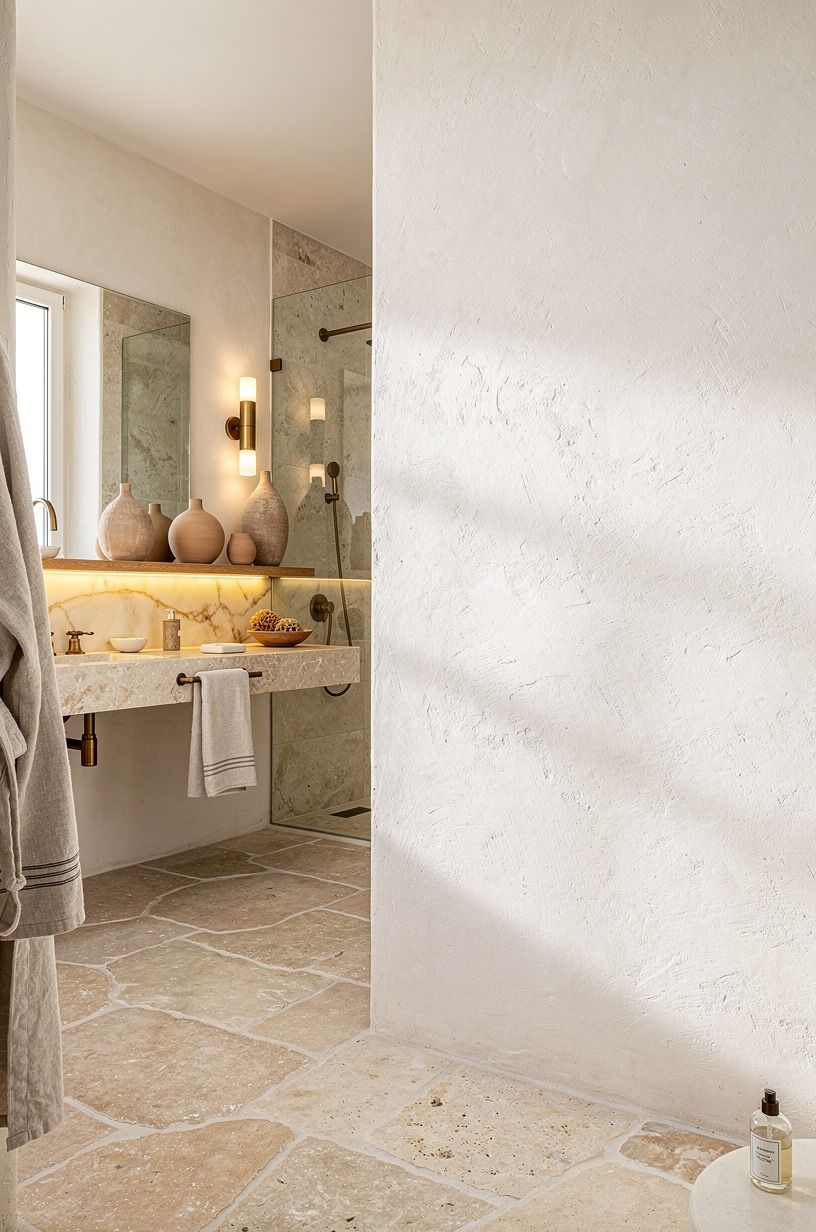
Hard-edged tile can make a modern clean bathroom design feel colder than you meant. Go with limestone-look porcelain or real Crema limestone with softly irregular edges so the floor has movement underfoot the second you step toward the vanity. In a first-person view, you notice the joints fast, and tight machine-perfect lines push the room toward showroom instead of home.
I’d rather see a warm 12×12 or 16×24 field tile with a little wobble than a busy mosaic trying too hard. The floor doesn’t need a performance.
It needs quiet grit, a sandy cast, and enough variation that your eye keeps moving toward the shower. For layout ideas in a tighter footprint, this guide to a small bathroom with big style and spa energy proves how much the floor sets the mood.
3Install an arched shower niche in microcement
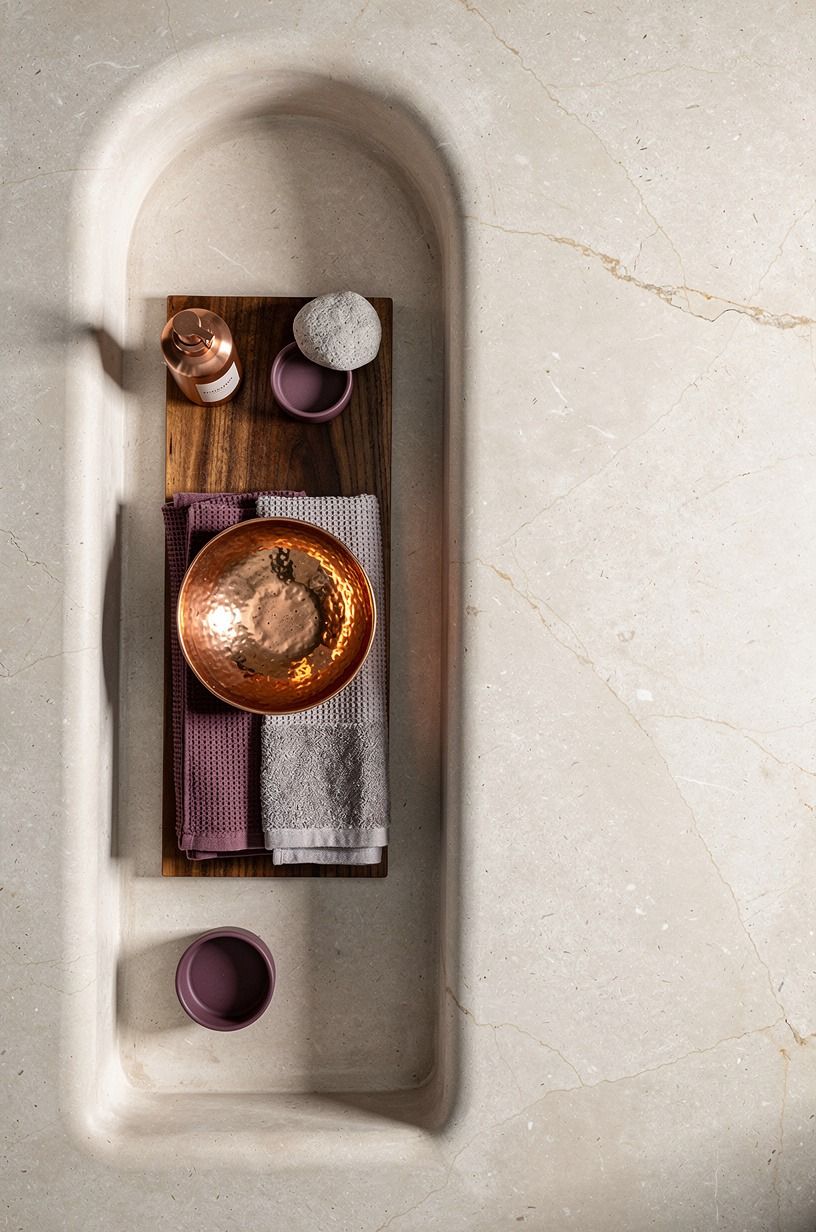
An arched niche is one of the easiest ways to make a cozy modern bathroom feel Mediterranean without tossing in themed decor. The arch does the cultural heavy lifting.
Smooth microcement keeps it current. In an overhead view, that curved opening reads almost like built architecture, especially when the ledge is spare and the finish stays tonally close to the wall.
Here’s my rule: one niche, one silhouette, no clutter. A bottle in amber glass, a bar of olive soap, maybe a small travertine tray.
That’s enough! If you’re building from scratch, keep your shower at least 36×36 in so the niche doesn’t feel crowded by the time you add fixtures. And yes, you’d rather have a plain rectangular niche than a badly proportioned arch, so draw it first and get the radius right.
4Pair aged brass fixtures with clean slab stone
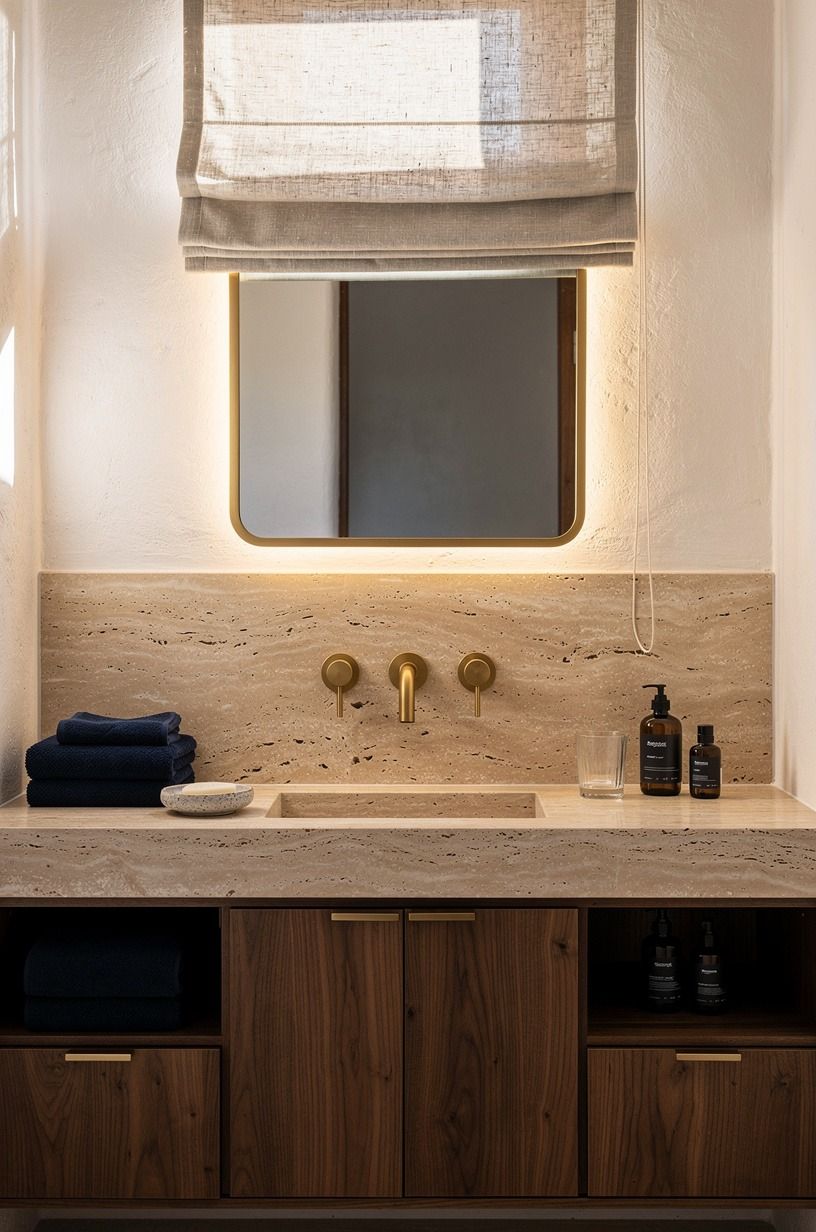
This is where you need contrast discipline. Aged brass looks right in a modern Mediterranean bathroom when the surrounding stone stays calm, broad, and almost monastic.
A veiny little mosaic plus warm metal can go faux-villa fast. I prefer a clean Carrara marble slab or pale quartzite plane behind the faucet so the patina has room to breathe.
Your eye should land on the faucet shape, then the stone field, then the mirror. Not twelve competing details.
I made the mistake once of mixing unlacquered brass with heavily patterned marble, and the vanity wall felt busy by noon. Skip that version. If you want old-world texture, let it come from the metal aging gently and the slab holding the line.
5Float a warm oak vanity under vessel sinks
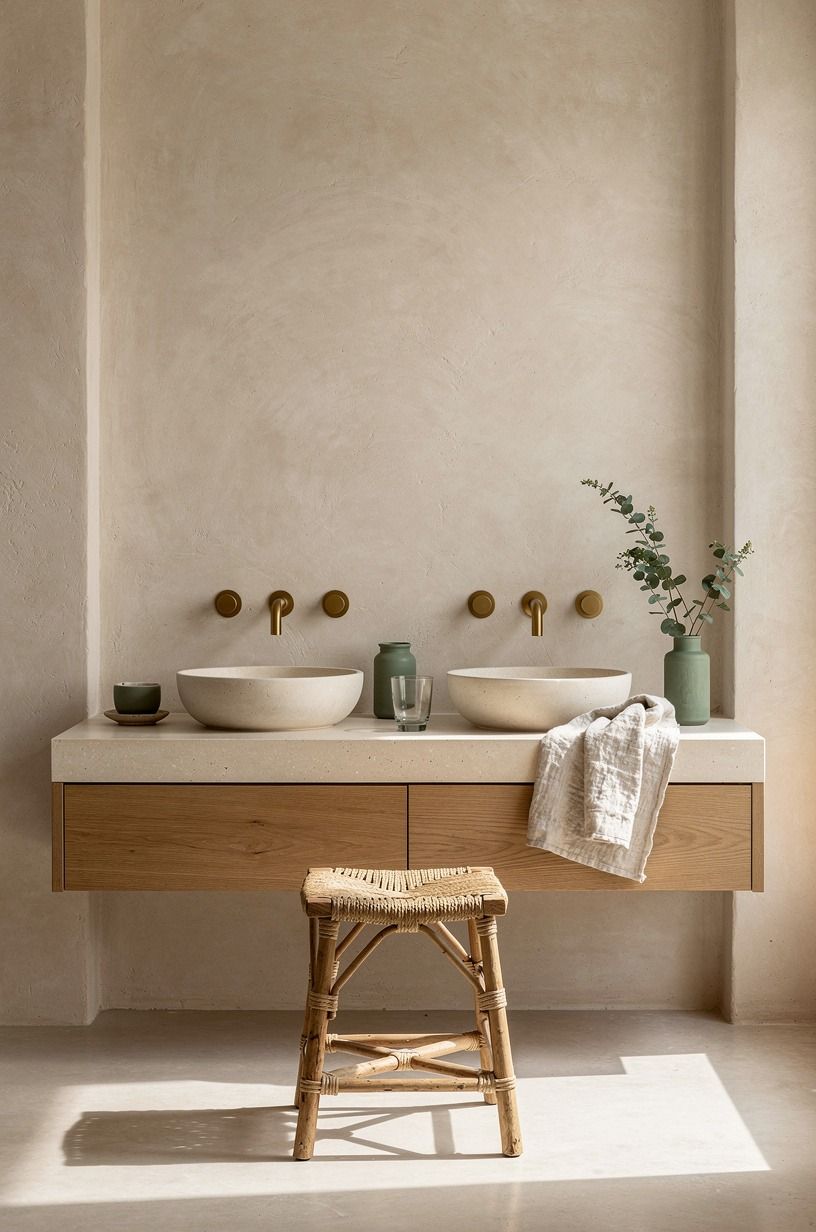
A floating vanity does two jobs at once in modern mediterranean bathroom ideas: it lightens the footprint and makes warm wood feel intentional instead of chunky. Choose white oak veneer or 3/4-inch solid white oak in a medium honey tone, then keep the face slab-front and simple. Under twin vessel sinks, that long horizontal run gives the room breathing space you can feel.
Watch the proportions. Vanity height still wants to land between 32 and 36 in, and the wood grain should read clearly from the front rather than disappearing under stain.
I like a vanity that sits a little proud of the wall because the shadow line matters. If you’re borrowing ideas across rooms, the restraint in this Mediterranean-inspired bedroom palette shows the same wood-against-plaster balance.
6Frame the mirror with a thin plaster arch (Why does this shape calm the room?)
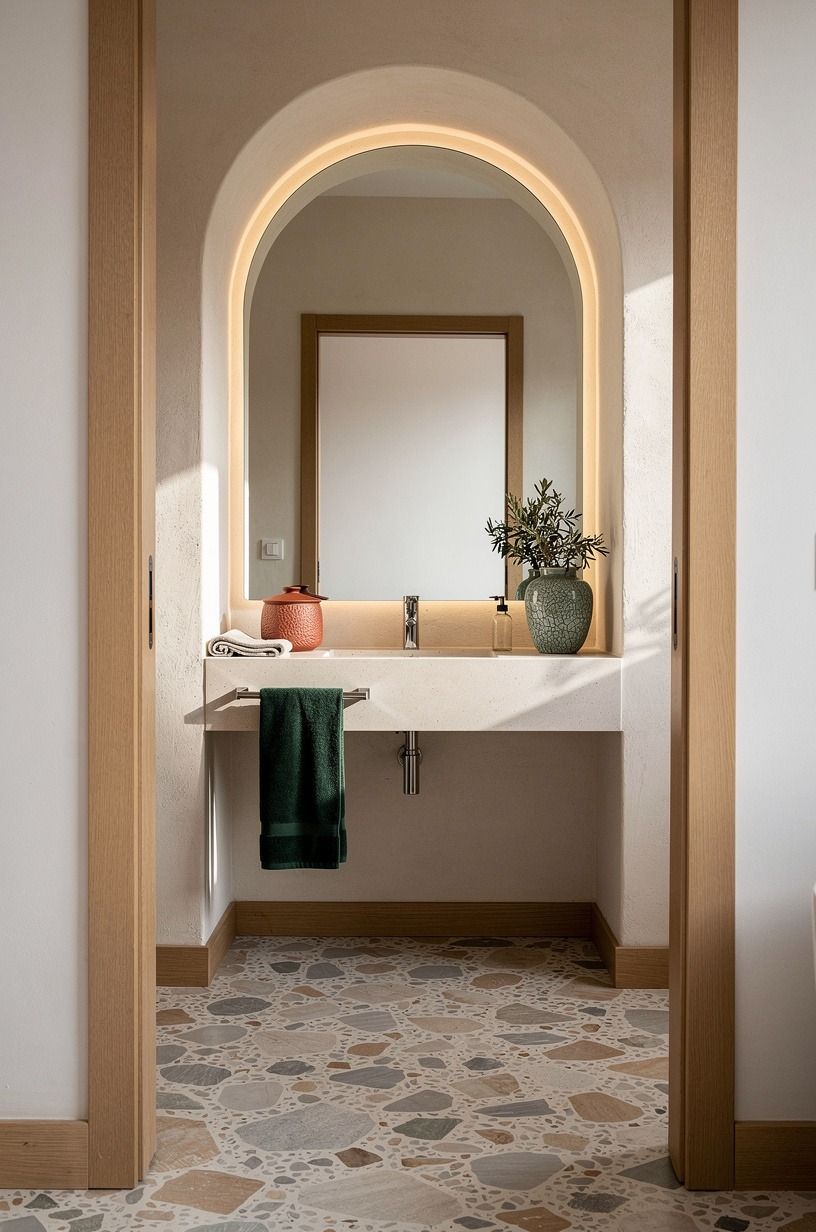
This is one of those details people notice before they know why the room feels softer.
7Lay zellige tile in one restrained stripe (The One-Stripe Rule)
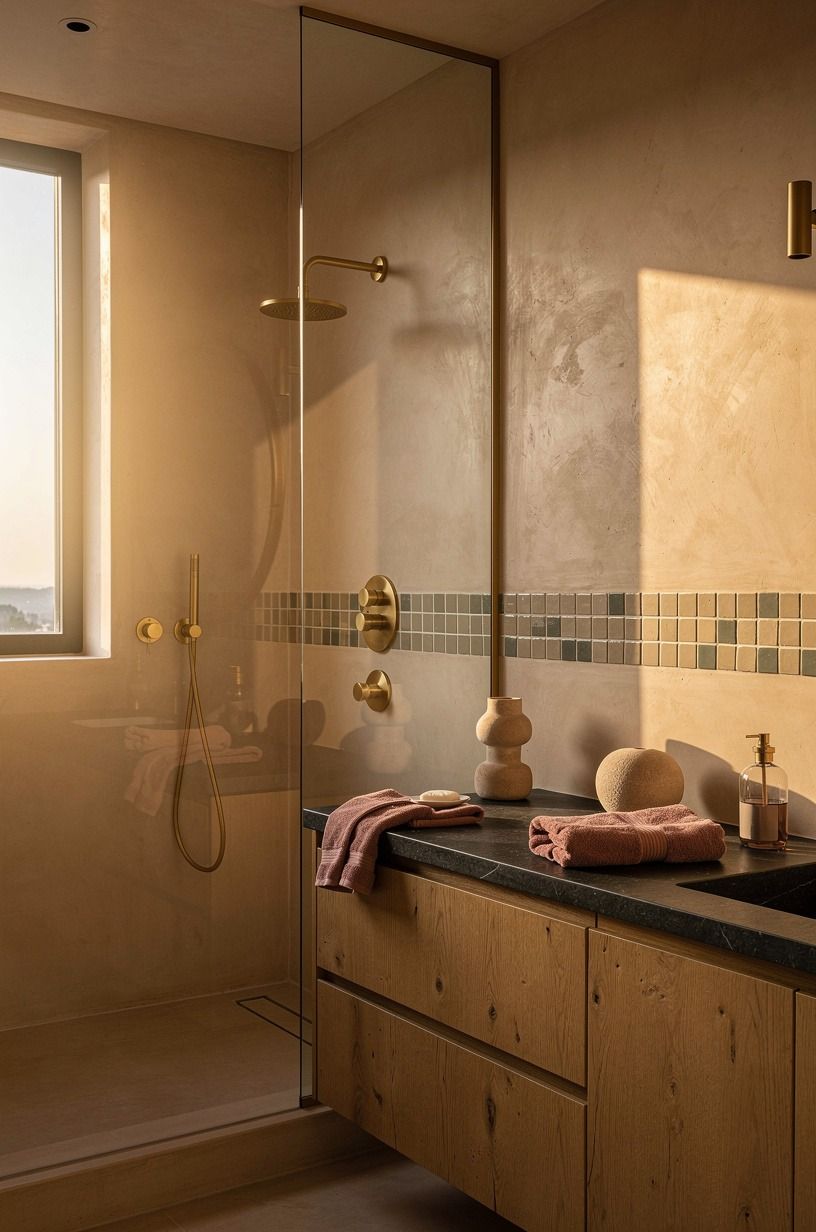
The One-Stripe Rule saves a lot of bathrooms. If you love zellige tile, don’t wrap the whole room in it unless you’re ready for a much stronger look.
A single stripe on the shower wall, especially in a dusty olive or chalky white, gives you that hand-fired shimmer while the rest of the room stays calm. In a wide corner-to-corner view, that stripe becomes the room’s measured accent.
Use the prettier tile where the light catches it, then let plain field surfaces support it. That’s cheaper, and it looks smarter.
Typical zellige tile runs about $15-$35/sq ft, while a simple subway tile can sit at $2-$10/sq ft, so this is one place where restraint helps both style and budget. You don’t need more square footage.
You need better placement.
8Mix ribbed glass with matte stone surfaces
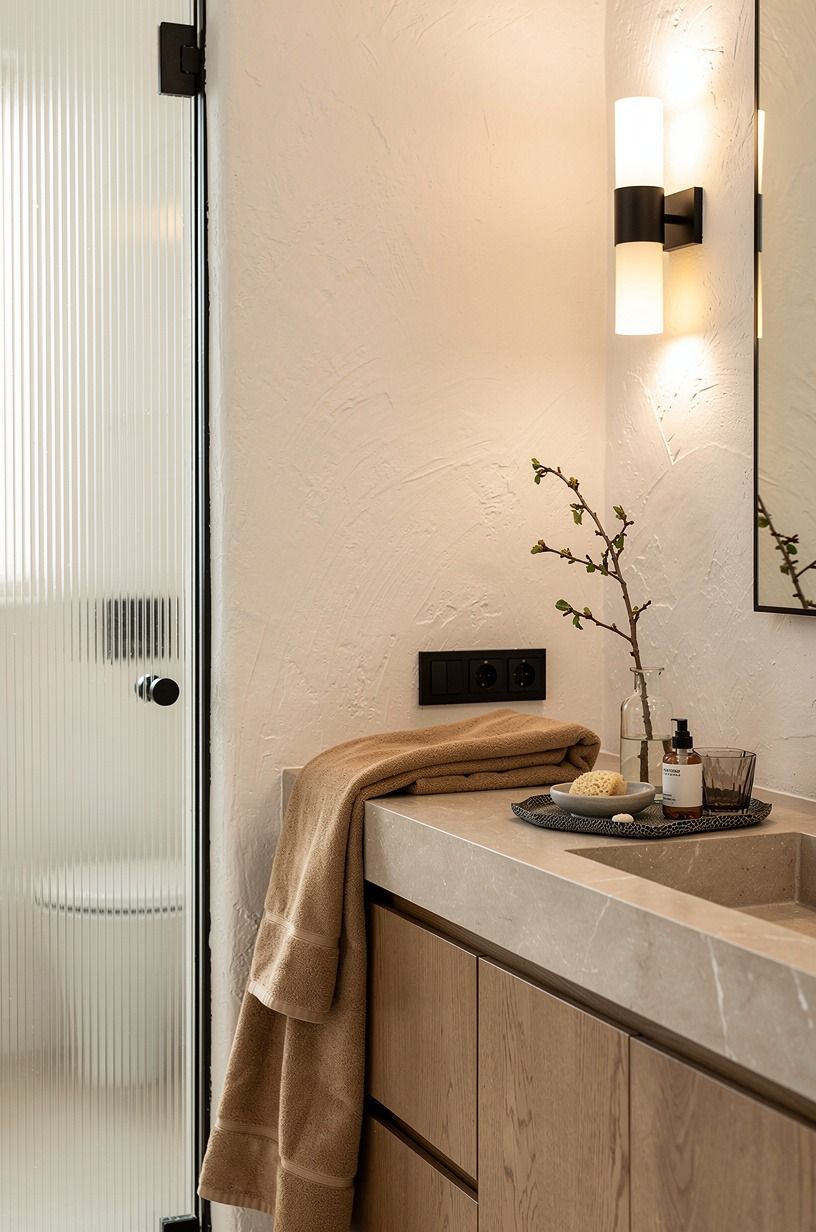
A ribbed glass shower screen is a great middle ground when you want privacy without closing off the room. Against a honed stone vanity or a matte travertine top, that fluted texture catches light in a very different way and keeps the bathroom from going flat. The contrast works because one surface diffuses and the other grounds.
But don’t pile on more texture just because you can. I’d skip a heavily patterned floor if ribbed glass is already in the plan.
Let the glass do the flicker, let the stone do the quiet weight, and keep your hardware straightforward. A room can hold two texture stories well.
After that, you start hearing noise instead of seeing design.
9Bring in terracotta through a single accent wall
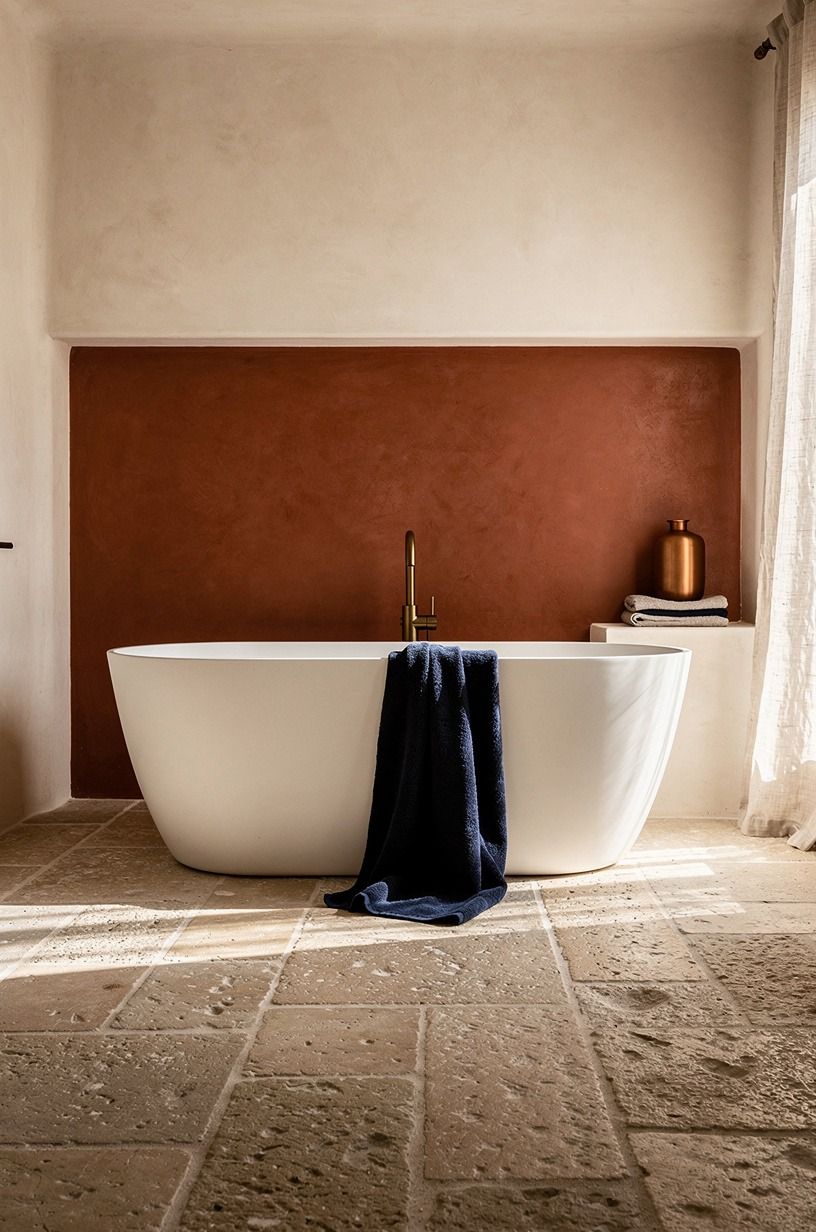
Terracotta works best here when it’s concentrated. One accent wall behind the tub in Roman clay or a baked-earth paint tone gives you that Mediterranean heat without turning the bath into a theme set. In a low floor-level perspective, the warm wall pulls the eye through the stone floor and lands right behind the tub, which is exactly where you want the drama.
I wouldn’t splash terracotta across every surface. It starts reading heavy, then a little muddy by evening.
Try Farrow & Ball Hague Blue No.30 somewhere else in the house if you want contrast, but keep this room warmer and dustier. A single wall in Benjamin Moore Chestertown Buff HC-9 mixed with clay accessories can do the job too, especially if your bathroom doesn’t get much natural light.
10Use rounded corners on the vanity and shower (The Soft-Edge Payoff)
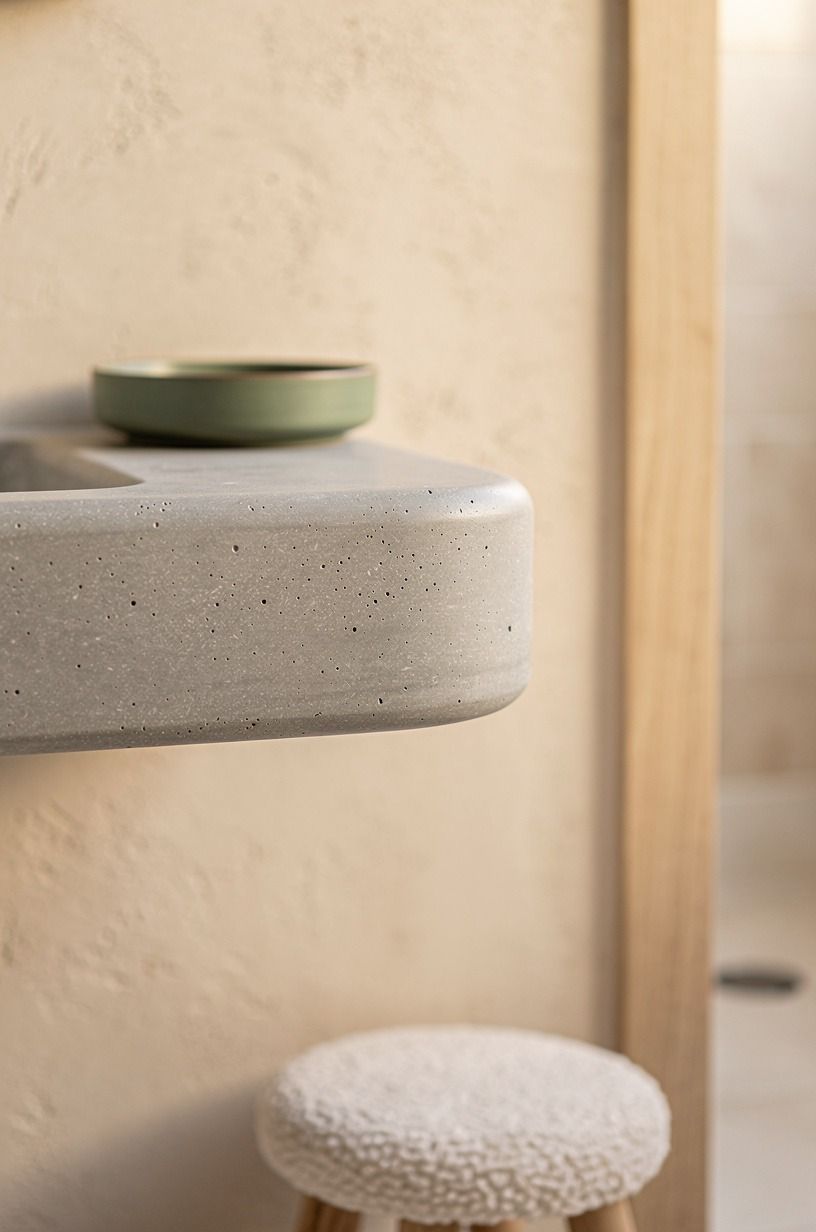
Sharp corners can make a cozy modern bathroom feel more corporate than calm. Rounded corners fix that fast.
A softly radiused poured concrete countertop beside a curved shower return feels tactile in a way square millwork doesn’t, and a close-up view makes that obvious because the edge catches both shadow and touch. Your hand reads it before your brain does.
This is my Soft-Edge Payoff, and I’d use it before adding decorative arches everywhere. Why? Because it works at the level of habit.
You brush past the vanity. You lean into the shower opening. Those daily contacts matter more than one flashy focal point.
If you use visible aggregate in the concrete, keep it fine, not pebbly, so the finish still feels clean.
11Hang woven pendants above a freestanding tub
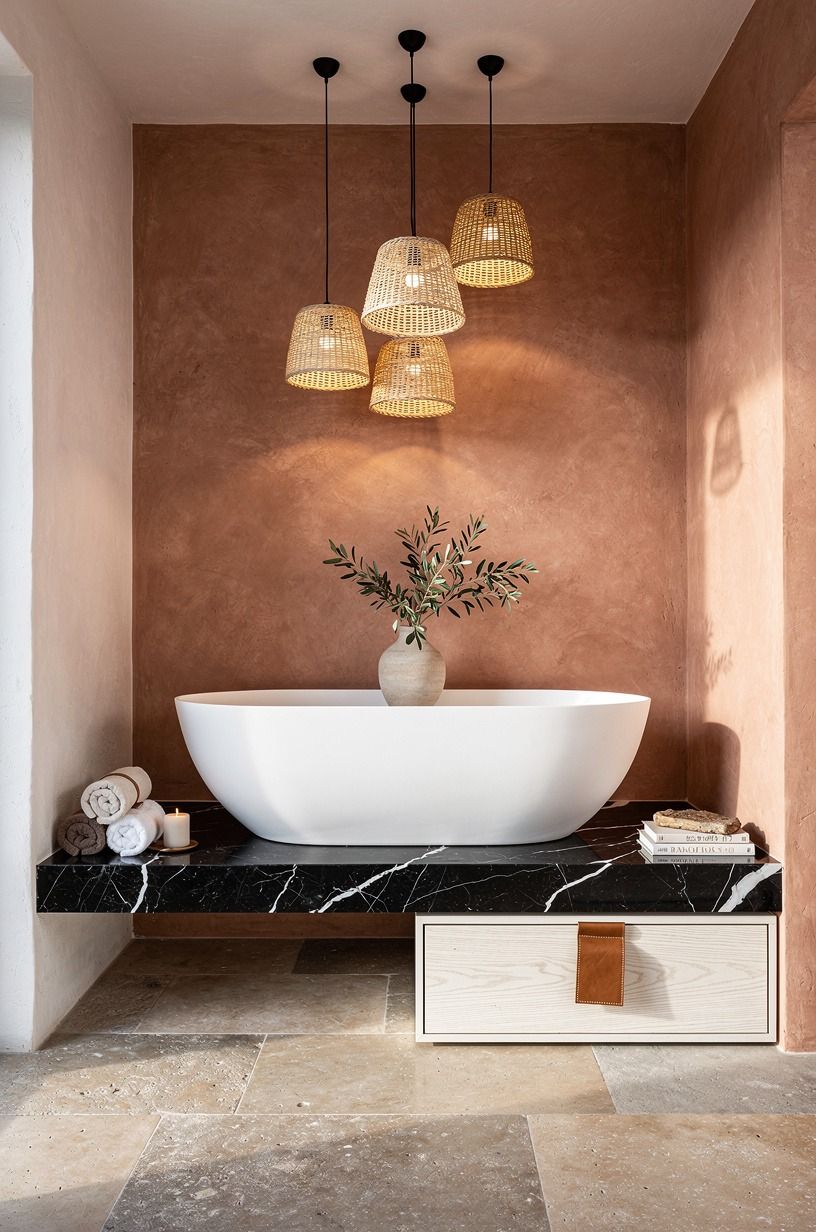
A freestanding tub can look lonely if the ceiling plane is blank. Hanging a pair of woven pendants above it fixes the vertical balance and makes the bathing zone feel gathered, not dropped in. In a ground-level shot, those shades pull warmth down toward the stone platform and stop the tub from floating in empty space.
And choose a weave that’s tight and sculptural rather than beachy. That’s the line.
I like natural rattan or seagrass in a shape with some discipline, almost urn-like, and warm bulbs around 2700K so the room glows amber at night. If your tub is the standard 60×30 in size, keep the pendants scaled smaller than you think.
The tub already makes a strong statement, and that restraint pays off every night!
12Layer cream towels with olive ceramic trays
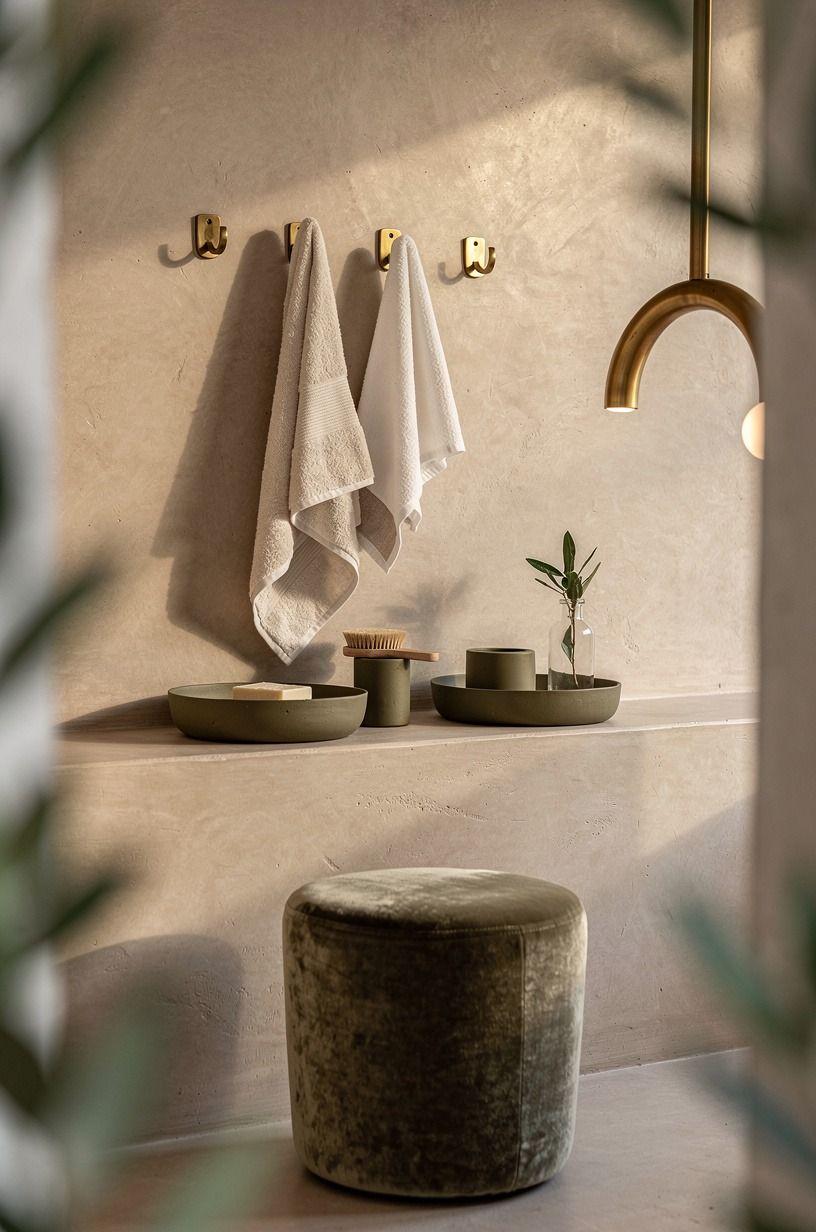
This is styling, yes, but it’s also color control. Cream towels soften stone immediately, and olive ceramic trays bring in that green-brown note Mediterranean rooms wear so well. Seen through foliage near a window, the composition feels loose and lived with rather than staged for a catalog.
You want the room to look used by a person with taste, not merchandised.
Try this stack. 600gsm Turkish cotton towels in cream.
One olive-glazed tray for soap and a small brush. A folded Belgian flax linen hand towel off to the side.
That’s enough. But keep the tray matte or lightly glazed, not glossy, or the styling starts pulling modern farmhouse instead of Mediterranean.
Small difference, huge result!
13Run stone flooring into the shower seamlessly (The Continuous-Plane Move)
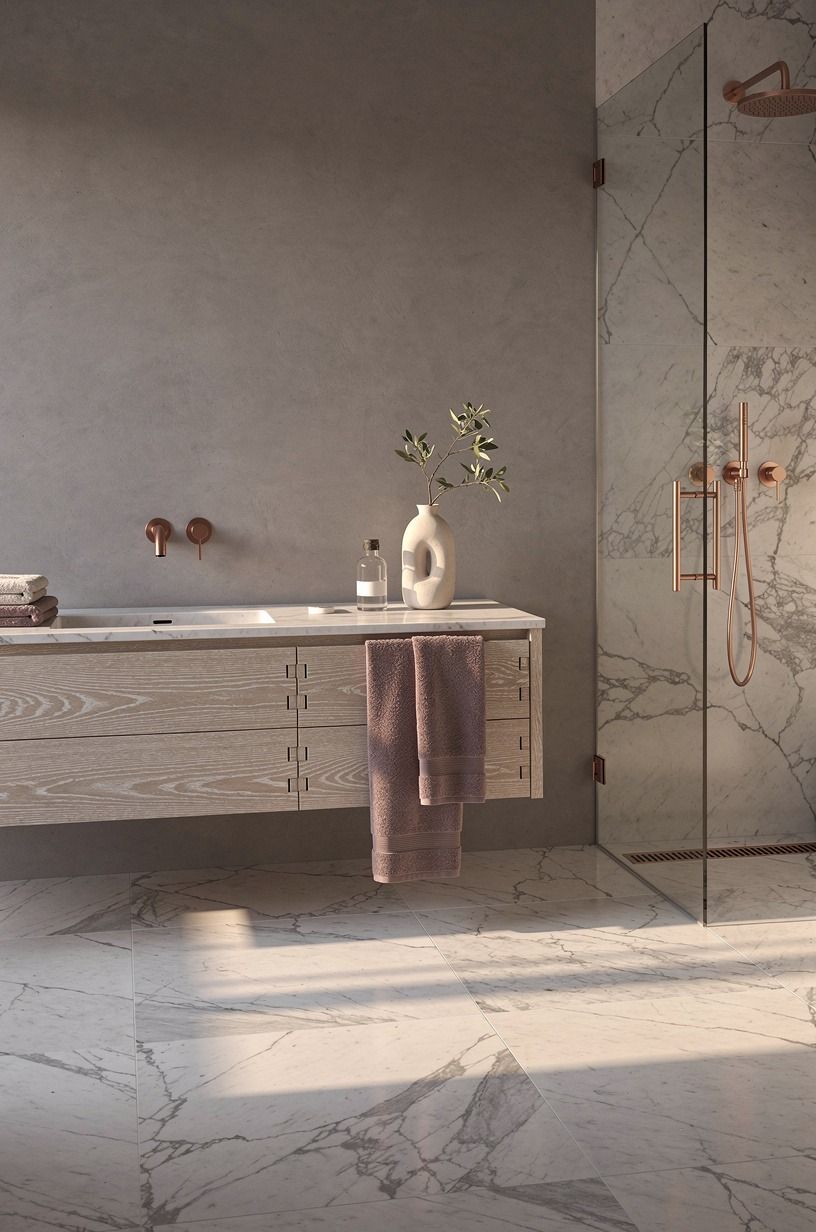
Continuous flooring is one of the cleanest ways to make a bathroom feel larger and calmer.
14Add blackened bronze hardware for modern contrast (Bronze over brass when the room feels flat)
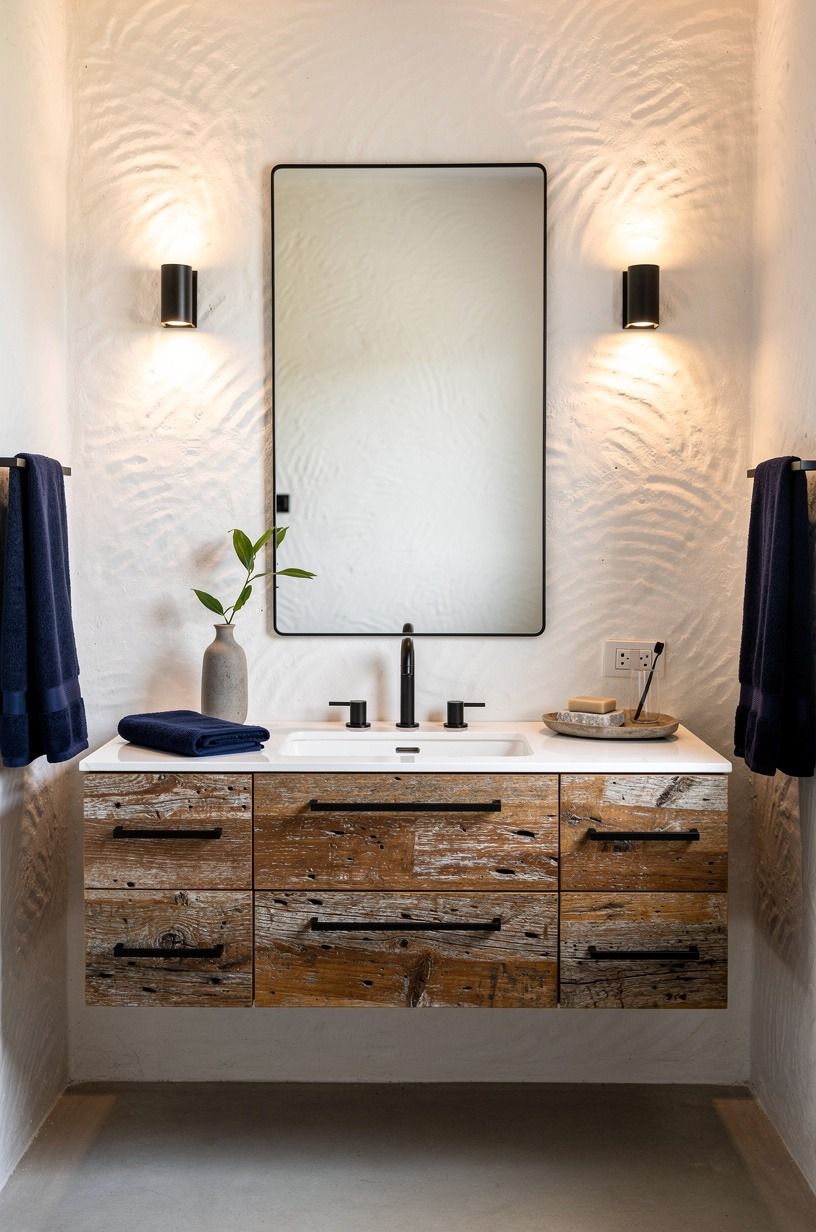
If the room is getting too sandy, too pale, or a little sleepy, blackened bronze is the reset button. A darker metal on the vanity pulls the whole composition back toward modern clean bathroom design, especially when it’s framed against teak, stone, or a muted navy accent. In a front-on vanity view, those dark hardware marks read almost like punctuation.
Don’t spread it everywhere, though. I like blackened bronze on pulls or a mirror frame, then warmer metal at the faucet if the room needs softness.
Mixing metals can work when the roles are clear. If everything goes dark, you lose the Mediterranean glow.
If everything goes brass, you lose edge. The sweet spot is tension you can feel but not immediately explain.
15Style open shelves with clay and linen
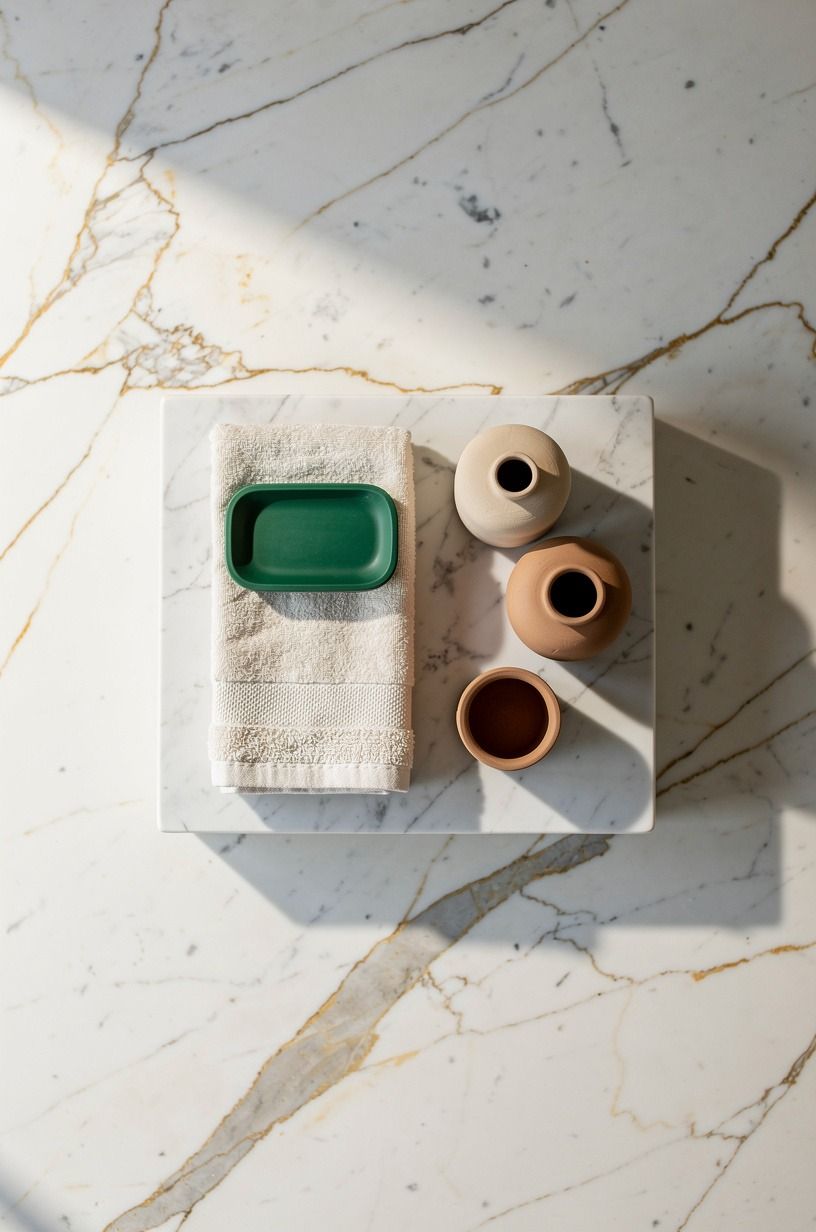
Open shelving goes wrong when every object tries to speak at once. Keep yours edited to a few tactile pieces that look good from above: clay vessels, folded linen hand towels, a pale marble shelf, maybe one little brush or soap dish. In an overhead flat-lay composition, those materials do more than color ever could because they carry dust, fiber, and weight.
I’d rather see three good objects than nine little souvenirs. One tall terracotta vase. One folded Belgian linen towel.
One low travertine bowl. That’s the shelf.
If you need more storage, hide it below. The visible layer should feel almost ceremonial, which sounds dramatic, but in a bathroom that restraint keeps the room from becoming a prop closet.
16Choose a fluted travertine backsplash panel
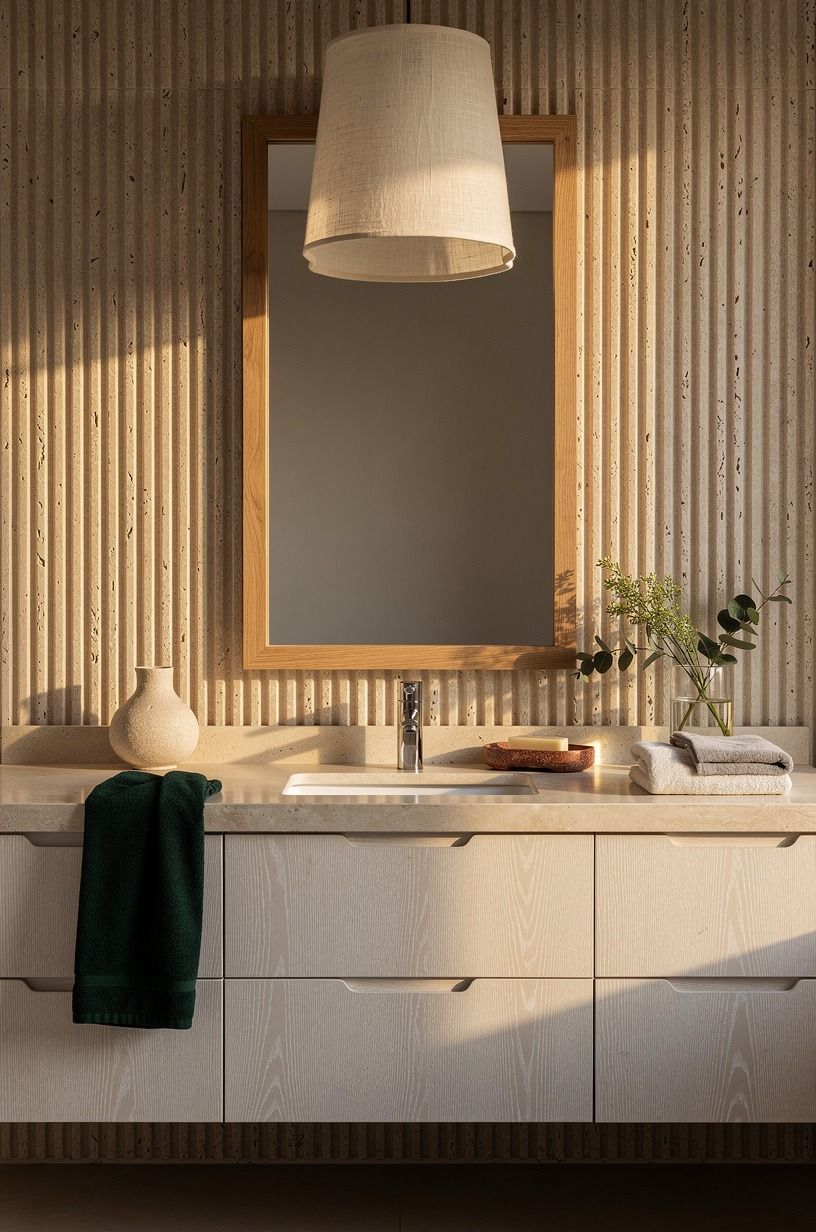
A fluted travertine panel behind the vanity gives you pattern without print and texture without clutter. That’s a very useful trade in a modern Mediterranean bathroom because the rest of the room can stay simple while the backsplash carries the visual detail. In a classic editorial angle, the ribs catch side light beautifully and make the vanity wall feel finished even before you add decor.
This is also one of the better splurge points if you’re deciding where money matters most. A marble top typically runs about $50-$100/sq ft, and a brushed brass faucet often falls between $120-$450, so your statement wall doesn’t have to be the biggest line item to change the room. I’d still keep the sink simple.
Let the stone talk.
17Finish with greenery in sculptural stone planters
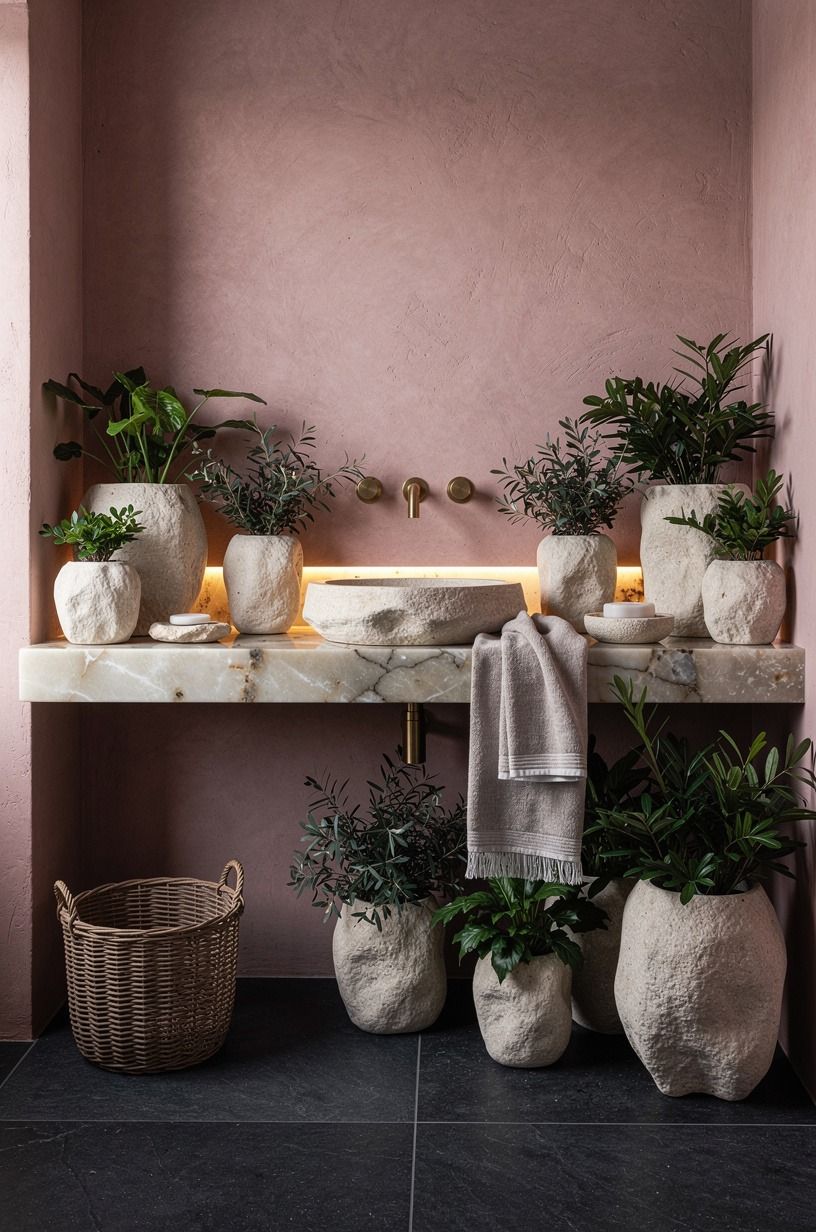
Greenery is the last move, not the first.
Why this look works now
What I like about modern Mediterranean bathrooms is that they are not trying to recreate one postcard village or one era. They’re borrowing the right things: chalky walls, warm stone, softened edges, edited wood, and metal that gets better as it dulls.
That’s why the room feels honest when you walk in. It has age signals, but it still behaves like a clean modern space.
I’ve also noticed people are tired of bathrooms that feel either icy or overly ornate. Fair.
This style lands in the middle, and the costs can scale with your project. If you want the clearest non-bathroom reference for that relaxed restraint, the mood in this Mediterranean beach renovation and this hidden French town near the calanques gets surprisingly close.
My own decision framework is simple. First, fix the shell. That means plaster, stone tone, and one curve you can feel from the doorway. Second, bring in warmth through wood and towels, not through a pile of props.
Third, add one accent with age, usually aged brass or blackened bronze, and stop there. I went too far on a bathroom years ago with striped pottery, rope, and blue glass.
It wasn’t charming. It was loud.
Once I pulled almost all of it out, the room finally exhaled.
But the better news is that you don’t need the high line to get the feeling right. The part that changes a room fastest is usually the shell: wall texture, one strong material choice, and better lighting. I’d put money there before chasing decorative extras every single time.
If you want a good mental image for material honesty, this piece on an ancient citadel built without mortar explains why rough surfaces and imperfect joints still feel so convincing now.
What People Always Want to Know
What is the best How to Nail Modern Mediterranean Bathroom Style (Without It Feeling Themed) for a small bathroom?
The best move for a small bathroom is continuous stone flooring plus a floating oak vanity. More visible floor area makes the room feel calmer right away, and a wall-hung vanity keeps the footprint light. I also like borrowing scale ideas from this small bathroom style guide.
Where can I buy How to Nail Modern Mediterranean Bathroom Style (Without It Feeling Themed) pieces on a budget?
Start with IKEA, Target Threshold, and Wayfair for mirrors, lighting, and basic vanities. Lower spend, faster payoff.
Then check Facebook Marketplace for a wood dresser you can convert or a vintage stool in warm oak. I’d save new-money purchases for the faucet and the towels.
How much does a How to Nail Modern Mediterranean Bathroom Style (Without It Feeling Themed) makeover cost?
A typical makeover can run from about $200 to $1,200 for surface changes, then up to $3,000-$9,000 once you swap the vanity, tile, and lighting. The shell sets the budget. Free moves still matter too: editing accessories, repainting, and removing visual clutter from open shelves.
Can I create a How to Nail Modern Mediterranean Bathroom Style (Without It Feeling Themed) on a budget?
Yes, and you can get surprisingly far with paint, textiles, and one material-led accent. Budget changes show fast here. Try a limewash-style paint effect, cream towels, a warm-toned mirror, and a single clay or stone tray.
Skip the themed props. Keep the surfaces quieter instead.
Is a How to Nail Modern Mediterranean Bathroom Style (Without It Feeling Themed) worth it in a small space?
Yes, it’s worth it because a small room benefits from fewer materials and a tighter palette. Less visual noise helps every inch. Keep the toilet clearance at 21 in minimum, run one floor through the shower, and use the mirror arch or plaster texture to add character without bulk.
Is How to Nail Modern Mediterranean Bathroom Style (Without It Feeling Themed) a good idea for a rental?
Yes, if you lean on reversible layers. Rentals can still hold the mood. Use peel-and-stick warm sconces, a removable arch mirror, a tension-rod linen curtain, and clay accessories.
I’d avoid faux-stone wallpaper in a bath, though. It rarely looks convincing once steam hits the room.
Where I’d Start First
If I had to pick one, I’d start with hand-troweled plaster. Flat walls fight every warm material you add after that.
Get the shell right first. Pin the plaster idea for later and let the fixtures, stone, and wood fall in behind it.