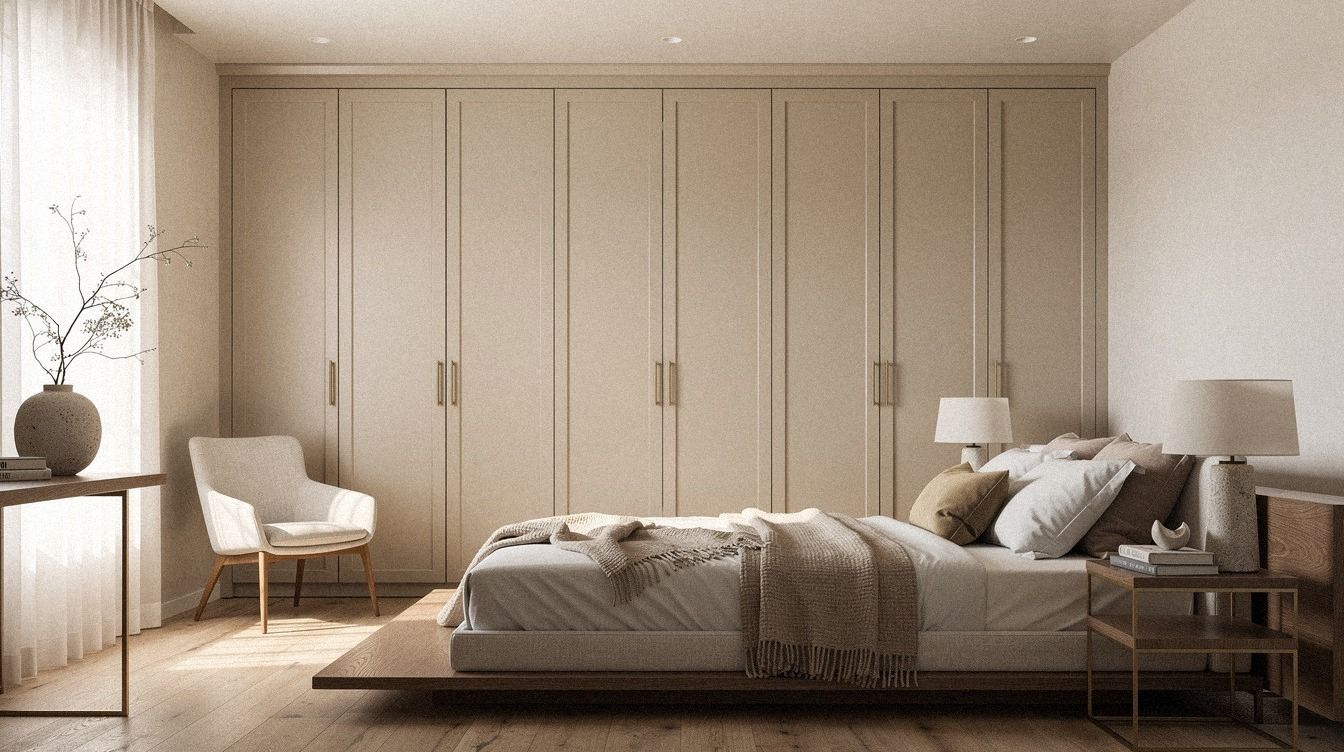
Hidden wardrobe doors for a clean bedroom wall work best when you treat them like built-in architecture, not furniture, and a typical setup can start around $150 to $800 if you’re using rods, shelves, bins, and lighting behind the scenes. I learned that after fighting one too many bulky closets that made the bed wall feel chopped up. Your eye wants one calm plane. Give it one.
- Start with full-height wall-matched wardrobe doors
- Anchor the bed wall with concealed oak fronts
- Layer slim battens across door seams
- Hang linen curtains over flush wardrobe tracks
- Why does a headboard wall beat separate furniture?
- Wrap wardrobe doors in continuous wood veneer
- Paint push-latch panels the bedroom wall color
- Cover door gaps with vertical oak slats
- Run picture-frame molding across every wardrobe joint
- Install mirror slabs that read as wall panels
- Frame bedside niches inside the hidden wardrobe run
- Tuck labeled organizers behind seamless pocket doors
- Light the toe-kick below invisible wardrobe fronts
- Finish with handle-free minimalist closet panels
- Try an IKEA PAX base hidden behind custom fronts
- What about West Elm vs CB2 for high-end flat panels?
- Hide the seams with Sherwin-Williams Urbane Bronze trim
1Start with full-height wall-matched wardrobe doors
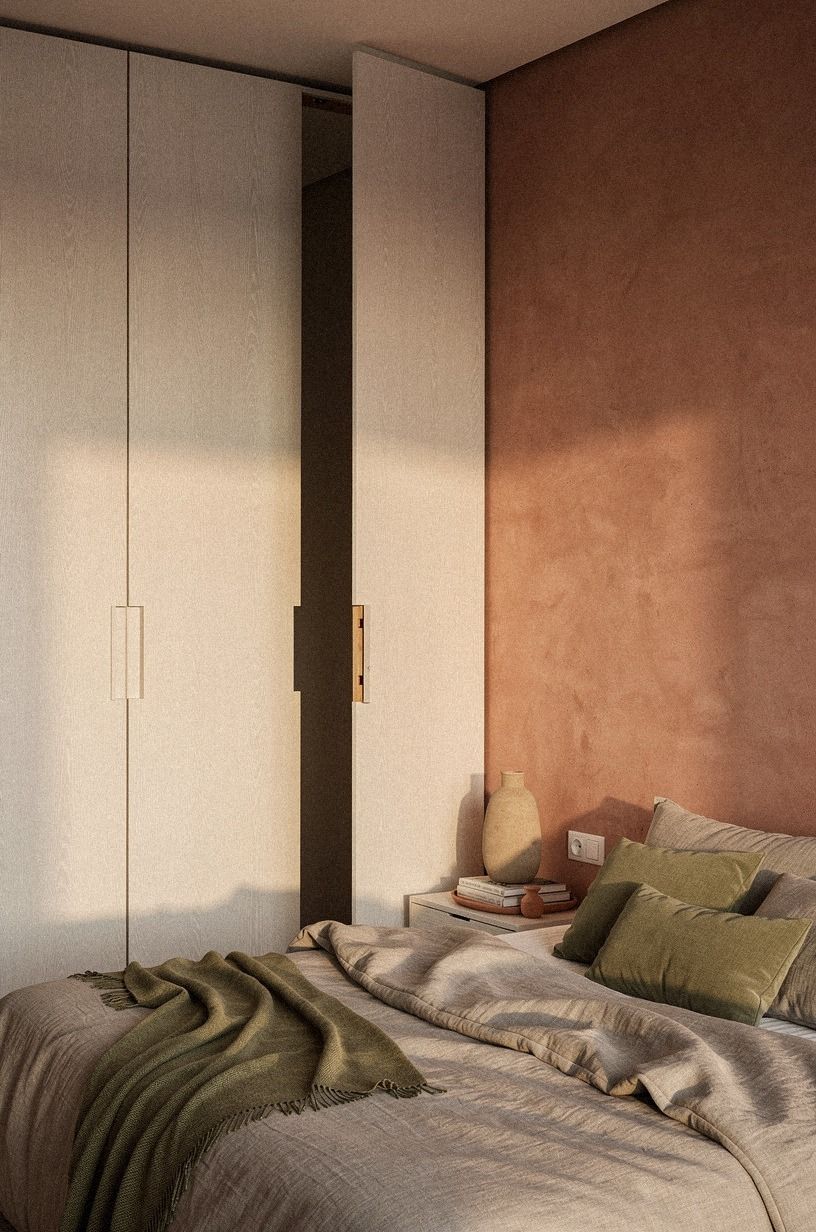
Start with doors that run all the way to the ceiling, because your eye reads height before it reads storage. If you stop short, you get that heavy cabinet-top shadow line that makes the whole bedroom feel lower. I’d rather see a plain slab finished in cerused white oak than a fancy shaker profile here, because profile lines announce the door before you even reach the bed.
Keep the fronts wall-matched and quiet, especially if your room already has terracotta, plaster, or a warm neutral palette. A painted slab in Benjamin Moore Pale Oak OC-20 works if you want the doors to disappear into a soft wall color, while a white-oak veneer works if the rest of the room already carries warm grain.
If you’re comparing other concealed-wall approaches, this guide to hidden doors in wall paneling shows why one continuous surface always reads calmer than broken cabinet lines. And if you’re thinking about the same vanishing trick on a different elevation, concealed TV walls apply the same logic in the living room.
I made the mistake of choosing standard closet doors once because they were cheap, and I spent months trying to soften the stop-start seams with art and baskets. It never worked.
Full height first. Then style.
2Anchor the bed wall with concealed oak fronts
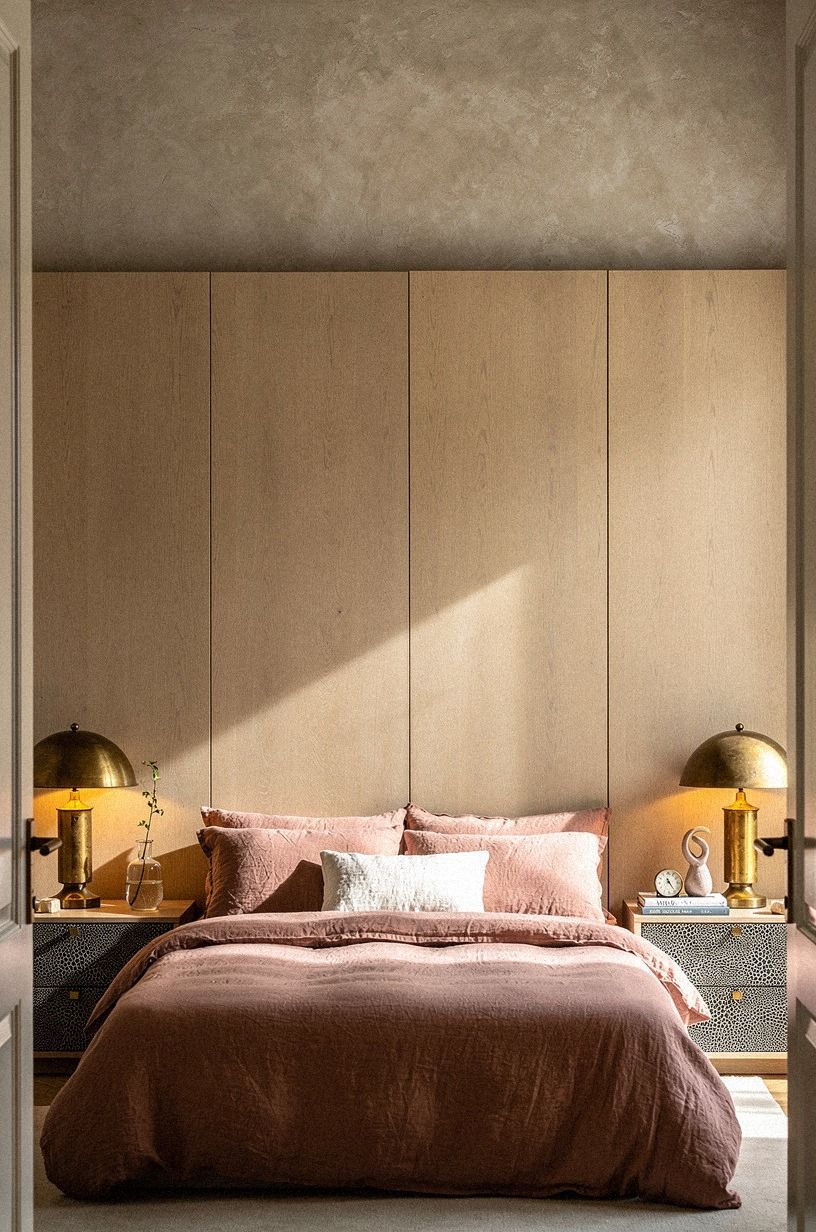
If your wardrobe sits on the same wall as the bed, let the storage anchor that whole elevation instead of pretending it’s a separate piece. You want the oak fronts to read like flush storage architecture, the same way a good headboard wall does. That means you should carry the tone of the wardrobe close to your clay linen bedding rather than fighting it with bright white doors.
A flush run in 3/4-inch solid white oak veneer feels steadier beside a bed than glossy laminate, especially when your bedding is muted and textured. Think clay linen, a matte ceramic lamp, a low rug in grey, then one warm wood plane beside it.
But skip contrasting handles. They break the illusion right where your eye rests when you walk in.
If you like this built-in effect, you’ll probably also like the way a concealed TV wall can hide an entire opening without looking busy. Same idea, different room. Calm is the point!
3Layer slim battens across door seams
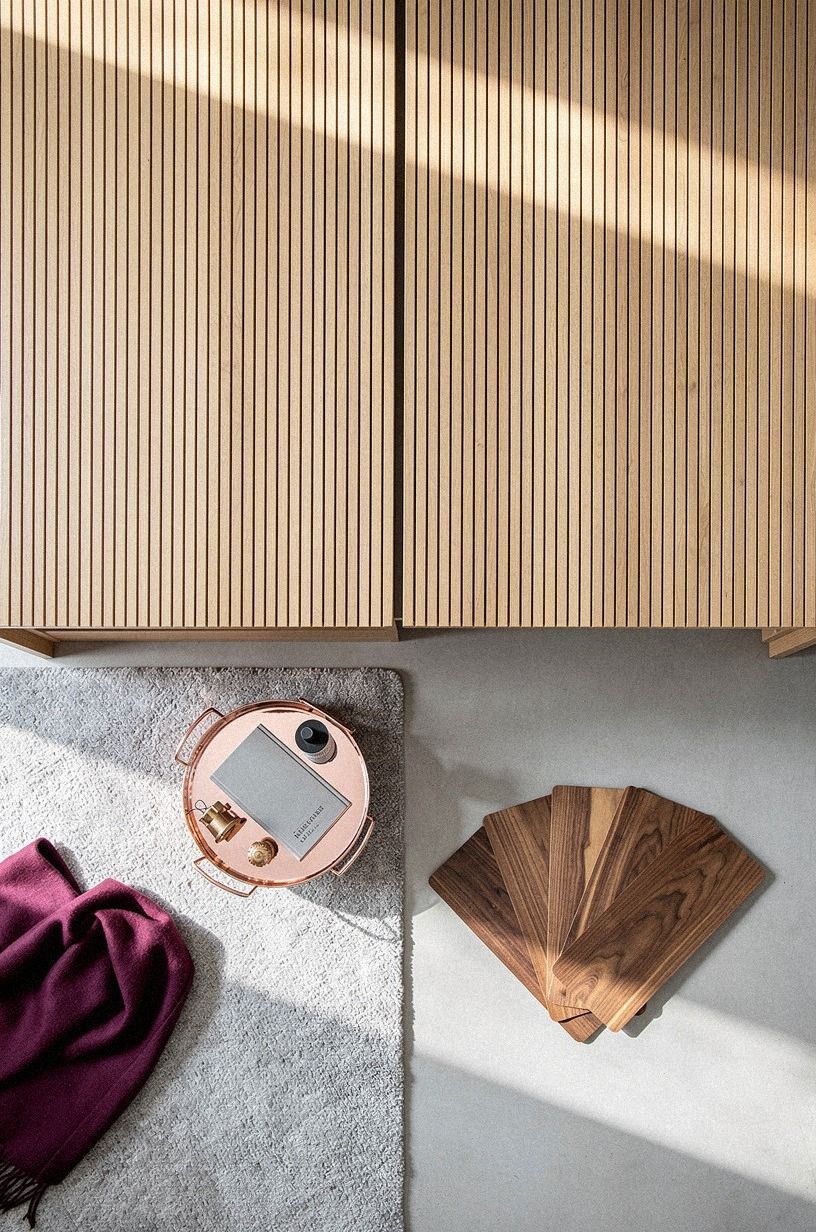
Battens are your cheat code for bad seams, but only if they stay slim and evenly spaced.
4Hang linen curtains over flush wardrobe tracks
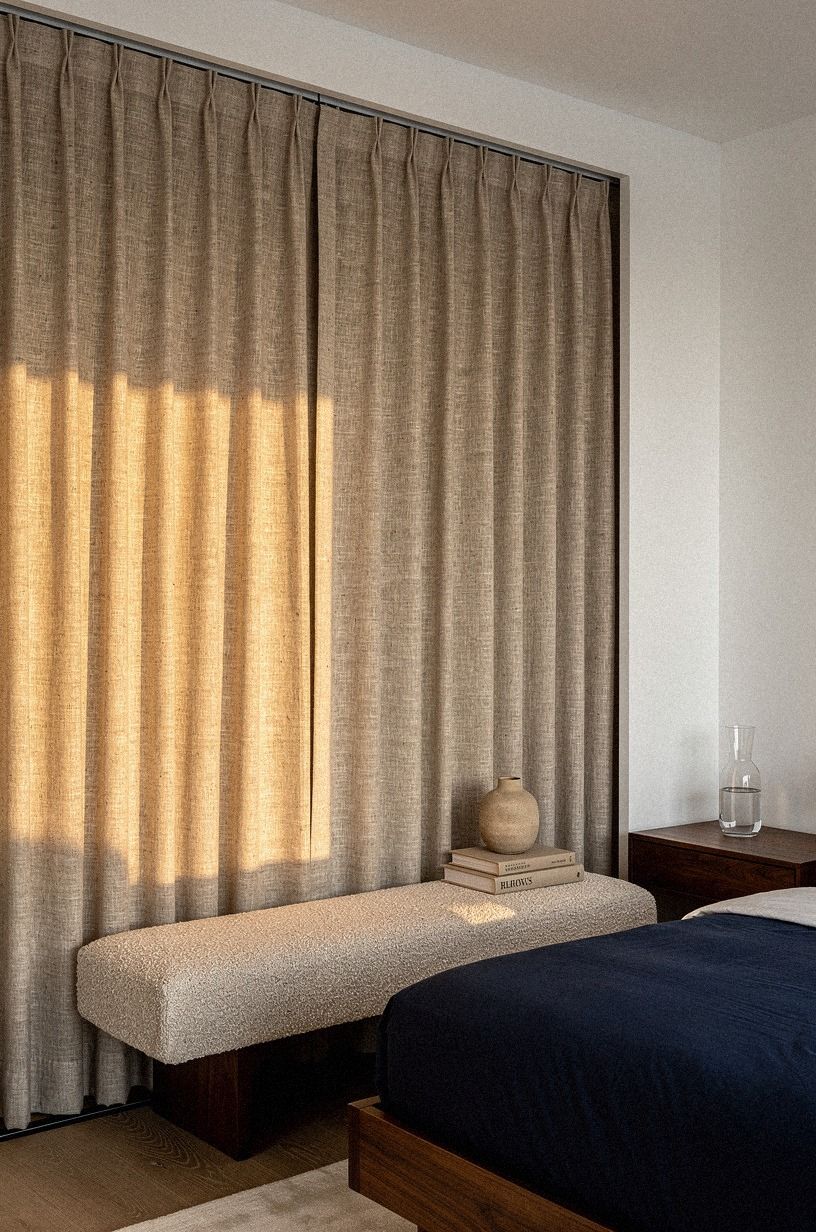
Curtains sound softer than millwork because they are, and that’s exactly why they can save a clean bedroom wall. If your wardrobe system sits on a flush ceiling track, hanging full-length linen in front of it lets you hide the openings without adding visual hardware. I like this more than mirrored bi-folds, which always feel louder than they promise.
Use Belgian flax linen in a warm off-white if your walls are white and your bedding swings navy. You want the curtain to skim the floor and fall with a little weight, not puff out like a stage set.
A ceiling-mounted track keeps the line quiet, and the fabric gives you the kind of softness that hard-panel bedrooms often miss. Expect to budget around $25 to $60 per panel for the linen itself, plus another $40 to $120 for a quiet ceiling-mounted track.
And if your home leans toward concealed openings in more than one room, the same logic from this hidden bathroom door guide applies here too: the less visible hardware you show, the more custom the room feels.
5Why does a headboard wall beat separate furniture?
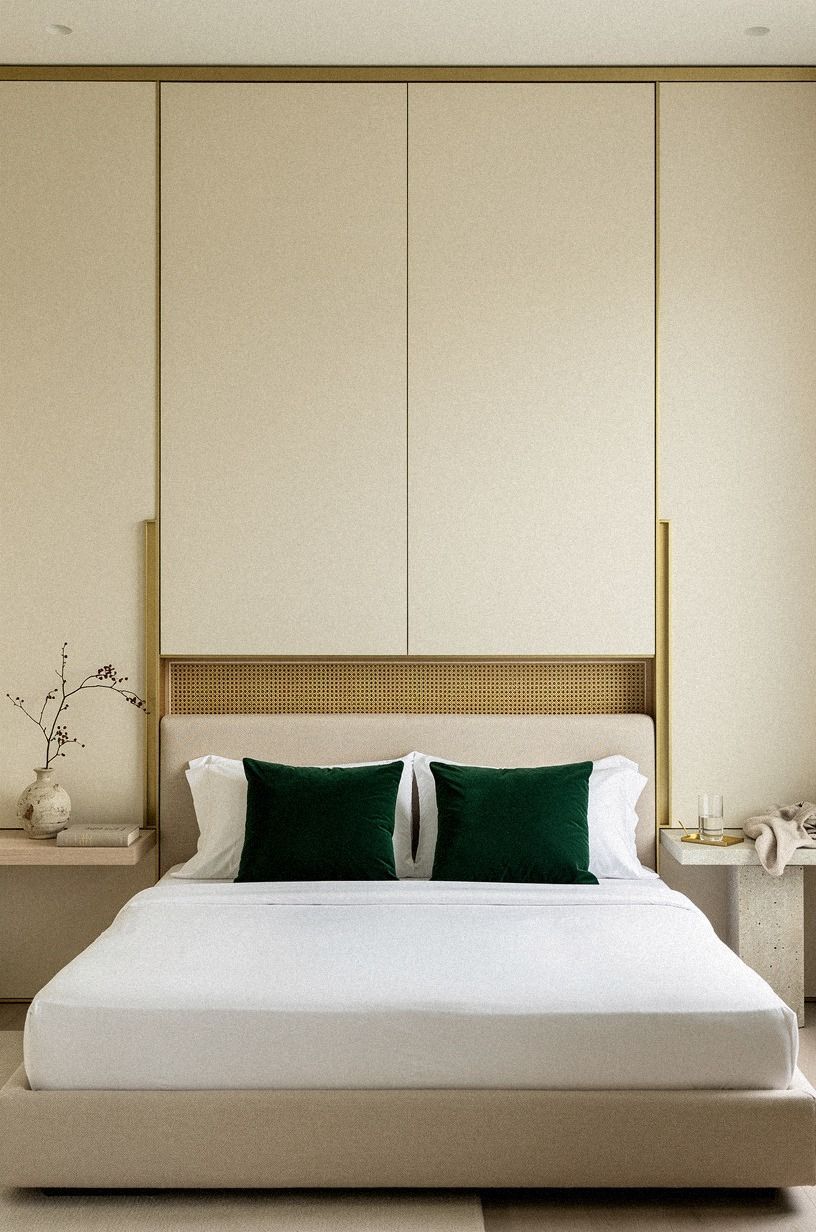
If the wardrobe sits behind or beside the bed, build the whole wall as one composition.
6Wrap wardrobe doors in continuous wood veneer
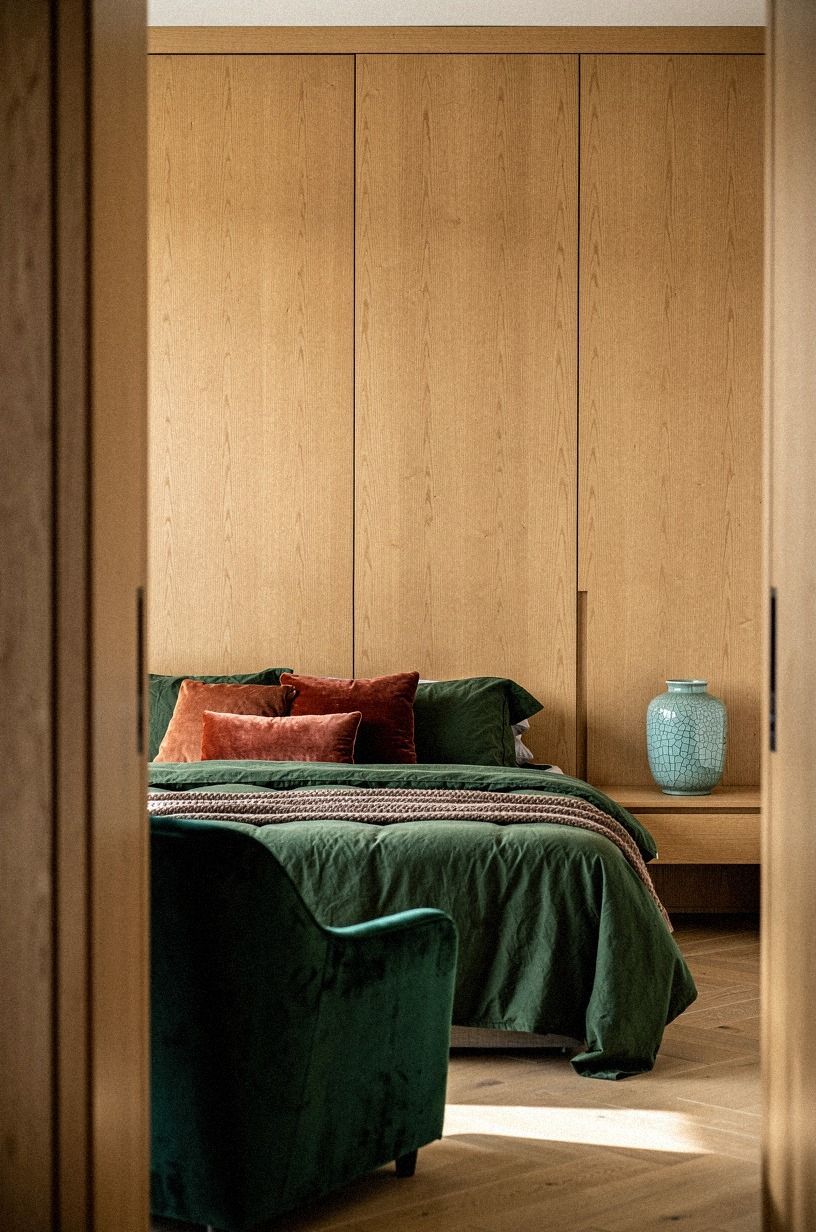
Continuous veneer is what you choose when you want the wardrobe wall to feel almost invisible from the doorway. The continuous grain keeps moving across every panel, so your eye follows the wood instead of hunting for door edges.
I’ve seen cheap printed wood wraps try to do this, and they always die at the seams. Real veneer costs more, but this is one place where the upgrade shows.
In a room with forest green bedding and rust cushions, a run of rift-cut oak veneer is especially good because the linear grain feels orderly next to deeper color. Let the veneer flow across fixed end panels too. If you stop at the door, the whole effect collapses.
You’ll want to budget roughly $90 to $180 per door for a quality rift-cut oak face, and most installers charge around $400 to $900 for a full wardrobe run.
For more whole-wall concealment inspiration, I keep coming back to hidden panel doors that vanish into millwork because they prove the same thing: continuity beats decoration every time.

7Paint push-latch panels the bedroom wall color
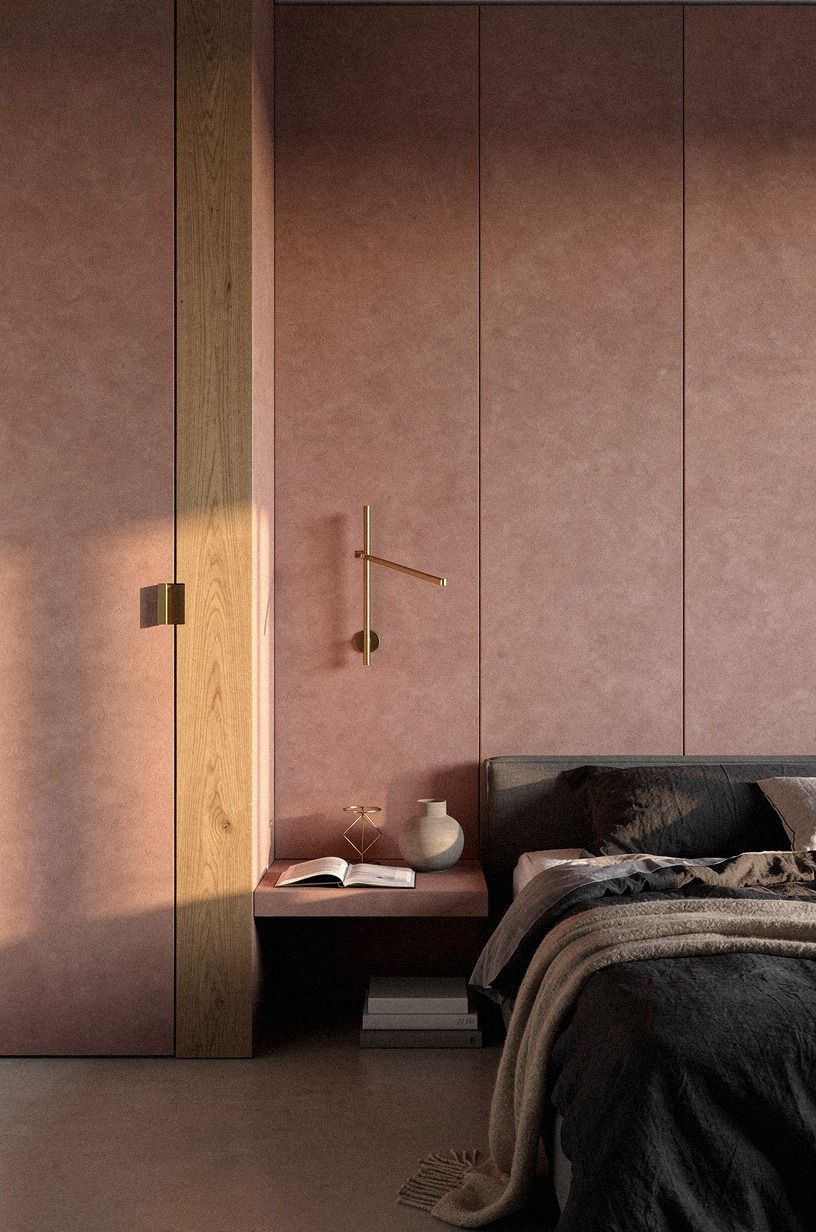
Push-latch panels are one of the easiest ways to make storage disappear, especially when your room already leans minimal. No knobs.
No finger pulls. Just flat doors painted to match the wall so the wardrobe reads as surface, not object.
This is where The Quiet Hardware Rule matters. If you’re using a dusty rose Venetian plaster wall, paint the wardrobe fronts the same color and keep the sheen level matched too. A matte face beside a satin wall will still flash at the joints.
I’d rather see a simple push latch behind Farrow & Ball All White No.2005 in a bright room or a clay pink plaster in a moodier one than any decorative pull pretending to be subtle. Farrow & Ball All White No.2005 reads cleaner than builder white because the pigment carries a touch of warmth, which is why it disappears instead of shouting.
But check the latch pressure before you commit. If it takes a hard push, you’ll resent it every morning.
Ask me how I know. I also like comparing push-latch walls to full-span media walls that hide openings cleanly because the geometry issues show up the same way.
8Cover door gaps with vertical oak slats
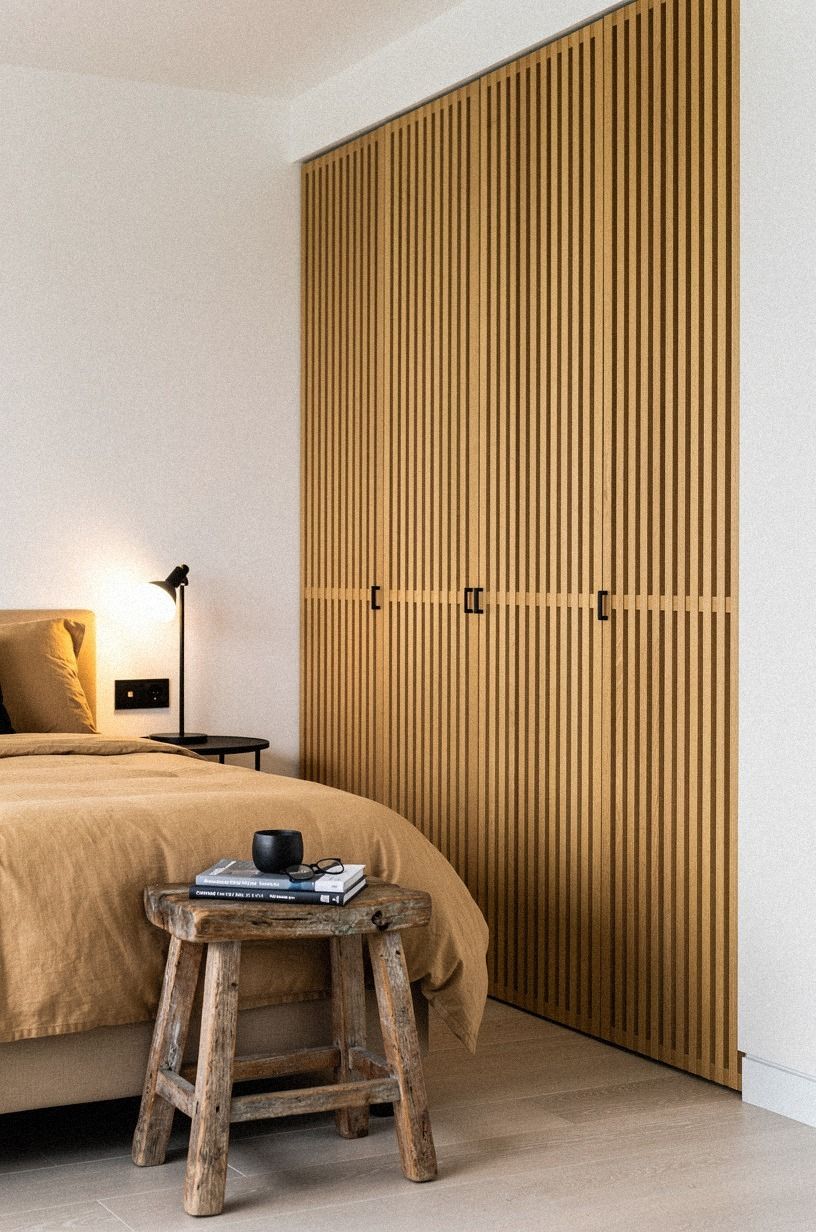
Vertical slats do more than hide the door lines.
9Run picture-frame molding across every wardrobe joint
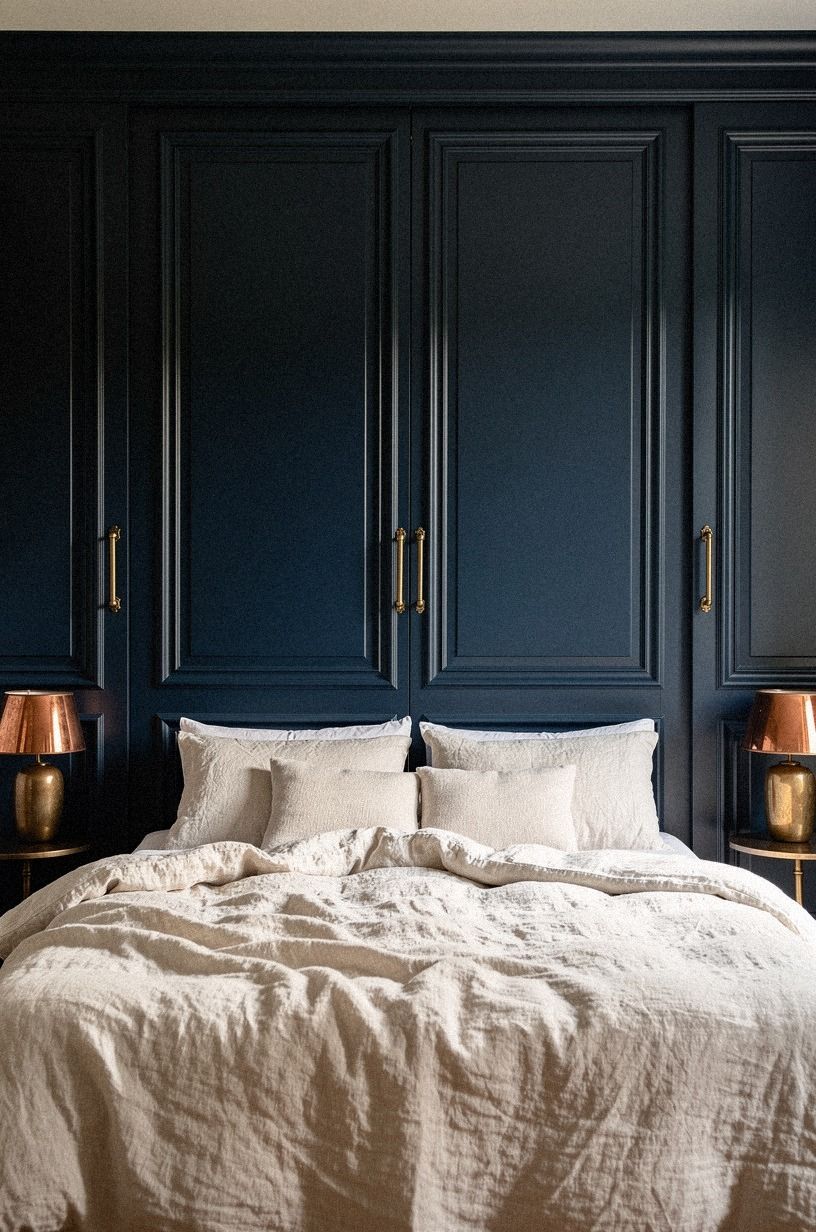
If your bedroom leans classic, picture-frame molding is the cleanest way to disguise doors without pretending the room is modern. Carry the same picture-frame pattern across fixed wall sections and door leaves so the whole wardrobe run reads like intentional paneling. That’s how you get charm without visual clutter.
A low-angle view tells the truth on this move. If the joints break the rectangles, you’ll see it right away, so map the doors first and the molding second.
I’d rather simplify the pattern than force one more narrow panel that throws the rhythm off. In cream or pale sage rooms, Benjamin Moore Pale Oak OC-20 under crisp molding gives you depth without the chilly cast of plain builder white.
And if you’re weighing paneling styles, this concealed wall panel door article is the one I’d read before ordering trim. Good proportions are doing the heavy lifting here.
10Install mirror slabs that read as wall panels
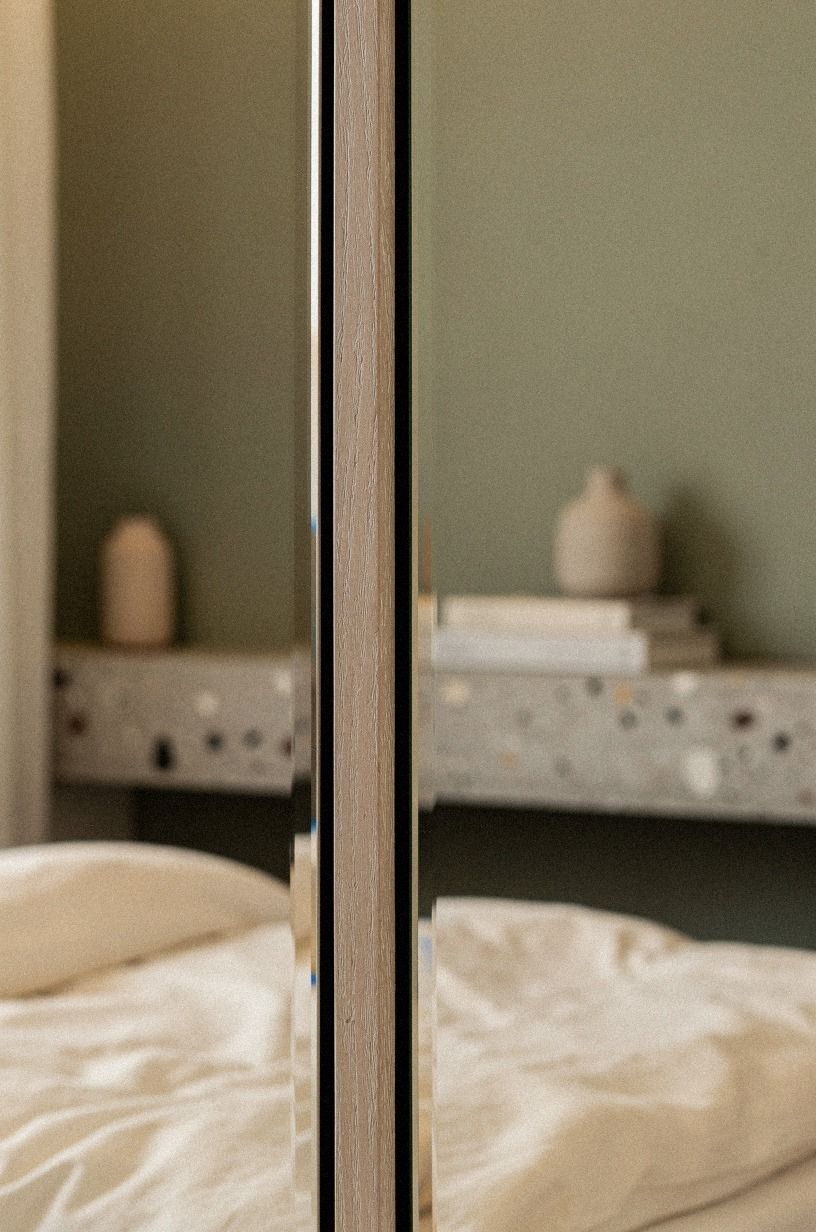
Mirror slabs work when you treat them like architecture, not closet showroom doors. Use large quiet pieces with slim seams so the reflection feels like part of the wall plane. If the mirrors come chopped into tiny framed panels, the room starts looking like a dressing room from 2007, and you don’t want that.
In a room with sage walls, cream bedding, and cerused oak, a near-seamless mirrored slab reflects light back into the bed zone without making the storage scream for attention. Go for a thin safety-backed mirror panel and keep the vertical seam narrow.
The reflected bedding should feel soft, not busy. For a 7-foot run you’ll typically land around $250 to $600 installed, depending on whether you go custom or prefab.
But I’d only use this on one run, never the whole room. Too much mirror makes you aware of every object you forgot to put away, and that defeats the calmer wall you came here for. For another example of a reflective surface staying controlled instead of flashy, I like revisiting concealed doors built into paneled walls.
11Frame bedside niches inside the hidden wardrobe run
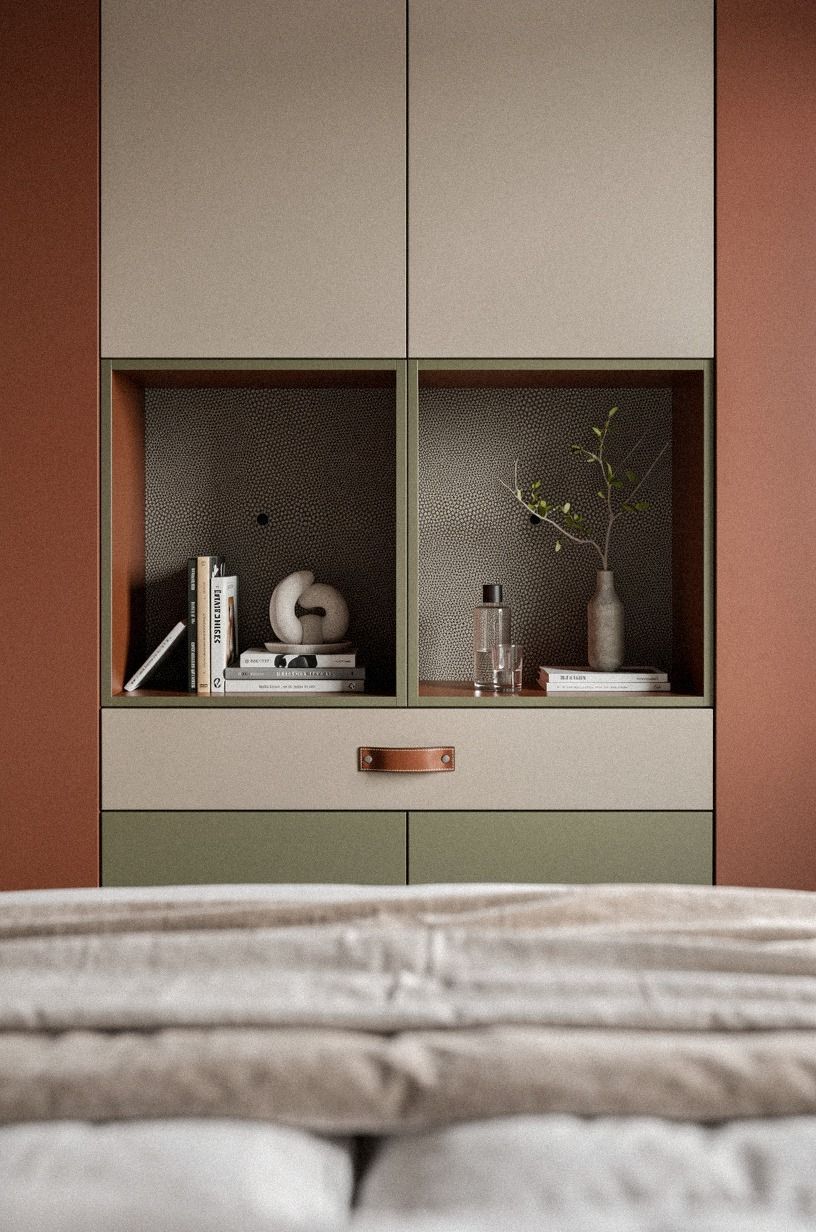
Built-in bedside niches are one of those ideas that sound custom because they are.
12Tuck labeled organizers behind seamless pocket doors
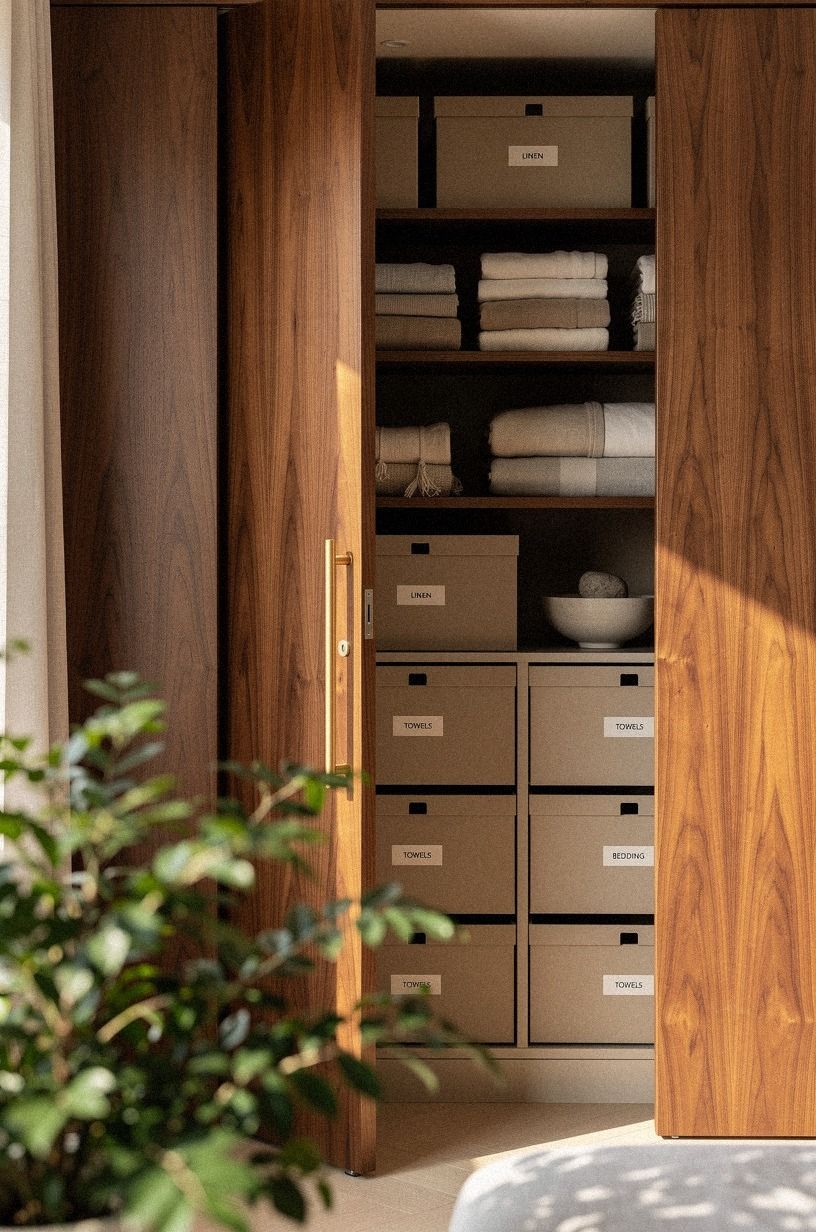
The best hidden wardrobes don’t just look calm from outside. They also stay usable inside, which is why pocket doors are so good in tight bedrooms. You open the run, the doors slide out of your way, and suddenly you can see your storage without another panel swinging into the room.
Inside, keep the organization clay-toned and simple. Folded textiles. Plain bins.
Soft boxes. A set of velvet hangers usually lands around $20 to $60 per set, and that small upgrade makes the inside look less frantic right away.
If you’re working with standard closet dimensions, 14-inch shelf depth is a reliable target, and double-hang rods at 42 inches and 84 inches keep everyday clothes easier to reach.
I’d skip clear plastic tubs if the closet opens onto the bed wall. You may think no one sees them, but you do.
And that visual noise leaks into the room every time the doors slide back. If you need help thinking in zones first, this four-zone wall system article is oddly useful for closet planning too.
13Light the toe-kick below invisible wardrobe fronts
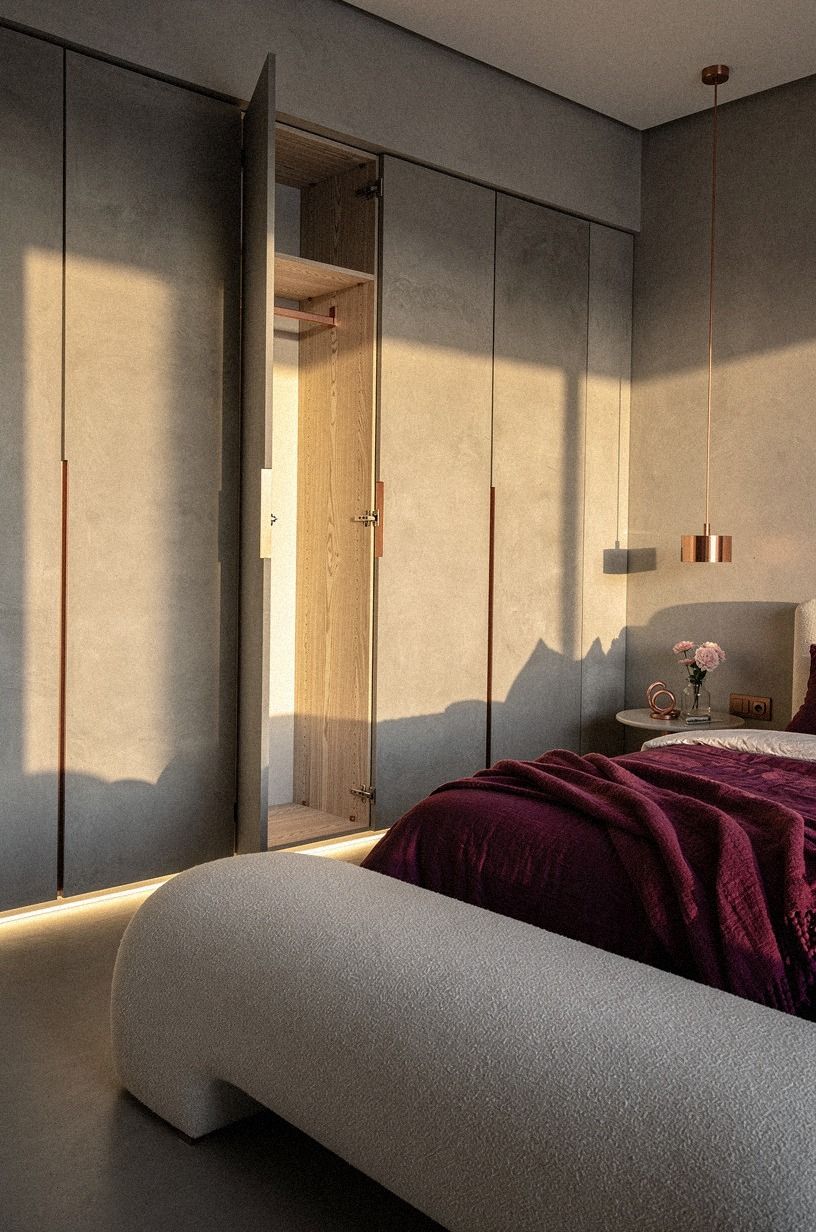
Toe-kick lighting is one of the few decorative moves here that also helps function. A soft strip under the wardrobe makes the run feel lighter, almost as if it floats a little above the floor, and it gives you just enough glow for early mornings without blasting the overhead.
In an asymmetrical wall layout, that low line of light helps the long wardrobe run feel intentional instead of bulky. Use warm LED rod or strip lighting, typically about $30 to $150 depending on the system, and keep it dim. You want a wash, not a runway.
In a room with navy, white, and oak, the amber edge under LED toe-kick lighting is what makes the built-in feel finished.
And yes, you’ll notice the difference every night. It’s one of those little upgrades that makes the whole wall look more expensive than it was!
14Finish with handle-free minimalist closet panels
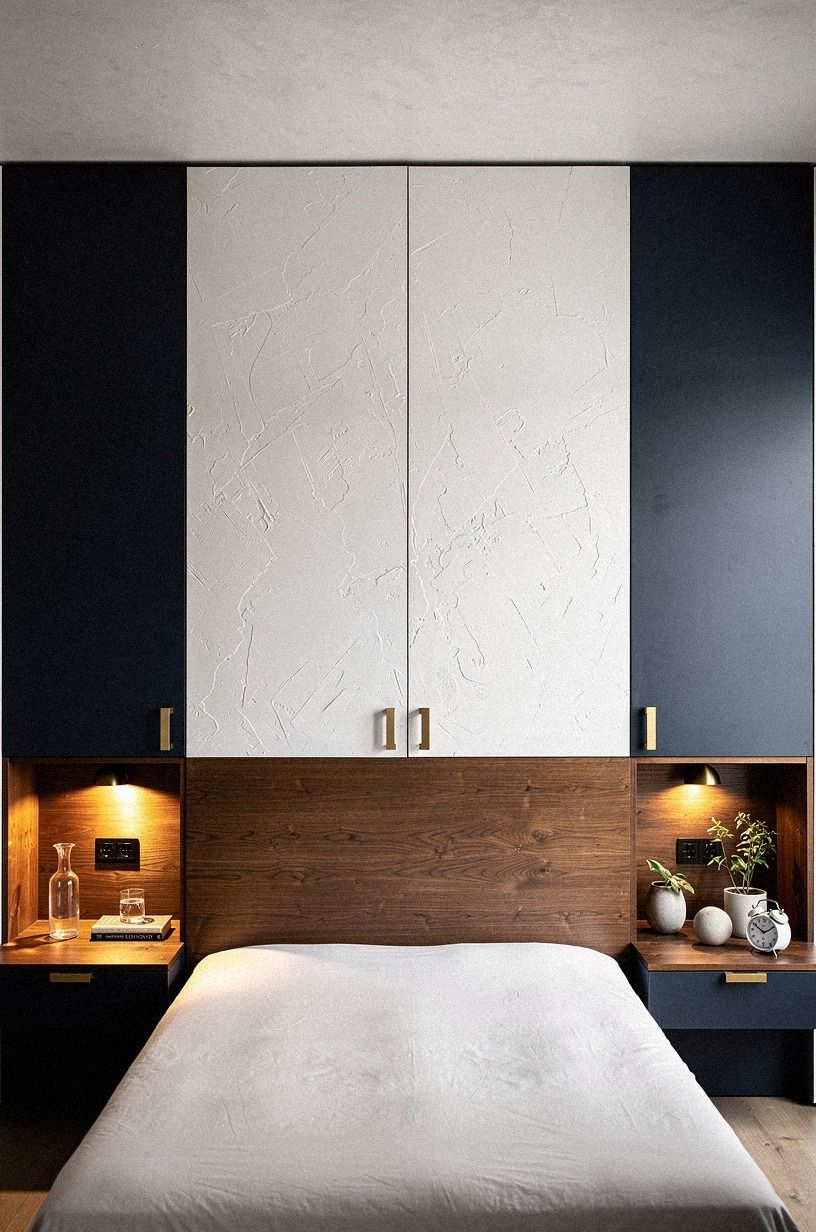
Handle-free panels are where you land when the goal is a bedroom wall that reads clean from the doorway all the way to the bed. No knobs interrupting the symmetry.
No pulls catching light. Just a controlled plane that lets the bedding, art, and one good wood tone do the talking.
If your room is navy, white, and walnut, keep the wardrobe fronts matte and the reveals tight. A run of flat walnut veneer panels can look rich without feeling heavy if the rest of the room stays spare. And if you’re planning the interior from scratch, a comfortable closet footprint often starts around 6×8 feet, with 4×4 feet as a bare minimum, which tells you how ruthless you need to be about what belongs behind these doors.
Look at the wall straight on before you call it done. If one reveal is wider, you’ll see it every time you walk in.
That’s the kind of tiny miss that nags forever. I double-check symmetry the same way I would after reading this full concealed wall breakdown.
15Try an IKEA PAX base hidden behind custom fronts
If you want the calm look without the custom-millwork invoice, start with an IKEA PAX frame and put the budget into the doors, not the box. The carcasses are predictable, the hardware is forgiving, and you can swap the fronts later without rebuilding the inside. A standard 39-inch-wide PAX pair lands around $300 to $500 before fronts, and you’ll spend another $150 to $400 per door on flat panels cut to size.
I’d rather see a hidden PAX than a loud custom carcass with cheap doors. The bones don’t show.
The faces do. So invest where the eye lands and keep the mechanical stuff invisible. The same trick shows up all over concealed bathroom wall storage, where prefab frames disappear behind custom faces and nobody talks about the brand.
What makes this move work is patience with reveals. Cut each door a hair proud, sand to fit, then check the wall straight on before locking the hinges. That’s the boring part that decides whether the room looks built or assembled.
16What about West Elm vs CB2 for high-end flat panels?
If you’re going premium, the wardrobe front is where West Elm and CB2 differ in ways that matter.
17Hide the seams with Sherwin-Williams Urbane Bronze trim
When wood alone can’t quite kill the joints, Sherwin-Williams Urbane Bronze SW 7048 trim at the reveal line reads as intentional detail instead of a missed seam. It’s the move you reach for when you want the doors to feel framed rather than blended. Think of it as jewelry on the wall, not paint on the wall.
Use it sparingly. A 1/2-inch trim line at every reveal, matched end panels, and that’s it. Too much bronze and the wall becomes decorative instead of calm.
In a room with cream walls, olive bedding, and aged brass lamps, the bronze picks up the warm metal without fighting the linen. It also photographs beautifully in low light, which matters if you’re styling the bed wall for an evening mood.
The same trick shows up in concealed panel door millwork, where a thin metal reveal is the secret to making a hidden door read intentional instead of missing. You don’t need much. You need the right line.
What things cost before you commit with The Inside-First Rule
If you’re trying to decide whether you should do paint, modular storage, or full custom millwork, use the ranges below as honest planning numbers. I always tell people to spend for the surface only after the inside works, because a gorgeous hidden door is useless if the storage behind it still wastes space.
For a bedroom-scale setup, you probably won’t use every single one of those components. But the table helps you see where the money goes: interior organization first, finish layers second, and custom veneer last. If you want a deeper breakdown of how wall systems break down by tier, this concealed wall zoning guide goes further.
Why The Calm Wall Rule keeps working
I’ve gone back and forth on hidden wardrobes because the idea can get precious fast. Some rooms look so committed to the vanish act that they start feeling stiff, like nobody’s allowed to toss a sweater on the chair.
The version that works is simpler than that. Your bedroom isn’t a showroom.
It’s the room where you wake up, drop a book, miss the hamper, and want things to still feel settled by night.
What I keep learning is that the clean wall matters less as a look and more as a relief. When the wardrobe face stops shouting, the bed finally gets to be the focal point. The light lands better.
Your paint color reads truer. Even a plain duvet looks more considered because it isn’t fighting a stack of mirrored doors, louvers, shiny pulls, and random trim profiles. That’s why I push people toward one continuous language: one oak tone, one paint finish, one hardware idea, one rhythm.
More options aren’t always more freedom. Sometimes they’re just more cleanup for your eye.
And here’s the honest money piece. I’d spend for alignment before I spent for luxury veneer.
Flush fronts, good reveals, and the right layout do more for a room than expensive handles ever will. I learned that the annoying way after paying extra for fancy pulls on a closet that still looked busy because the panel lines were wrong.
If you’ve got a limited budget, fix the geometry. If you’ve got more room to spend, then go after the material richness.
That’s the order. Every single time!
The Questions Worth Answering First
What is the best Hidden Wardrobe Door Ideas for a Clean Bedroom Wall for a small bedroom?
Full-height flush panels are usually the best move in a small bedroom because they keep the wall reading as one plane. I like a slim IKEA PAX base hidden behind painted doors or oak fronts, especially if your bed already sits close to the storage wall. If you want to see how the same trick plays out in a tighter footprint, hidden bathroom door ideas show the smaller-room logic well.
Where can I buy Hidden Wardrobe Door Ideas for a Clean Bedroom Wall pieces on a budget?
Start with IKEA, Target Threshold, and Wayfair because you can mix inexpensive inside parts with better-looking outer finishes. For cheaper upgrades, check Facebook Marketplace for flat-panel doors, then add paint, battens, or removable linen panels yourself. I also like browsing concealed wall-panel door examples before buying trim.
How much does a Hidden Wardrobe Door Ideas for a Clean Bedroom Wall makeover cost?
A simple version usually runs about $150 to $800, and that’s enough for rods, shelves, bins, and light. A bigger built-in style with drawers or modular parts often climbs to $2,000 to $6,000, while custom millwork sits much higher. The bigger line items are usually the doors themselves and any custom veneer.
Can I create a Hidden Wardrobe Door Ideas for a Clean Bedroom Wall on a budget?
Yes, and the cheapest wins are usually surface-level first. Paint your existing doors the wall color. Add linen on a ceiling track.
Swap to matching bins and velvet hangers so the inside looks calmer the minute you open it. A weekend and about $150 will surprise you.
Is a Hidden Wardrobe Door Ideas for a Clean Bedroom Wall worth it in a small space?
Yes, because small rooms benefit most from fewer visual breaks. When the wardrobe reads as wall, your bed and windows get more breathing room. Keep the tallest storage on one run and don’t scatter extra dressers across the other walls.
The same visual payoff shows up in concealed media walls.
Is Hidden Wardrobe Door Ideas for a Clean Bedroom Wall a good idea for a rental?
Yes, if you use reversible layers that hide the clutter without damaging the shell. Think tension-rod linen panels, removable battens over lightweight panels, peel-and-stick molding, and freestanding wardrobe interiors you can take with you later.
What’s the right door finish if my walls are Benjamin Moore Pale Oak OC-20?
Match the wall color exactly and stick with the same sheen, so the joint stops flashing. If you want a touch of definition instead of pure vanish, run a slim Sherwin-Williams Urbane Bronze SW 7048 reveal at each seam. It reads as detail, not error.
Where I’d Start First with The Height-First Rule
If I had to pick one step, I’d start with full-height wall-matched doors. Bad proportions keep announcing themselves no matter how nice the finish is.
Get the height and the quiet surface right first, and every other layer lands more convincingly. You’ll save yourself from repainting trim three times.