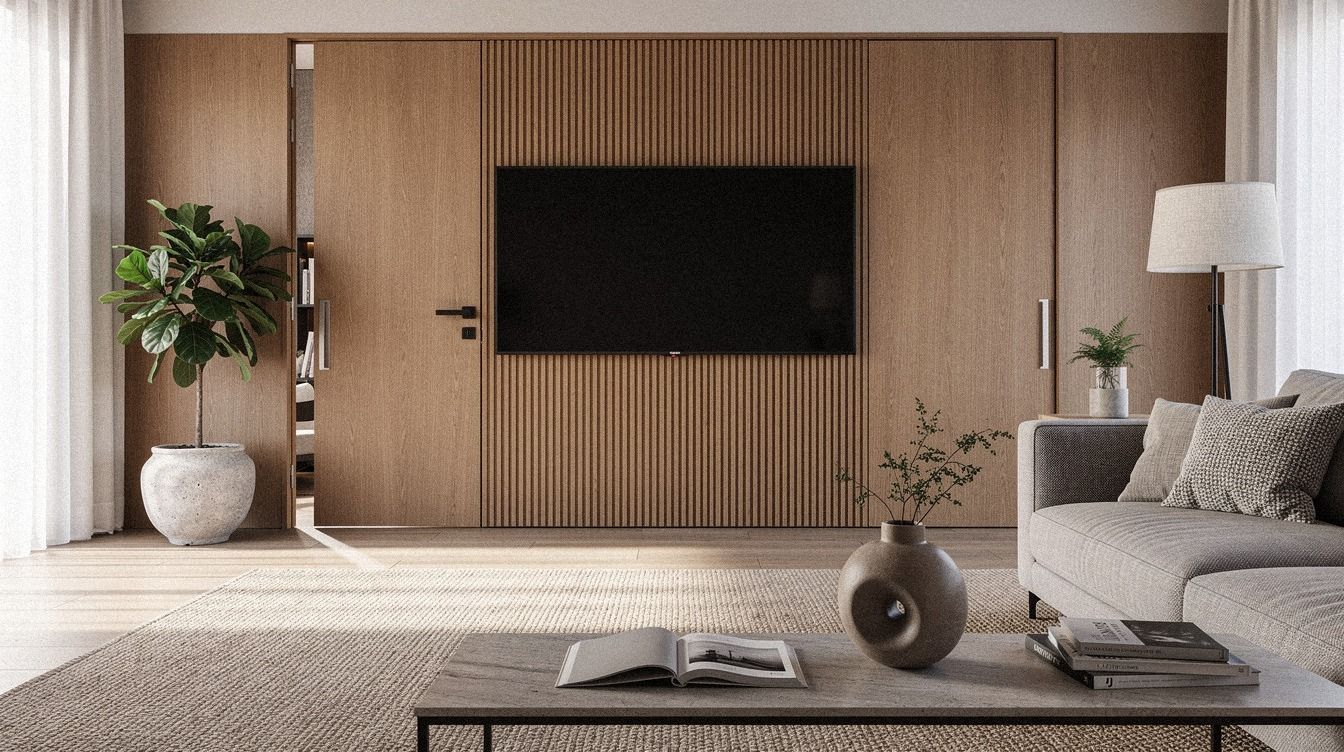
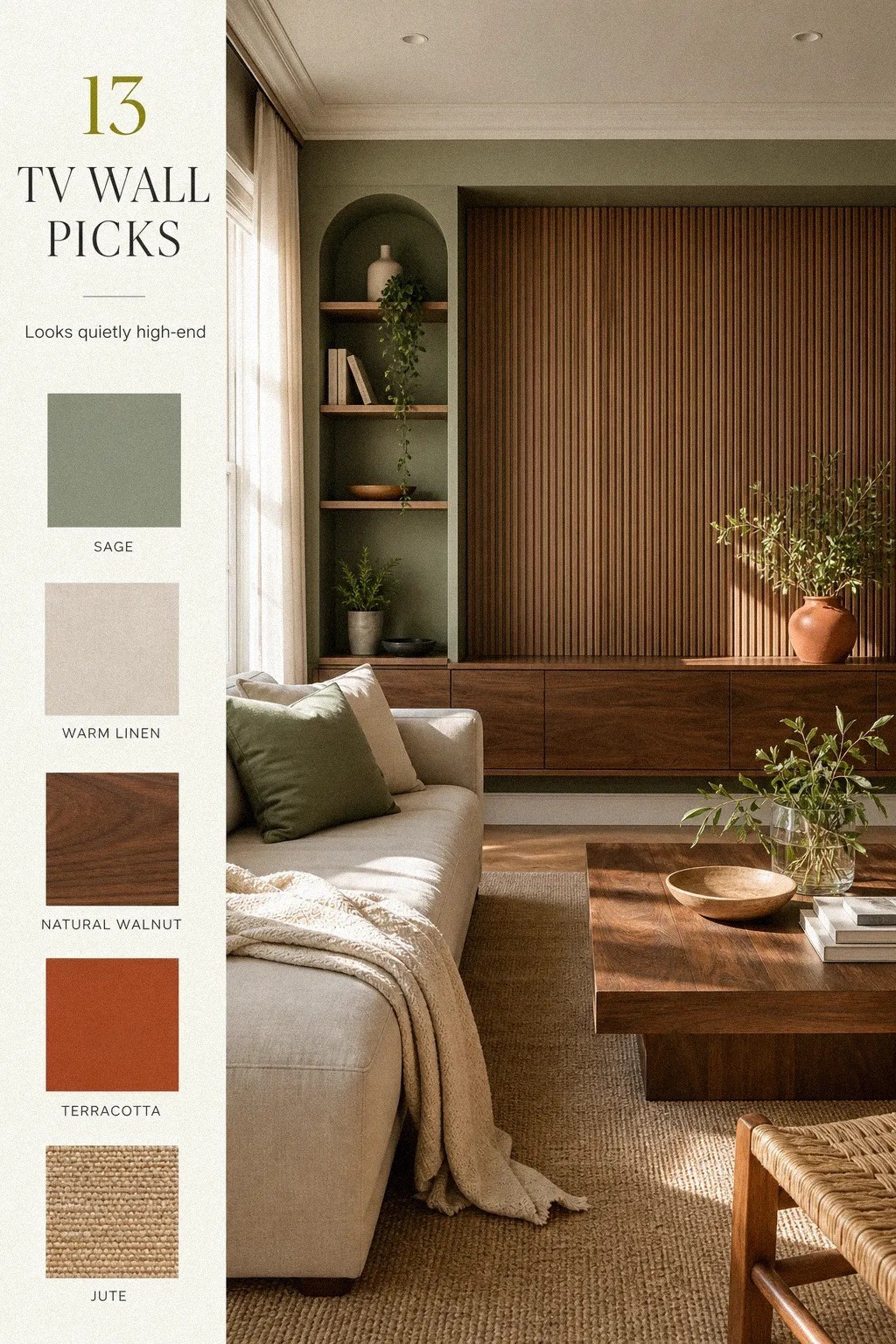
TV wall with hidden door ideas work best when you stop thinking about the door as a door and start treating it like architecture. I learned that the hard way after trying to outline one like a feature, which only made the seam louder. If you want to conceal a whole room, the win isn’t gimmickry. It’s matching grain, shadow, scale, and the stuff your eye notices before your brain does.
- Conceal the TV wall with fluted panels
- Frame the hidden door inside walnut millwork
- Blend a push-latch door behind shelving
- Run vertical slats across the doorway
- Wrap the media wall in painted molding
- Hide the passage behind bookmatched veneer
- Mount the TV on a pivot panel
- Camouflage the seam with picture-frame trim
- Build a fireplace wall with detail access
- Use reeded glass beside the TV niche
- Continue stone cladding over the door
- Design a gallery wall across the opening
- Tuck the door into a built-in console
1Conceal the TV wall with fluted panels
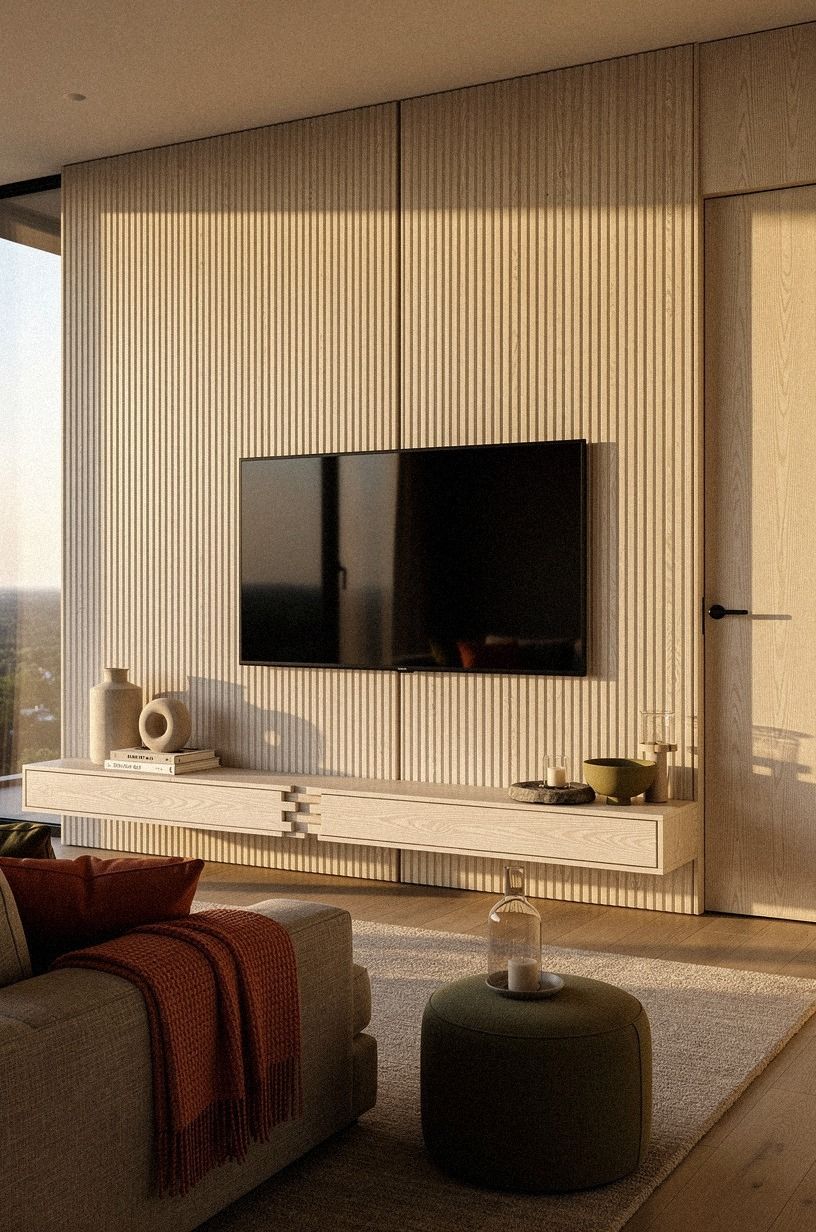
Start with full-height fluting if you want a tv wall with door that reads restrained from across the room. In the photo, the cerused white oak panels run wide across the whole living room wall, so your eye lands on rhythm first and the hidden opening second.
That’s the move. I wouldn’t stop the fluting at the jamb, either, because the interruption is what gives the passage away.
Keep your panel spacing steady from console to ceiling, then let the TV sit inside a recess that feels planned rather than pasted on. A low white oak media console with a visible dovetail corner helps the wall feel built, not bought.
If your sofa sits 8 to 10 feet back, remember the usual viewing rule of about 1.5 to 2.5 times the screen diagonal so the paneling doesn’t do more work than the television. And if you’re comparing panel layouts, this hidden door in wall paneling guide shows why continuous lines matter so much.
Typical cost by tier (US averages):
2Frame the hidden door inside walnut millwork
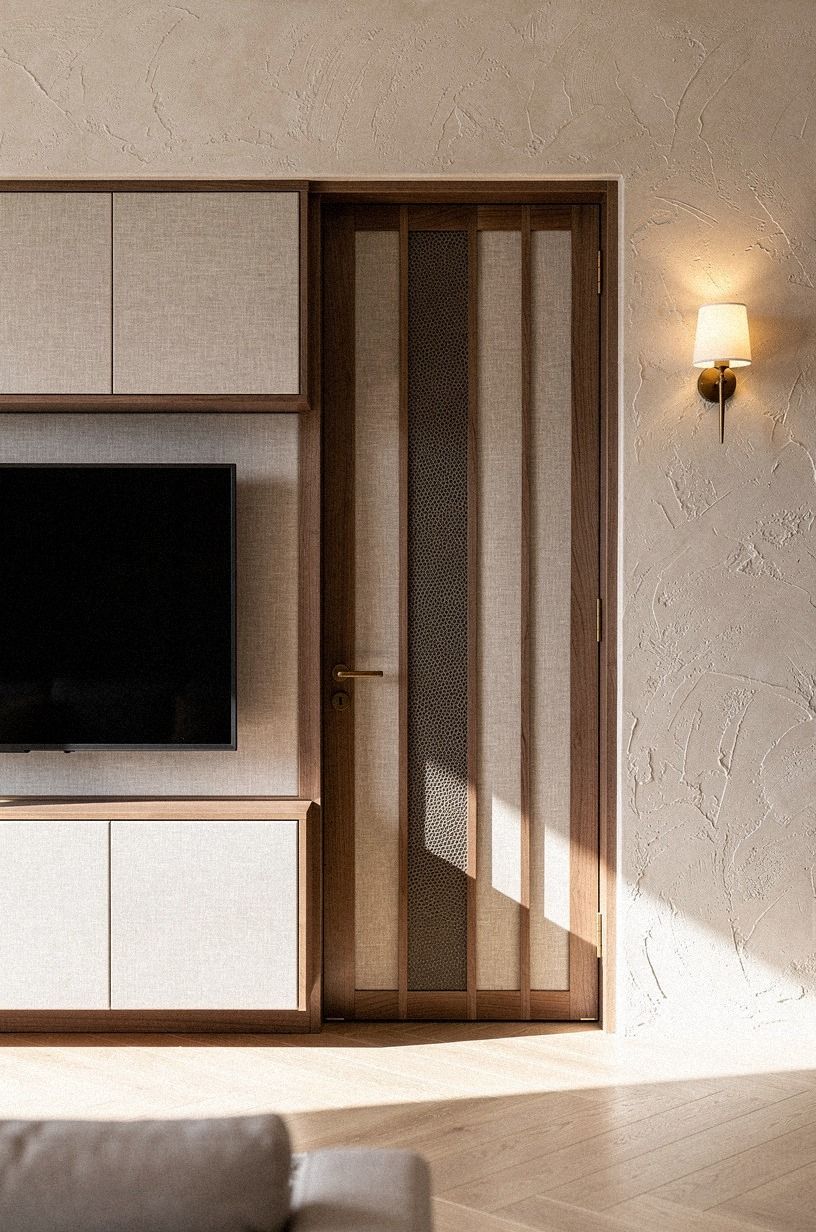
Go darker when you want the door line to disappear into shadow. A media wall with door framed in walnut millwork can hide a lot because the rails, reveals, and grain already give your eye several places to look. You don’t need a dramatic outline.
You need control.
I like this route when the room already has clay, linen, and brass in it, because the brown reads settled instead of heavy. Use one walnut tone across the face frames, the door slab, and the TV surround, then keep the hardware invisible with a push latch.
A hand-troweled plaster back panel softens all that wood, and a touch of aged brass on nearby shelves is enough to tone it without turning the passage into a focal point. If you want a softer companion palette, this living room paint color guide helps you keep the wall rich without making it gloomy.
But keep the reveal tight, around one-eighth inch if you can, or you’ll see the perimeter every time afternoon light skims the wall.
3Blend a push-latch door behind shelving
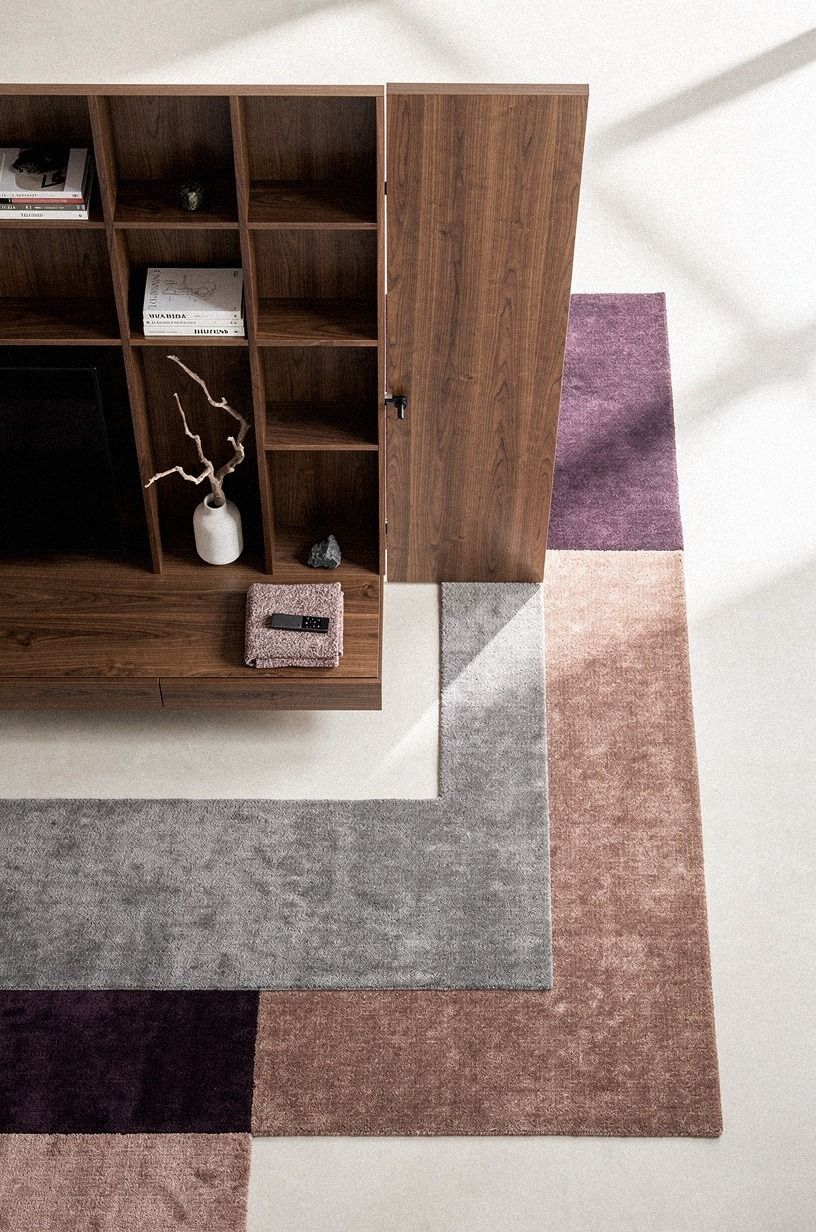
Shelving is the easiest way to make a wood accent wall hidden door feel earned, because shelves already create shadow lines and visual breaks. In the image, the book-matched walnut shelving wraps the media zone while the push-latch panel hides in plain sight.
That’s smart. Your eye reads objects and balance before it reads access.
You do have to edit the shelves, though. Too many objects and the door feels theatrical.
Too few and the seam becomes obvious. I aim for a low stack of books, one hand-hammered copper bowl, a matte ceramic, and some breathing room, especially if your rug is already doing color work in plum and gray. If you want more guidance on concealment by repetition, I keep coming back to this wall paneling door approach because it proves the same principle in a cleaner format.
If you’re hiding a whole nook rather than a full room, these compact hidden room ideas show how shelf styling can make a compact opening feel intentional and inviting. And yes, push latches are worth it!
4Run vertical slats across the doorway
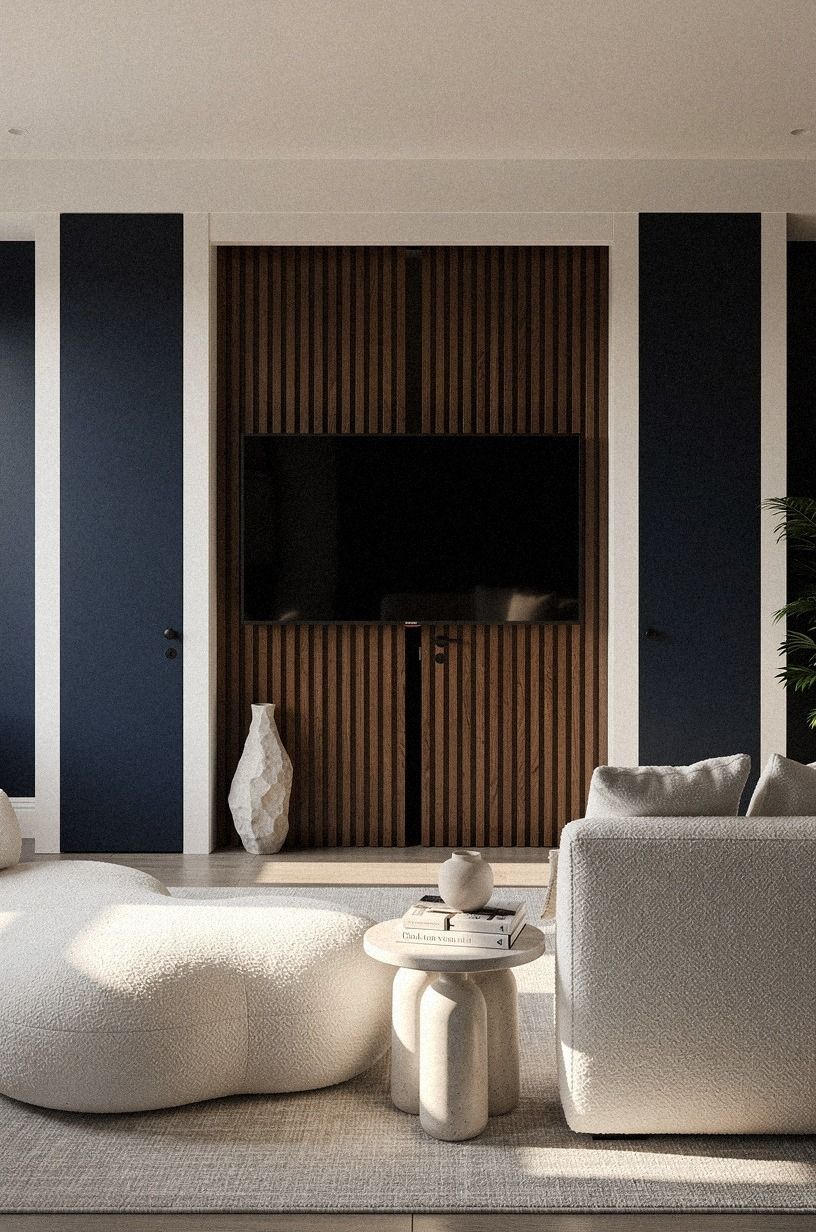
Vertical slats are great when your room needs height as much as concealment. They give a plain media wall a sharper, more tailored rhythm, and they make the doorway seam feel like part of the pattern instead of a mistake. The effect is crisp, calm, and quietly dramatic.
Use a narrow, consistent slat profile and keep the spacing identical on the fixed wall and the door panel. I wouldn’t mix two wood tones here.
One walnut slat finish against a navy-and-white room is plenty, especially with boucle lounge chairs and linen nearby to keep the wall from feeling too hard. You can even hide acoustic treatment behind the slats if your TV area echoes. But the slats need a clean stop at the baseboard and crown or the illusion falls apart fast.
Want a second version of the same move? This hidden door in wall paneling story shows why repeated vertical lines are so persuasive.
5Wrap the media wall in painted molding
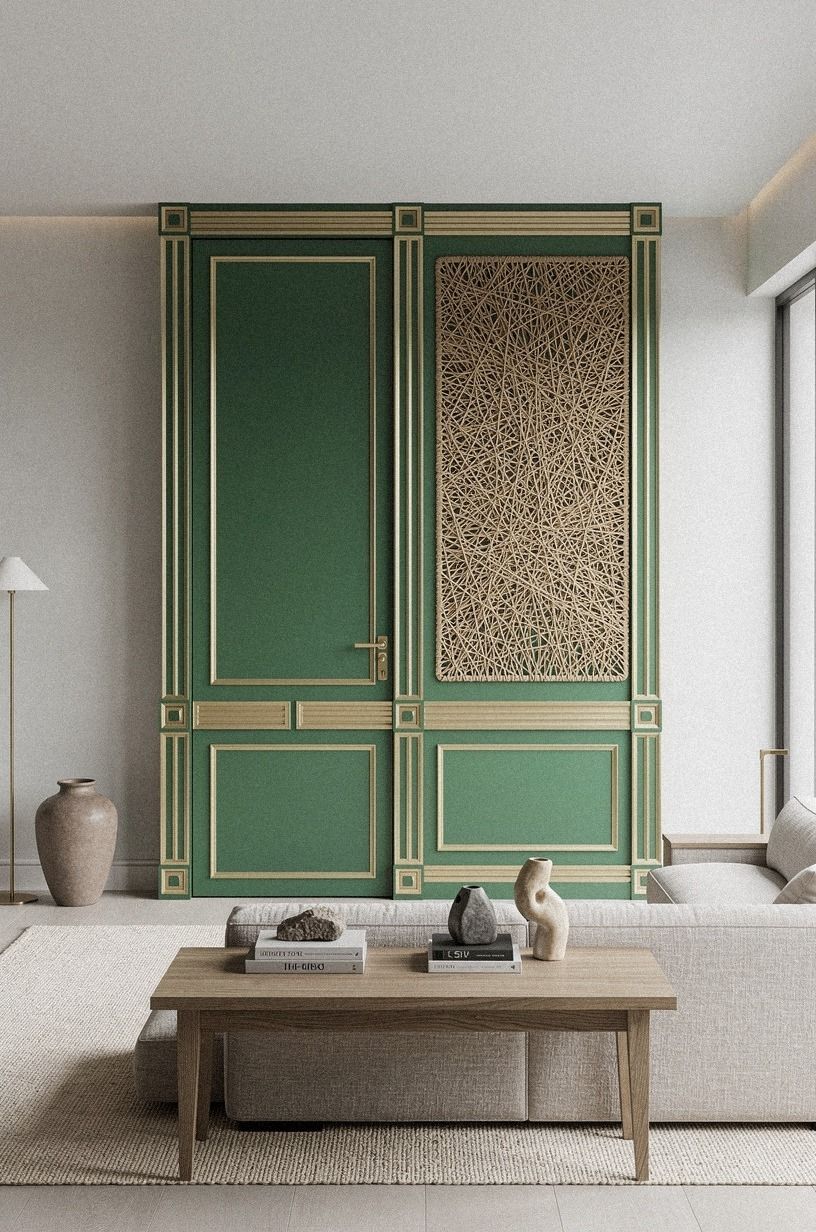
Painted molding works when you want charm instead of sleekness. The framed wall in this room uses emerald, gold, and cream, with the door disguised as just another paneled section around the TV niche.
It reads refined instead of busy. That’s why it feels calm.
You’re reading proportion, not a slab.
For a tv wall with door design like this, pick one wall color and let the molding do the patterning. Sherwin-Williams Evergreen Fog SW 9130 is softer than a flat dark green, while Benjamin Moore Revere Pewter HC-172 keeps trim from looking chalky if you want the room warmer. I like a satin finish on the trim and eggshell on the field so you get a little shift without making the seam flash under light.
If your seating area uses a sofa around 35 to 40 inches deep and a 9×12 rug with front legs on, this kind of detailed wall can still feel airy because the furniture footprint stays grounded. For more color layering, this painted one-wall living room article is a helpful companion.
6Hide the passage behind bookmatched veneer
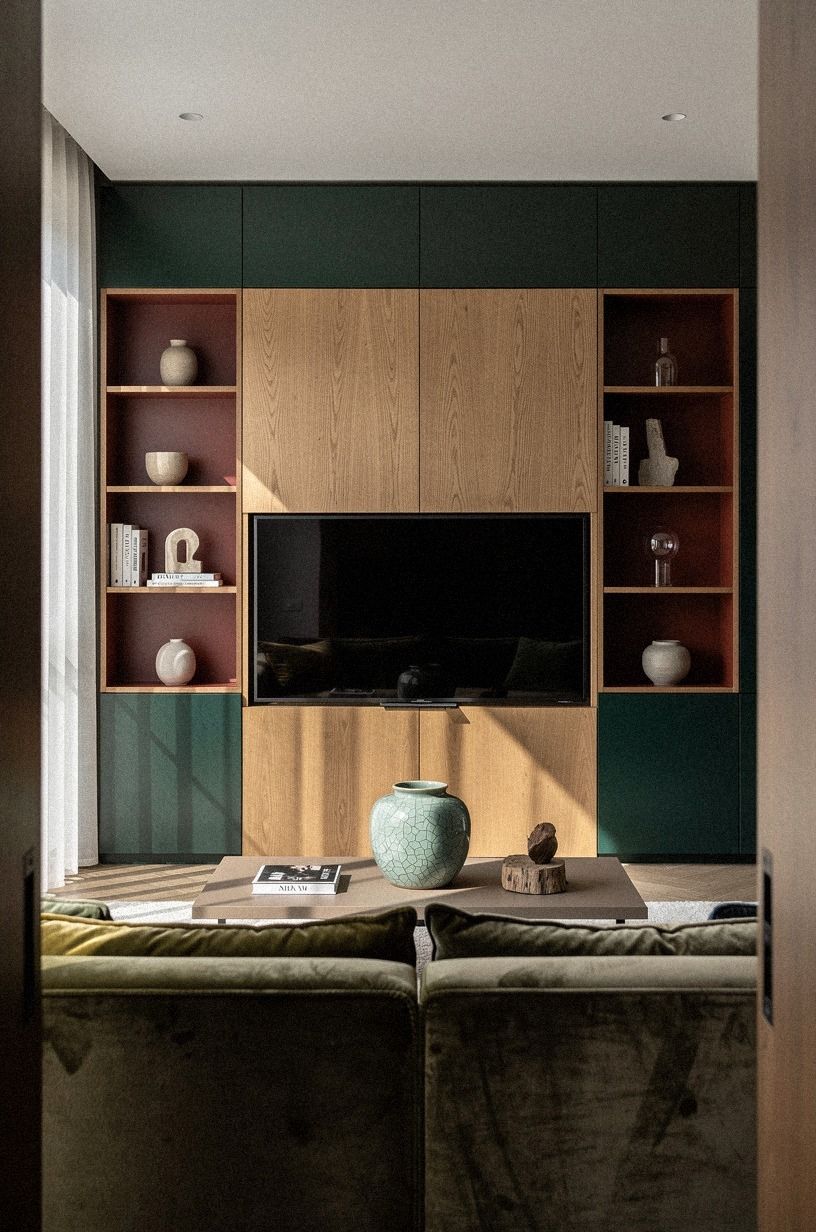
This is the version I’d choose if you want the whole room to feel custom. A tv wall with door design wrapped in bookmatched veneer doesn’t just hide the opening. It gives you a focal point with a built-in center line, which means the door can disappear off to one side while the mirrored grain steals all the attention.
The photo leans into forest green, rust, and natural oak, and that palette helps a lot because it makes the veneer feel expensive instead of glossy. The whole mix feels rich, moody, and tactile.
I like pairing a wall like this with one tactile counterpoint, maybe mohair velvet seating or a cracked ceramic vessel, so the wood doesn’t read too perfect. But you should ask the millworker to lay out the veneer sequence before fabrication, because a bad mirror match is impossible to ignore once it’s installed.
And if you’re still deciding between painted paneling and wood, I wrote about visual expansion in this one-wall paint story that helps clarify what color can and can’t do on its own. If your hidden opening leads to a den or reading hideout, these closet hideout planning ideas are useful for the inside finish.
It’s a small planning step, but it saves a huge amount of regret later!
7Mount the TV on a pivot panel
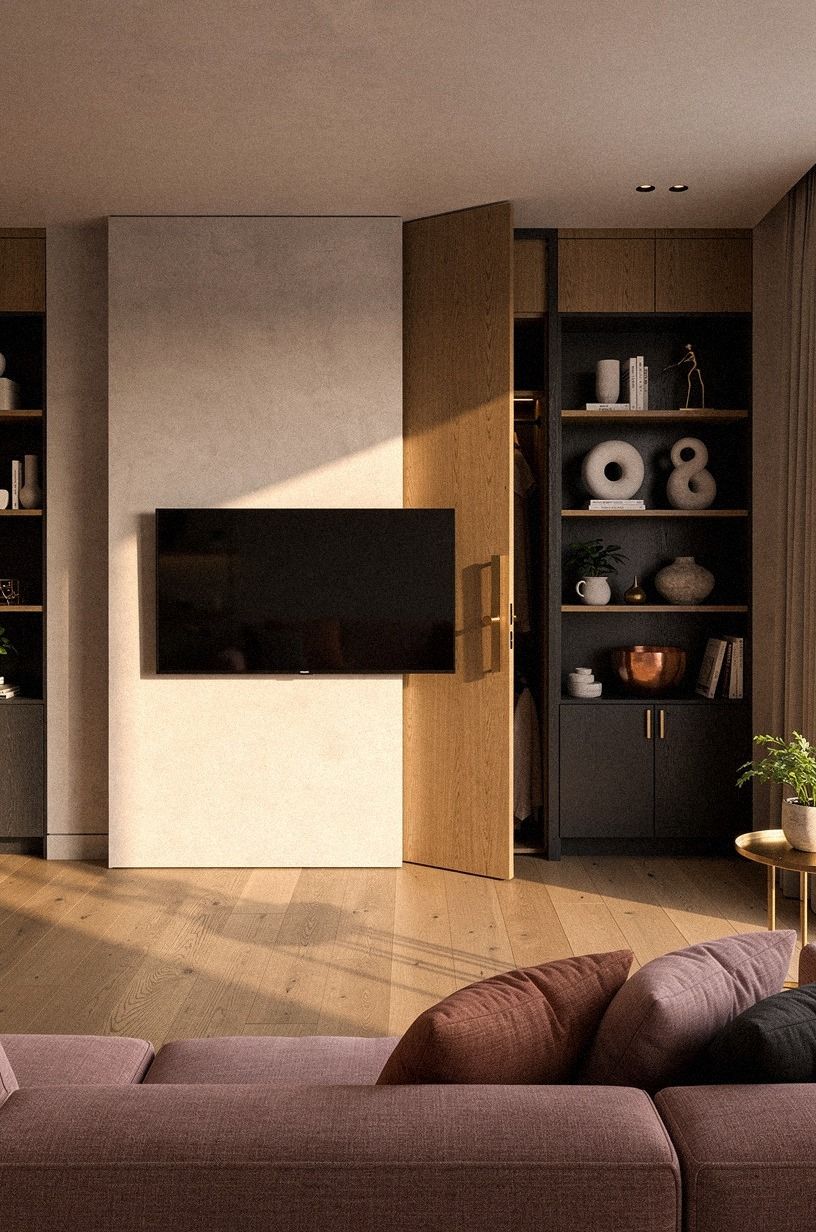
Want the whole entrance to vanish until movie time is over? A pivot panel is the high-drama answer, but only if you keep the face simple. In the room shown, the TV mounts to a panel that swings away from the opening, with Venetian plaster and oak grain doing the visual work around it.
I love this for a concealed whole-room entry because the mechanism solves two jobs at once. You hide the doorway, and you keep the screen from becoming a black rectangle at every angle.
But you need to budget for the hardware and cable management early, because retrofitting a pivot after drywall is where these ideas go sideways. Use a finish like dusty rose, charcoal, or plaster on the surrounding wall, then let one oak pivot face be the hero.
If you’re planning more than one hidden opening in the house, this door-that-vanishes guide is a smart starting point.
8Camouflage the seam with picture-frame trim
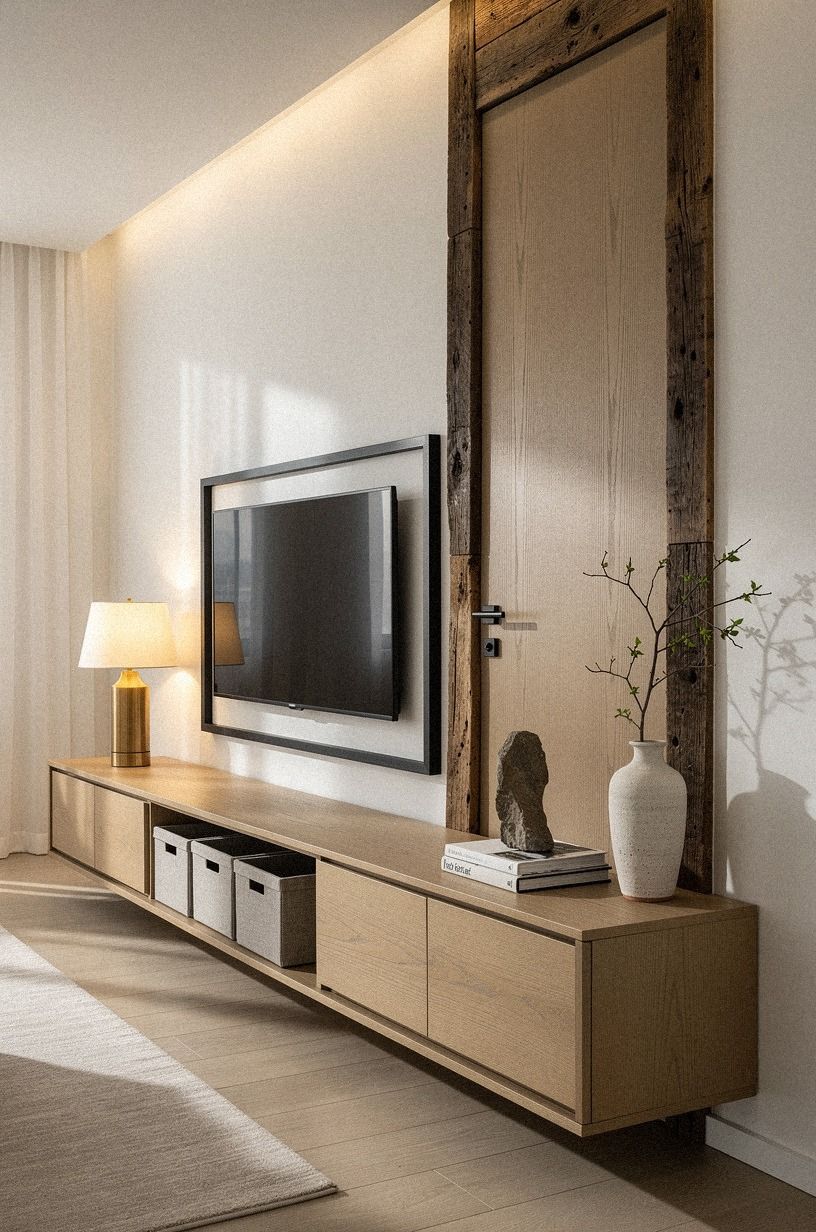
Picture-frame trim is the answer when you need concealment but don’t want a full millwork budget. In this living room, the media wall sits off to one side, and the trim grids break up the surface enough that the hidden seam stops reading like a door line. It’s a smart renter-friendly visual strategy if you adapt it with removable molding.
The finished look can feel polished and surprisingly elegant.
The key is to let the trim cross the seam instead of outlining it. Use reclaimed teak toned trim, or a painted version if your room already leans warm white and camel, then keep the TV centered inside the largest frame so the geometry feels intentional.
I wouldn’t go too ornate. Simple rectangles look richer beside a black screen.
And this is where color matters more than people expect, and this boho living room paint piece is useful if you’re trying to decide whether the trim should blend or contrast. If you want the same logic applied to an even smaller opening, look at these under-stairs hidden room ideas.
9Build a fireplace wall with detail access
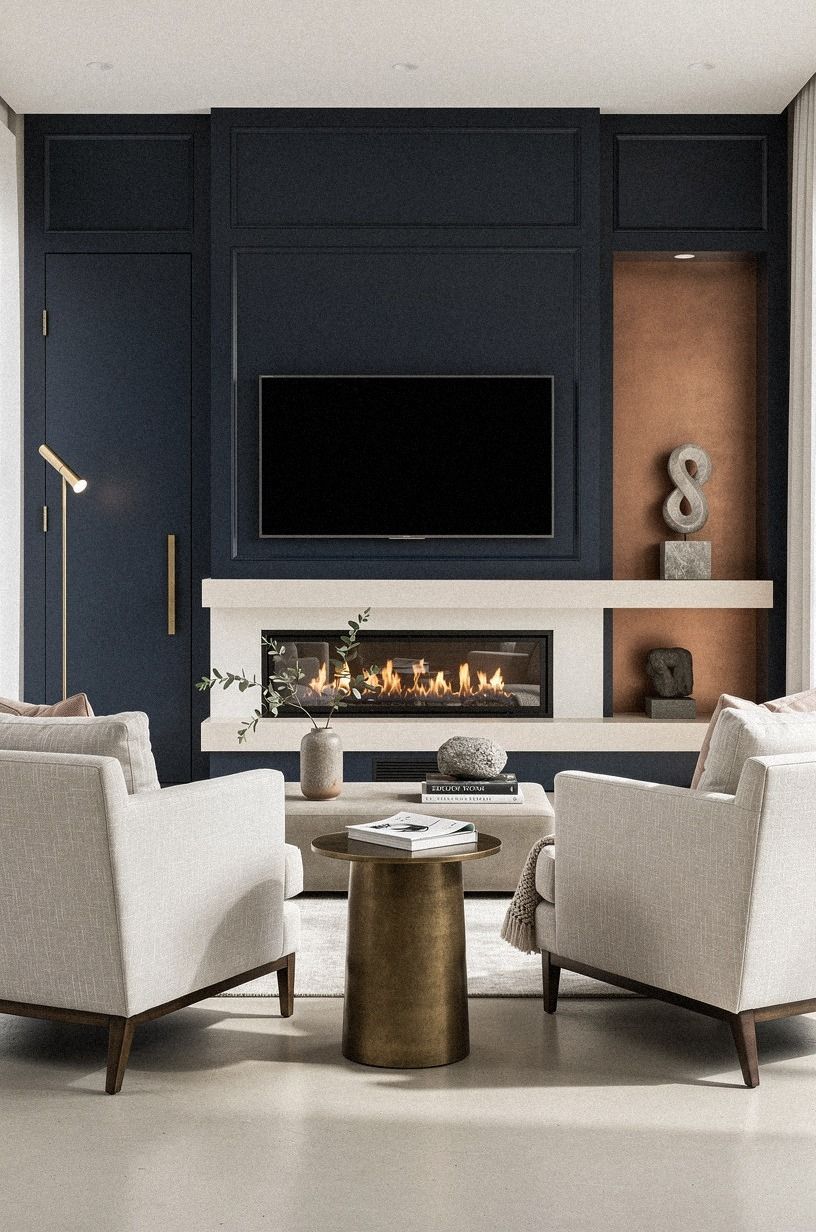
A fireplace wall can hide a passage beautifully because the surround already asks for symmetry, depth, and a strong material story. That extra architecture gives you cover.
The hidden door stops feeling sneaky and starts reading like part of a substantial, polished composition. That’s the quiet luxury of this move.
I’d keep the fireplace finish bold and the access panel subdued. Think honed travertine or painted plaster at the center, then let the concealed side panel borrow the same mantel line, reveal depth, and base detail. If the room already has a generous rug and one sofa, a fireplace wall like this can carry the whole sightline without needing busy decor.
But don’t fake grandeur with cheap stone veneer cut into tiny pieces. Large formats feel calmer and much more convincing. For more on architectural concealment, this hidden wall paneling article is worth a look.
10Use reeded glass beside the TV niche
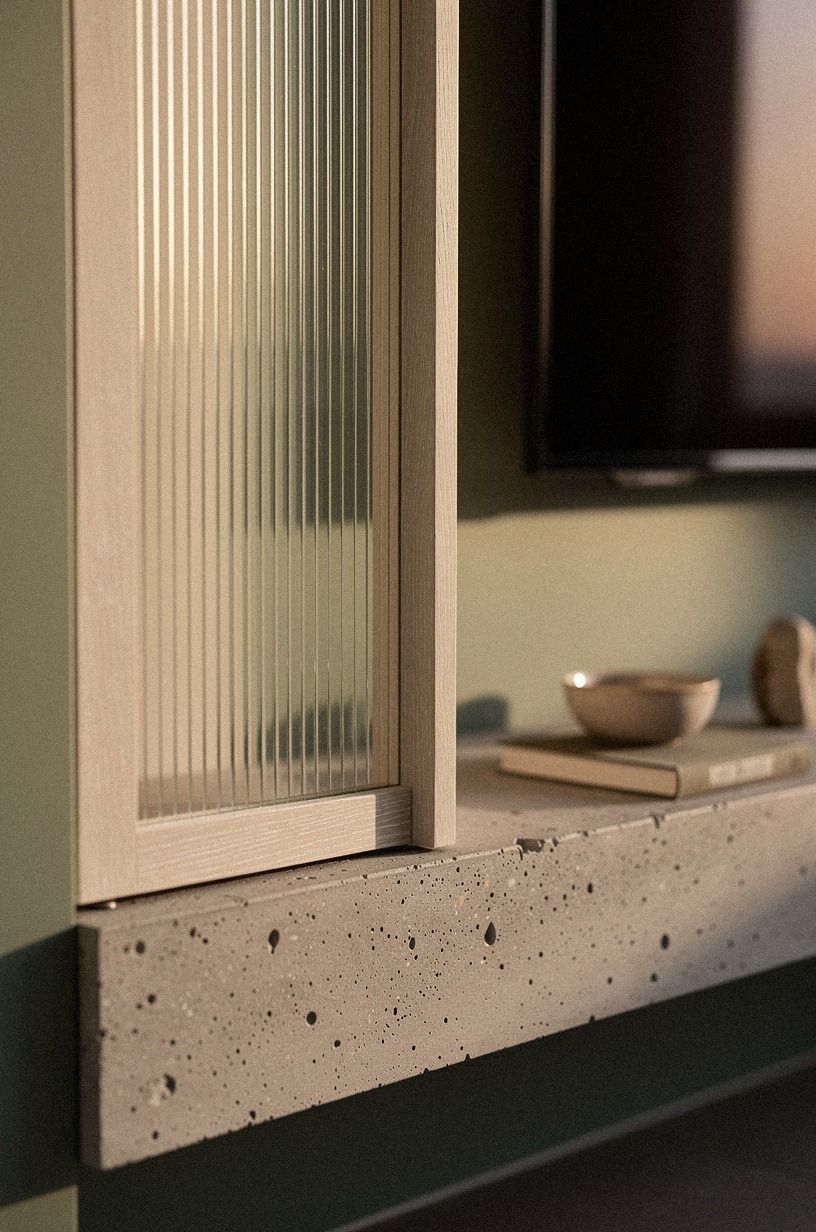
Reeded glass is one of those details that looks decorative but does real concealment work. Beside a TV niche, it breaks reflections, softens the edge of the opening, and gives you a reason for a vertical seam to exist. In the close-up photo, the ribbed glass and cerused white oak edge make the joinery feel delicate, luminous, and graceful instead of sneaky.
I wouldn’t use reeded glass across the whole opening unless privacy matters less than glow. One fixed or hinged panel beside the niche is usually enough.
Pair it with Sherwin-Williams Evergreen Fog SW 9130 or a cream wall so the ribbing catches light without reading icy. And if you add a shelf below, poured concrete with visible aggregate is a nice counterweight to all that linear wood.
But keep the lighting low. Cool bulbs turn ribbed glass office fast, and that’s exactly the mood you don’t want.
For another way to soften a concealed threshold, this closet concealment guide is full of good glow-first moves.
11Continue stone cladding over the door
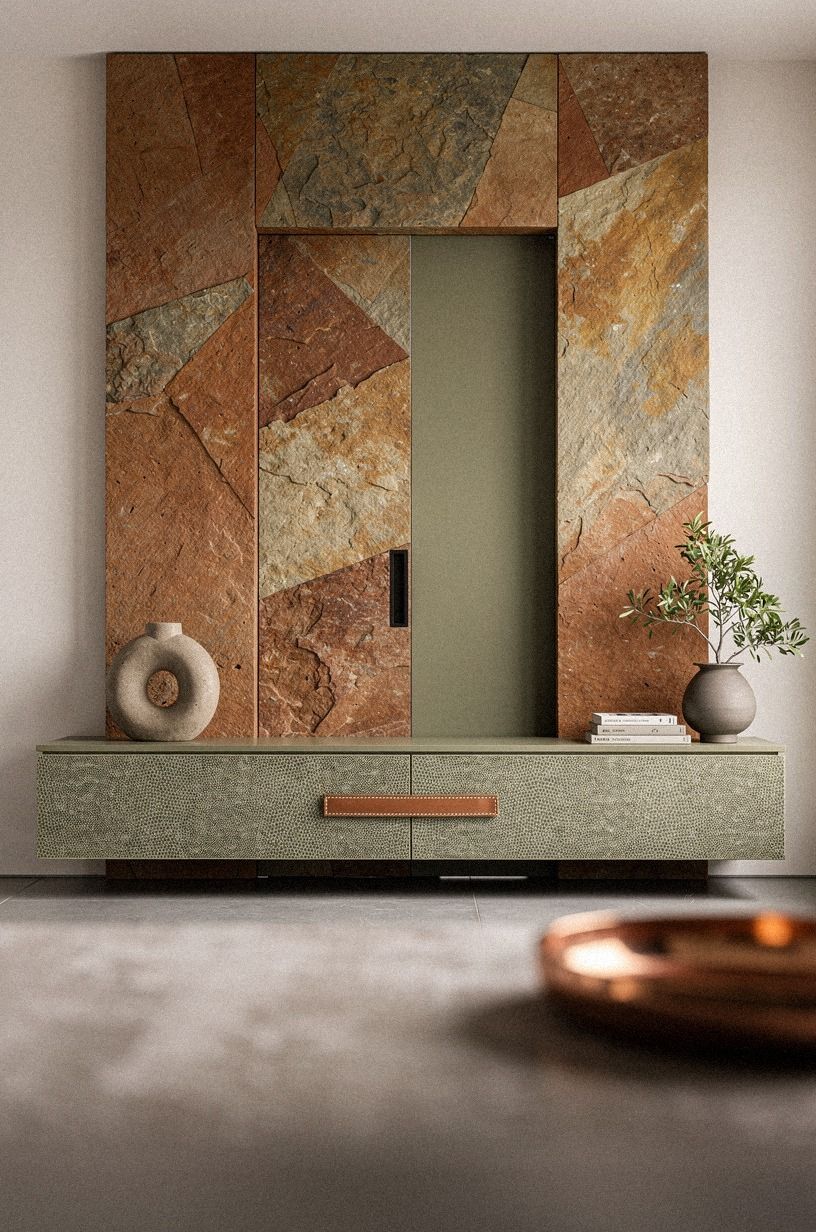
Stone is what you use when you want the wall to read architectural, not decorative. A slabbed surface makes the seam feel almost ceremonial, especially when the veining keeps moving right across the concealed panel. It looks bold, serene, and very grown-up.
I’d rather see one Calacatta Gold marble pattern or a limestone-look slab continue over the opening than a patchwork of small pieces. The bigger the stone visual, the less your eye hunts for the cut line.
Keep the hardware invisible, keep the grout minimal, and let one table lamp do the evening work. If your room already leans creamy and tailored, stone can make the whole media wall feel expensive in the best restrained way.
For more on letting one surface do all the camouflage, revisit this painted one-wall living room story and this hidden pantry slab-door article.
12Design a gallery wall across the opening
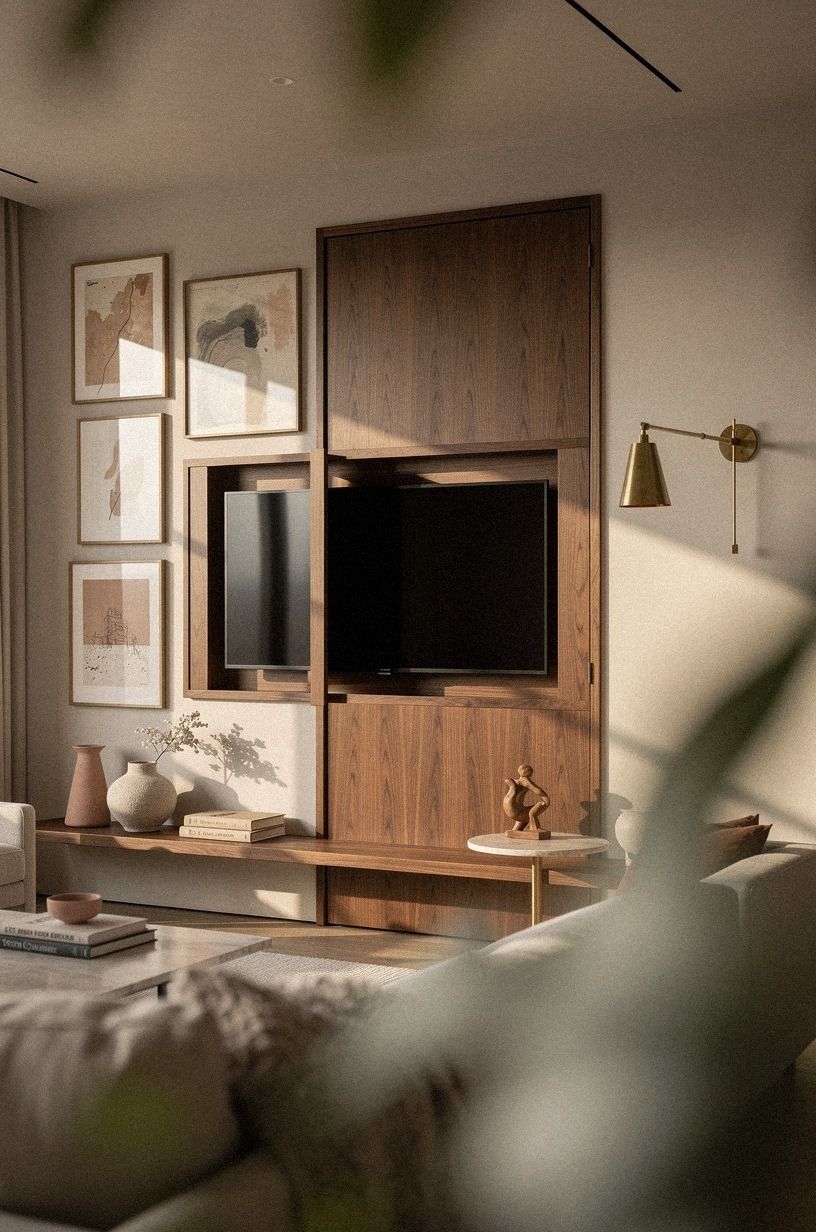
A gallery wall is less about hiding the door and more about redirecting your attention. The frames become the event. In the image, you look through foliage toward a clay-and-linen media wall where the artwork grid rides across the concealed opening, so the whole composition feels lived-in, soulful, and relaxed instead of engineered.
Keep your frame rails level, repeat two or three finishes at most, and let one larger piece sit near the TV so the screen doesn’t dominate. I prefer aged brass frames mixed with oak in a room like this because the warmth echoes the millwork.
You can even mount a lightweight art panel directly on the door if the swing clearance allows. And if you’re nervous about color underneath the art, this living room paint story is a helpful reminder that a slightly deeper wall tone makes almost every gallery arrangement look more deliberate. For a smaller-scale version, these compact hidden room ideas show how art can blur a seam without looking fussy.
13Tuck the door into a built-in console
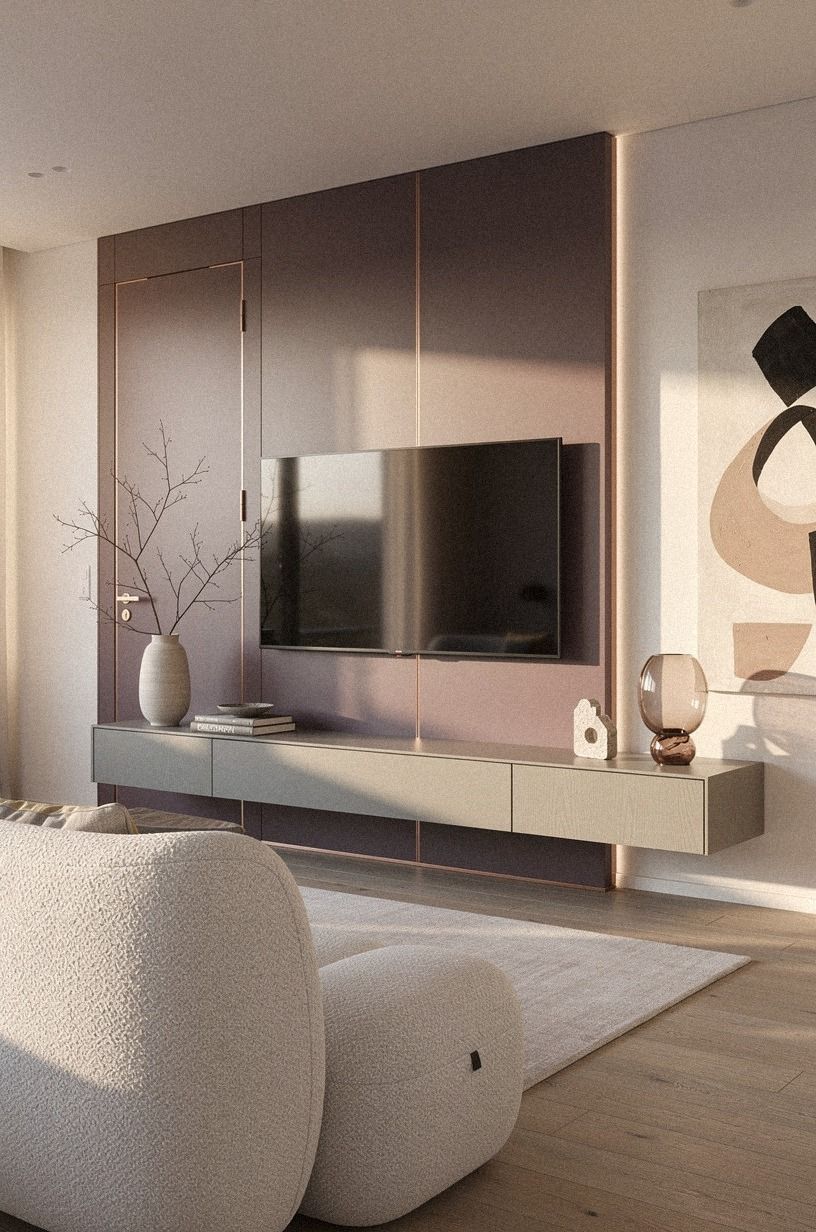
Instead of making the wall do all the hiding, let the console shoulder some of it. In this room, the built-in base rises into one full-height panel that becomes the concealed entry, so the door feels like a continuation of storage rather than a separate event.
It lands as calm, handsome, and intentional. That’s a very good compromise if you want custom without going full fireplace wall.
I like this especially in asymmetrical rooms where the TV can’t sit dead center. A long built-in console gives you enough width to absorb the opening, hide components, and keep the eye moving across the wall.
Use one finish, maybe plum-gray paint below with white oak detailing above, then keep the hardware minimal. If your sofa is large, make the console roughly two-thirds the visual span of the seating group so the room still feels balanced.
But leave breathing room on top. A console packed with decor ruins the disguise every single time!
If you want more hidden storage logic, this hidden pantry ideas article and this closet concealment guide are both useful.
Why does this kind of hidden TV wall feel expensive?
What makes these walls look expensive isn’t the door. It’s the restraint around the door, and the most convincing rooms feel warm, tailored, and deeply settled before you even spot the seam.
I’ve seen plenty of hidden passages that cost a fortune and still looked homemade because the owner wanted you to notice the move. Bigger trim.
More contrast. Heavier hardware.
A reveal line sharp enough to announce itself from the hallway. That’s backwards.
If you want a tv wall with hidden door to feel grown-up, the design has to act like it has nothing to prove.
The best rooms in this category do three things well. First, they pick one dominant language and stay loyal to it: fluting, slats, framed molding, stone, veneer.
Not all five. Second, they let lighting stay low so the seam isn’t spotlighted at night.
Third, they scale the rest of the room correctly, because a hidden door beside undersized furniture feels theatrical in a bad way. A wool rug that is truly 9×12, a coffee table that lands around two-thirds the sofa length, drapery that reaches the floor, and a media console that doesn’t look like an afterthought. Those details do more for believability than any fancy latch ever will.
I also think people underestimate color here. Farrow & Ball Hague Blue No. 30 can make a media wall feel deep enough to absorb a seam, while Benjamin Moore Revere Pewter HC-172 helps traditional molding read quieter and less busy. But I’d skip high-contrast trim unless you want the door to be part of the story.
In most living rooms, you don’t. You want guests to register warmth, order, and a soft, memorable little confusion a few minutes later (and yes, they notice).
Wait, was that a room back there?!
So if you’re choosing between a louder reveal and better material continuity, choose continuity. Every time.
And the part that worked in my own projects wasn’t the clever mechanism. It was matching the grain, lowering the contrast, and letting the room keep its dignity. If you want to compare this logic to another concealment-heavy layout, start with these wall paneling hidden door ideas before you sketch your millwork.
The Questions I Get Asked Most
What is the best TV Wall With Hidden Door Ideas [Conceal a Whole Room] for a small living room?
Fluted panels or a built-in console are usually the best picks for a small living room because they keep the wall visually flat. IKEA BESTA bases can fake the built-in look surprisingly well, and your room feels bigger when the doorway hides inside one continuous surface.
Where can I buy TV Wall With Hidden Door Ideas [Conceal a Whole Room] pieces on a budget?
Start with IKEA, Target Threshold, and Wayfair for consoles, trim-ready cabinets, and budget lighting. Then check Facebook Marketplace for solid wood pieces you can paint to match your wall. A secondhand base with new molding often looks better than a cheap glossy unit.
How much does a TV Wall With Hidden Door Ideas [Conceal a Whole Room] makeover cost?
A cosmetic version usually lands around $300 to $1,200, while a more built-in look can move into the $2,500 to $8,000 range. Paint and styling are the cheapest wins. Custom millwork, pivot hardware, and fireplace work are what push the total up.
Can I create a TV Wall With Hidden Door Ideas [Conceal a Whole Room] on a budget?
Yes, and you don’t need custom joinery to get close. Paint the wall one color, add applied molding across the seam, and edit the styling so the door doesn’t call attention to itself.
Removable trim, a push latch, and thrifted art can get you surprisingly far. This one-wall paint article shows how much heavy lifting color can do.
Is a TV Wall With Hidden Door Ideas [Conceal a Whole Room] worth it in a small space?
Yes, especially in a small space, because one concealed opening can remove the visual clutter of an extra door leaf and frame. A flatter wall makes your layout feel cleaner. Keep the seating tight to the rug and the TV centered on the main axis for the best payoff.
Is TV Wall With Hidden Door Ideas [Conceal a Whole Room] a good idea for a rental?
Yes, if you keep it reversible. Use peel-and-stick molding, freestanding shelving, removable wallpaper, and a curtain or art strategy instead of built-in stone or veneer. You still get the disguise, and your deposit doesn’t have to pay for your design phase.
Stone over trim if you only do one thing
If I had to pick one, I’d start with fluted panels. They hide the seam without asking the room to perform, and that restraint is what makes the whole wall feel architectural. Pin the fluted-panel look for later, then read these hidden door wall paneling ideas before you plan your first layout.