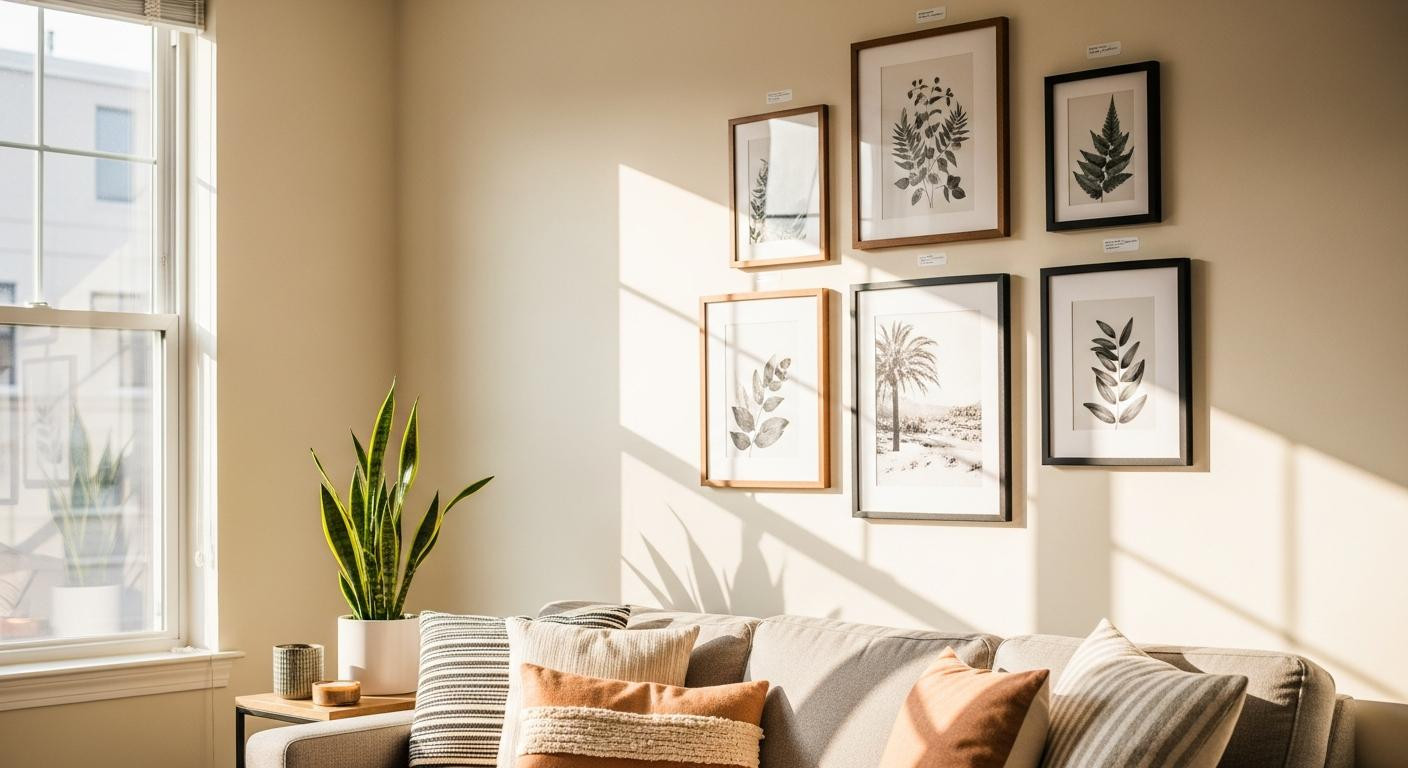
Your apartment living room on a Saturday in May when you’re holding $87 worth of Command Strips, peel-and-stick hooks, and two framed prints from Target, wondering if committing to wall damage is worth it when your lease ends in November. The blogs promise gallery walls and accent walls, but they don’t mention the part where you stare at builder beige for 40 minutes calculating whether your landlord notices nail holes. The solution isn’t buying less or committing harder. It’s building a three-piece foundation that works for three months or three years, then layering upgrades only when the move-out date shifts.
The $87 starter system that works for any lease length
Three components deliver maximum visual impact while remaining 100% reversible and portable. First, a Command Strip gallery wall with 5-7 frames in consistent finish. Thrift stores average $6 per frame for wood or metal options, so five frames cost around $30. Add $22 for Command Large Picture Hanging Strips rated at 15 pounds each, which handle frames up to 11×14 inches without stress.
Second, three portable textile swaps. Target’s seasonal throw pillows run $14-18 each during spring clearance, kitchen towels cost $8 for a set of two, and bath mats sit at $15. Total textile budget: $28. Third, one large floor plant in a lightweight pot. Snake plants and pothos run $25 at Home Depot in 8-inch ceramic containers. But according to ASID-certified designers, even “terrible, outdated bathrooms” feel intentional once greenery enters the space.
This system costs less than one month’s streaming subscriptions but transforms daily spatial experience. The frames come with you through four apartments. The textiles fit in one suitcase. The plant travels in your car.
Why this works when you’re moving in 4 months or 4 years
The portability math nobody shows you
Five frames at $6 each equal a $30 investment that survives multiple moves. Removable wallpaper at $168 per room only makes financial sense past the 8-month mark when cost-per-day drops below $0.70. Under 6 months? Starter system only. Between 6-12 months? Add one accent wall. Over 12 months? Full upgrade path unlocked.
Command Strip adhesive residue, if removed correctly, falls below damage thresholds in 90% of standard leases according to property management professionals. Contrast with nail holes, which are flagged in nearly every move-out inspection, or paint alterations, which sometimes trigger deductions if not returned to original color.
What your landlord actually notices during move-out
Professional organizers with residential portfolios note that inspectors check for wall texture changes, not light adhesive marks. A Magic Eraser removes Command Strip residue in under 2 minutes per strip. But spackled nail holes show through primer unless you match the exact wall texture, which costs $40-60 in materials and three hours of labor you don’t have on moving day.
The upgrade tiers for renters who are staying longer
Tier 1 add-on ($168): one accent wall with removable wallpaper
If your lease renews or you’re past month 8, one accent wall in the bedroom or behind the sofa justifies the investment. Tempaper self-adhesive botanical patterns run $56 per roll, covering approximately 56 square feet. A standard 10-foot by 8-foot wall requires two rolls. Application takes 2-3 hours for someone working alone with a smoothing tool.
Removal involves peeling in 15-minute sheets with zero residue if applied to properly primed drywall. Removable wallpaper that looks like $180 velvet proves the luxury illusion works when you choose patterns with texture variation and avoid flat, obviously printed designs.
Tier 2 add-on ($47): kitchen backsplash with peel-and-stick tile
This upgrade works for renters past the 10-month mark who cook frequently. Smart Tiles Peel and Stick systems cost $8-12 per tile, and you need 12-15 tiles for a standard 18-inch backsplash run. Application takes 90 minutes. Removal involves a heat gun and patience but leaves zero damage. And this only works if existing wall is smooth, because textured drywall shows tile edges within weeks.
Design experts featured in Architectural Digest recommend testing one tile in an inconspicuous corner for 48 hours before committing to full installation. If the adhesive pulls paint during test removal, stop.
What I’m not telling you to buy and why
Don’t buy faux fireplace mantels. They’re too heavy to move at 40+ pounds, and the $200+ investment only justifies itself for 18-month leases or longer. Don’t buy floating shelves with toggle bolts, which leave 1/2-inch holes requiring spackle and paint matching. Don’t buy removable wallpaper for bathrooms, where moisture causes edge lift within 4 months even in well-ventilated spaces.
Don’t DIY board and batten, even “renter-friendly” versions. They require paint matching on removal that costs $60-80 in materials plus three hours you don’t have. These aren’t bad ideas. They’re just wrong for the starter system economics. Command strips fail at 2 weeks unless you follow the 16-pound quadrant rule, which means understanding weight distribution matters more than buying premium products.
Your questions about rental-safe DIY answered
Will Command Strips actually hold through summer heat?
Yes, if you apply at 70°F or higher for a 24-hour cure time before hanging weight. Texas renters report failures because they apply at 8am when walls are 62°F. If your AC breaks in July, remove heavy frames temporarily until temperature stabilizes. Lighting designers with residential portfolios note that vertical load on horizontal strips causes 80% of failures, not heat alone.
Can I take the peel-and-stick tile with me when I move?
Technically yes, but Smart Tiles become brittle after 12+ months of adhesive cure. Budget for leaving them behind if you’ve been in the apartment over a year. If under 8 months, careful removal with a hairdryer preserves 70% of tiles for reuse. The $15 Target planter that makes every shelf look intentionally curated travels better than tile and delivers comparable visual warmth in kitchens.
What’s the actual move-out cost if I do all three tiers?
Zero if executed correctly. The only potential loss is time: 2 hours to remove wallpaper, 30 minutes for tile, 15 minutes for Command Strips. Budget $40 for a Magic Eraser bulk pack and Goo Gone if adhesive residue appears, but proper removal technique eliminates this 95% of the time. Uneven gallery wall spacing makes rooms feel cluttered, but correct installation from day one prevents last-minute panic fixes during move-out prep.
Your living room on move-out day when the landlord walks through and you’ve already peeled the last Command Strip, rolled the botanical wallpaper into the moving truck, and packed the snake plant in a cardboard box. The walls look exactly like they did 11 months ago. But your next apartment already has a plan.