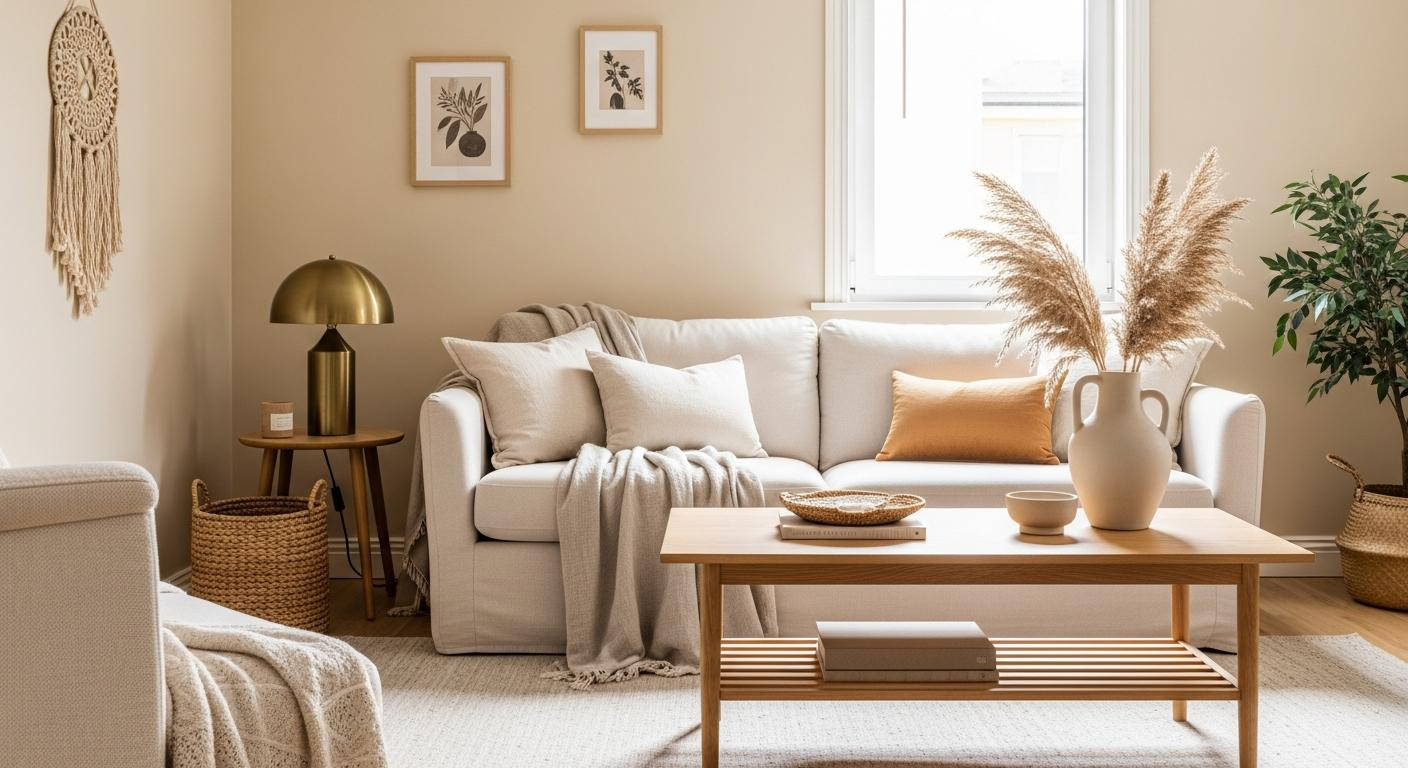
Your living room measures 186 square feet with one north-facing window, and you’re standing in the paint aisle on a Saturday in May, staring at Benjamin Moore Classic Gray and Behr Blank Canvas, wondering which warm neutral actually works when your apartment gets four hours of indirect light. The blogs say greige makes rooms feel bigger, but nobody mentions that the same color reads completely different in a 240-square-foot south-facing room versus your dim rental corner. The answer isn’t about picking the trendiest beige. It’s about matching paint warmth to window direction and room size.
North-facing living rooms under 250 sq ft need warmer beige, not greige
North light measures cooler on the color temperature scale and drops warm tones noticeably compared to south-facing rooms. In spaces under 250 square feet, this cool light makes greige read gray and flat. Warm beige like Benjamin Moore Shaker Beige or Behr Even Better Beige contains enough yellow undertone to counteract the blue cast.
According to ASID-certified interior designers, north-facing rooms benefit from what they call “sun-washed warmth” in small spaces. But the contrast matters here. Most people choose trendy greige because Pinterest shows it working beautifully in bright, south-facing lofts.
The spatial compression of small rooms amplifies color temperature, making warmth selection more critical than in larger spaces where volume dilutes the effect. And that’s exactly why your 180-square-foot rental corner feels cold in Classic Gray while your friend’s 320-square-foot south-facing living room looks magazine-ready in the same shade.
South-facing rooms over 200 sq ft handle cooler greige without feeling sterile
South windows deliver daylight that naturally warms any paint by a measurable percentage. In rooms over 200 square feet, this abundant warm light means you can use cooler-toned greige like Benjamin Moore Classic Gray without the space feeling cold. The larger volume diffuses light more evenly, preventing the harsh contrast that makes greige look institutional in cramped quarters.
Professionals with residential portfolios note that reflected natural light in bigger spaces needs more complex undertones to avoid looking flat in photos and evening lamplight. It’s the kind of detail that quietly elevates the whole space. And south-facing rooms already have the warmth advantage, so you’re not fighting the light the way you would in a north-facing setup.
The 280 sq ft threshold where mushroom beige outperforms both
Once living rooms exceed 280 square feet, even south-facing spaces benefit from shifting to richer mushroom or taupe tones. Behr’s mushroom family or Farrow & Ball Bone add depth that prevents large rooms from feeling washed out. The walls need enough character to hold the space together, especially when paired with warm wood floors or oak furniture.
This works because the room has enough volume to support a deeper color without feeling cave-like. But it only works if your ceilings are at least 8 feet.
Dark living rooms ignore window direction (warm taupe works in any orientation under 200 sq ft)
If your living room faces a brick wall, courtyard, or tree canopy that cuts direct light by more than half, window direction becomes irrelevant. These light-starved rooms need the warmest available neutrals regardless of compass orientation. Warm taupe like Sherwin-Williams’s warm mushroom tones or Benjamin Moore Shaker Beige create perceived brightness through color temperature alone, not light reflection.
The apartment light test is simple. Walk into your empty living room at 4pm. If shadows from furniture occupy more than 40% of floor space, treat the room as north-facing regardless of actual orientation.
Design experts featured in Architectural Digest confirm that shadow dominance overrides compass rules. And that’s the practical filter most people need, not theoretical north-south guidelines that ignore obstructions.
Ceiling height adds a third variable most paint guides ignore
Rooms with 8-foot ceilings trap paint color visually, intensifying whatever undertone you choose. This makes warm beige feel warmer and greige feel cooler than the same colors in 9.5-foot spaces. If your living room sits under 220 square feet with standard 8-foot ceilings, go one shade lighter than the conditional rule suggests.
Conversely, loft-style rooms over 250 square feet with 10-foot ceilings can handle richer, deeper versions of warm neutrals without feeling cave-like. Builder-grade apartments default to 8 feet, making this relevant for most renters. The vertical compression affects how light bounces, which directly impacts whether your warm beige reads cozy or dingy.
Similar logic applies when you’re deciding between one large art piece versus multiple smaller ones, since ceiling height changes the visual weight of wall decor just as much as it changes paint perception.
Your questions about the paint color that makes the biggest difference in any room answered
Does this work in bedrooms or just living rooms?
Bedrooms tolerate cooler neutrals better because lower light levels and evening use make warmth less critical. But the same north-south rule applies. North bedrooms still need warmer beige, south bedrooms handle greige.
The difference is you can go two shades cooler in bedrooms than living rooms of identical size and orientation. Professionals who specialize in room-specific color strategies confirm this adjustment works consistently.
What if I have both north and south windows in one room?
Dual-exposure rooms follow the dominant light source, which is usually the larger window or the window closest to where you sit most often. If windows are equal, treat the room as south-facing since that light is stronger and will dominate the overall color temperature. And if you’re also working with mirror placement for light optimization, the south window determines your paint baseline.
Can I use these colors in rentals without repainting when I leave?
Most lease agreements require returning walls to original color. Budget $180 to $320 for professional repainting on moveout, or use peel-and-stick wall panels in coordinating beige tones for a reversible alternative. If you’re not ready for paint commitment, faster transformation swaps can shift the room’s warmth temporarily.
Your living room at 6:47pm when table lamps click on and the warm beige walls hold the light instead of swallowing it gray. The room measures the same 186 square feet but reads eight degrees warmer, softer, like someone dimmed the overhead fluorescents in a hotel lobby and left only the good light.