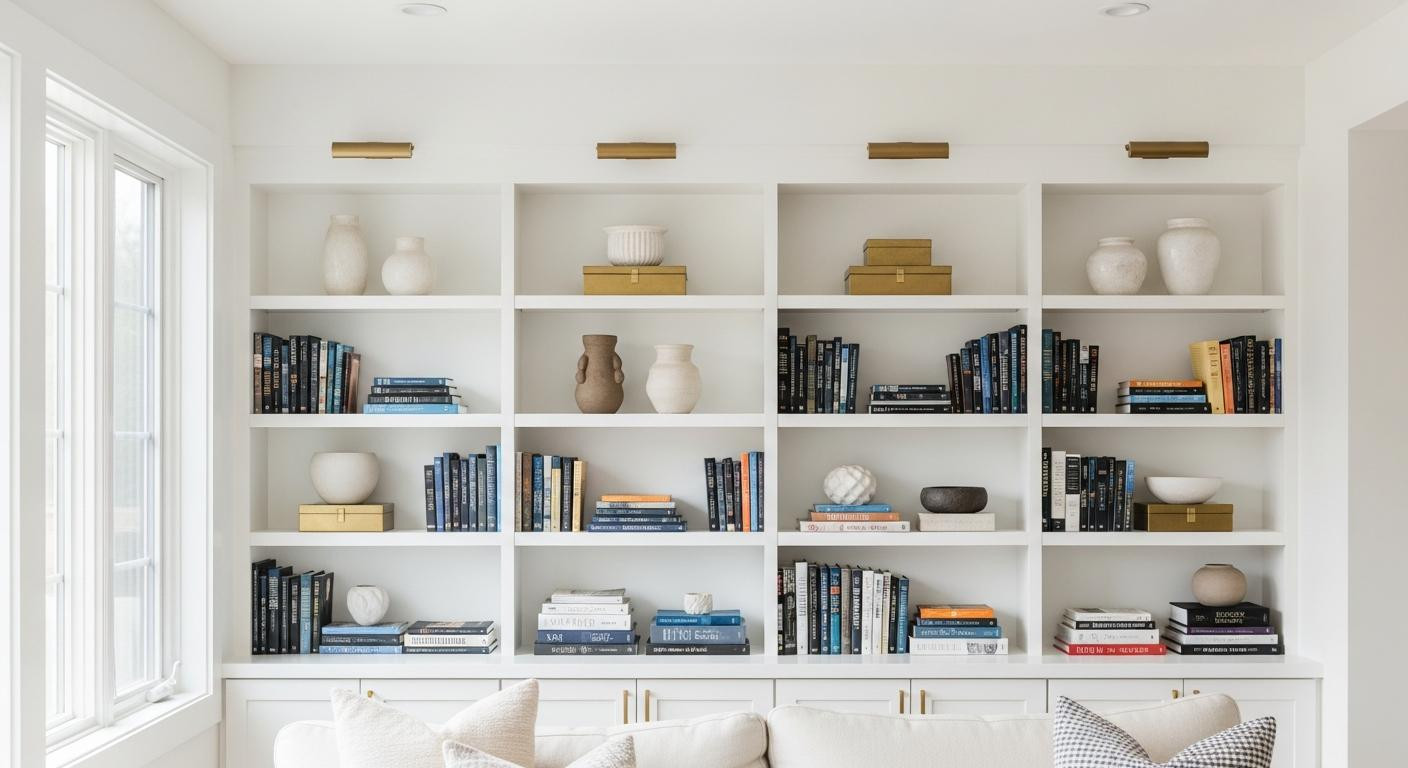
Your built-in bookshelf on a Thursday afternoon in May when you’ve followed three Pinterest tutorials, arranged 40 hardcovers across five shelves, and added seven ceramic vessels from Target, but the whole display reads cluttered on the left side and empty on the right. The books cost nothing. You already owned them. But something about the proportion makes your eyes dart around instead of settle.
The 60-40 books-to-objects ratio solves that visual restlessness by anchoring weight (books provide foundation) while punctuating with sophistication (objects add intentionality without noise). Unless your shelves measure under 36 inches wide, where the math breaks completely.
Why 60% books anchor visual weight without feeling utilitarian
Books alone read as functional storage, the way a filing cabinet reads as office equipment. But at 60% coverage, roughly 8 to 12 books on a standard 48-inch shelf, they create enough mass to ground the display without dominating it. Interior designers certified by ASID confirm that the 60% portion acts as “dominant color” in the 5-texture rule that stops rooms from feeling flat, providing background stability.
The texture of book spines (varied heights, colors, typography) adds visual interest that monochrome objects can’t match, but spreading books across 100% of the shelf makes them utilitarian clutter. And that restraint at 60% keeps books intellectual and collected rather than hoarder-adjacent. This only works if shelves exceed 36 inches wide. Narrow units need 80% books or the spacing looks gap-toothed.
The 40% objects that add sophistication without visual chaos
Ceramic vessels, small sculptures, and brass boxes create shadows and dimensionality that framed photos can’t. A 4-inch ceramic vase from CB2 at $49.95 casts light differently than a flat book cover, adding spatial depth. Budget version: Target Threshold vessels at $27.99 achieve similar effect.
But the “objects” portion isn’t just stuff. It’s the breathing room between items. On a 48-inch shelf, the 40% might be three objects plus 12 inches of empty space. Professional organizers with certification describe this as “undone, layered, lived-in feel” rather than stuffed. The negative space prevents the grandma chic aesthetic from tipping into grandma’s actual cluttered shelves.
Mixing one organic object (plant, driftwood) with one manufactured piece (candle, box) within the 40% creates the “collected over time” illusion that Instagram shelfies sell. The contrast in materials keeps the eye engaged without overwhelming.
Where the 60-40 rule fails (and what to do instead)
Shelves under 36 inches need 80-20 books-to-objects. Narrow IKEA Billy units at 31.5 inches wide can’t sustain 40% negative space. The gaps read as unfinished rather than intentional. At this width, push to 80% books (7 to 9 volumes) with one statement object.
The tighter ratio compensates for limited horizontal real estate. And deep shelves over 14 inches require layering, not ratios. Standard shelves measure 10 to 12 inches deep, where the 60-40 rule works in single-plane arrangements.
But built-ins deeper than 14 inches need front-to-back layering: books in back (60% of depth), objects in front (40% of depth). The ratio shifts from horizontal to spatial. Admittedly, this requires more objects and risks blocking book spines. Only works if you’re styling for photography rather than actual reading access.
The budget breakdown for one styled 5-shelf unit
You already own 30 to 50 books. The investment is the objects. Budget approach: $85 total for five shelves using Target Threshold ceramics at $27.99 each, one IKEA plant at $12.99, thrifted brass box at $15. Mid-range: $240 using West Elm vessels at $59.99 each, CB2 sculpture at $49.95, Etsy ceramic at $45.
High-end: $680 with Restoration Hardware marble box at $195, two artisan ceramics at $180 each, designer candle at $125. The ratio works at every price point because books provide free visual weight. You’re only buying the punctuation marks, not the full sentence.
That’s the balance that makes this room work without breaking the budget.
Your questions about shelf styling: the 60-40 books-to-objects ratio answered
What if I don’t have enough books to hit 60%?
Thrift hardcovers by color family at $1 to $3 each at estate sales or buy decorative book bundles on Amazon at $39.97 for six color-coordinated spines. The content doesn’t matter. You’re using them as textural anchors. Stack three horizontally to create pedestals for objects, maintaining the 60-40 visual ratio even if you’re faking the library.
Can I use matching objects or does the 40% need variety?
Three identical white vessels read as a collection (intentional). Seven identical vessels read as wholesale accident (unintentional). Limit repeats to two within the 40%. The third object should contrast in material, height, or color. The variety creates the “collected over years” aesthetic that design experts featured in Architectural Digest identify as core to 2026 grandma chic trend.
Does this work for floating shelves or just built-ins?
The ratio scales to any shelf format, but floating shelves under 24 inches wide struggle with the 40% breathing room. They feel precarious with gaps. For single floating shelves, push to 70-30 (books-objects) to maintain stability perception. Built-ins and standalone units handle true 60-40 because the frame contains the composition.
Your hand adjusting the brass box two inches left on the third shelf, Thursday evening light catching the spines at an angle, the space finally reading calm instead of cluttered. Sixty percent foundation, forty percent punctuation. The room exhales.