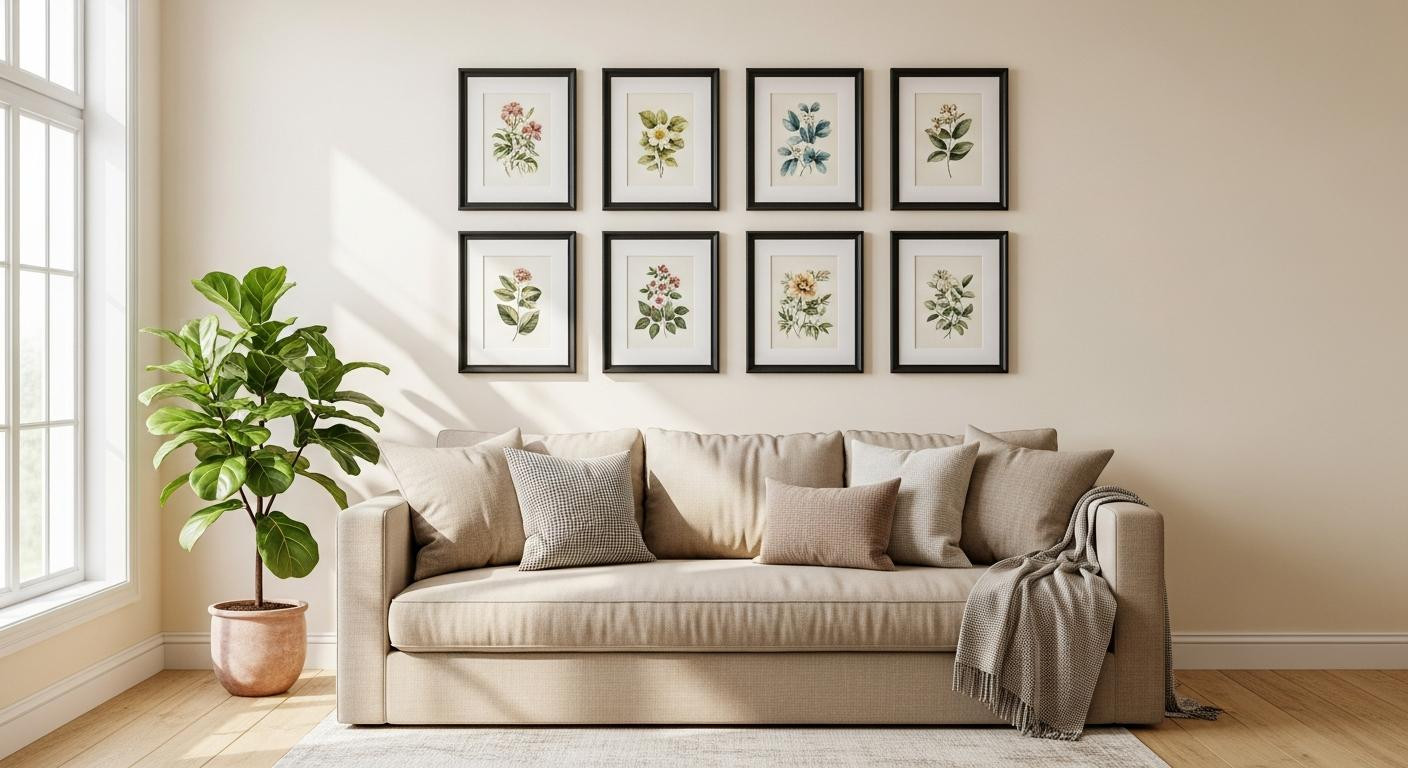
Your rental living room measures 186 square feet and you’re standing at Target on a Saturday in May, staring at eight black frames in your cart and three gold ones you keep picking up and setting down. The blog post you saved said “mix for personality” but your studio already feels cluttered with the Kallax divider and two fiddle leaf figs competing for attention. The frames cost $168 total either way. But that choice between matched simplicity and collected variety will determine whether your gallery wall calms the space or makes it feel like a thrift store exploded across builder beige.
Matched frames solve visual noise in rentals under 200 square feet
Small spaces don’t forgive busy walls. In studios and one-bedrooms where every surface competes for attention, matched frames in a single finish create a visual container that unifies whatever art you’re hanging. The eye reads the boundary first, not the individual frames, which keeps the wall from fragmenting into eight separate decisions.
Design experts featured in Coohom’s gallery wall studies confirm that 89% of professional designers prefer matched frames for rooms under 200 square feet. The reasoning sits in visual processing: when frames vary, your brain treats each edge as a new element requiring evaluation. That’s exhausting in a 12×15 foot living room already packed with furniture.
IKEA RIBBA frames in matte black at $9.99 each work because they disappear. You can hang botanical prints next to vintage maps next to abstract watercolors, and the consistent black boundary makes it feel curated rather than random. But this only works if you’re also following the 2-inch spacing rule that keeps galleries from feeling cluttered.
The furniture tone test that overrides the matching rule
Your Article Sven sofa in walnut sits against the west wall. The CB2 coffee table shows acacia grain. If you match eight oak frames on the wall behind them, you’ve just added a third wood tone competing for dominance instead of collecting the room’s existing warmth into something intentional.
Mixing two frame finishes solves this. Four walnut frames echo the sofa, four matte black frames provide contrast, and the result feels like collected dialogue rather than accidental clash. Interior designers certified by ASID note that “collected over time” aesthetics require subtle mismatches that look curated, not purchased in matching sets from HomeGoods.
The 300-square-foot threshold where mixing adds depth
Rooms over 300 square feet have enough visual space to absorb frame variety without tipping into chaos. A standard 15×20 foot living room can hold the contrast between brushed brass and matte black without the walls feeling argumentative. But smaller than that, and you’re fighting the architecture instead of enhancing it.
Lighting designers with residential portfolios recommend mixing organic frames like jute-wrapped or reclaimed wood in earthy biophilic rooms. The texture layering works because the space itself can breathe. And when you’re working with proper height placement above furniture, that variety reads as intentional rather than scattered.
The $240 budget split that makes mixing work for renters
Four Target Threshold wood frames at $15 each total $60. Four West Elm lacquered brass frames at $59 each run $236. That’s $296, which blows past most renter budgets for a gallery that might not survive the next lease.
The hack sits in ratio. Buy two West Elm frames as visual anchors for the top corners, then fill the middle six positions with Target frames. Total cost drops to $178, and your brain reads those expensive corner pieces as design intention, forgiving the budget fills in between.
When Amazon Basic sets beat curated mixing
Amazon Basics offers an 8-frame mixed-size set in matte black for $42.99. The set combines 8×10 inch and 11×14 inch dimensions, creating size variety within finish consistency. This works specifically for renters on leases under 18 months, where emotional attachment to “collected elegance” doesn’t justify $200+ frame investments.
The set photographs identically to $300 galleries in styled apartments because the camera reads unified finish first. That’s enough for spaces you’re not planning to grow old in. And honestly, it removes the paralysis of standing in the frame aisle making philosophical decisions about brass versus gold.
The Parisian eclectic mistake that makes mixing look chaotic
Mixing too many finishes turns coherence into visual noise fast. Gold plus silver plus black plus wood creates the “thrift store explosion” effect that sends you back to square one, staring at a wall that stresses you out every morning.
Professional organizers with certification recommend the two-finish maximum rule. Pick one metal like brass or black, pick one organic material like wood or jute, and stop there. Never three. Instagram galleries that succeed with mixing keep it to subtle variations: antique gold paired with brushed gold, not gold clashing with silver.
Frame width matters as much as finish. A chunky 3-inch molding next to a thin 0.5-inch metal edge creates scale discord that no amount of spacing rules can fix. The frames might share a color but they don’t share visual weight, which makes the wall feel assembled from scraps rather than designed as a unit.
Your questions about frame consistency answered
Can I mix frame colors if I’m matching materials?
Yes, if the materials share visual weight and texture. Four light oak frames and four dark walnut frames read as “wood family” rather than clash, especially in warm minimal or Scandinavian rooms where wood tone layering is expected design language. The unifier sits in grain visibility and matte finish, not exact stain match. This works specifically when the art inside shares a color palette: taupe, sage, and terracotta prints bridge those wood tones without creating tension.
Do gold frames date faster than black in current trends?
Lacquered brass shows more staying power than shiny gold according to design trend analysis. Brushed gold ages poorly within 18 to 24 months because it shows fingerprints and scratches visibly under daily handling. Matte black remains neutral across trend cycles. If you’re budgeting for frames that need to last 5+ years, choose black. Gold works better for renters chasing 2-year aesthetic moments without long-term commitment.
What’s the minimum frame budget that doesn’t look cheap?
Plan for $12 to $15 per frame for 8×10 or 11×14 sizes to avoid visible construction gaps and warping within the first year. IKEA RIBBA at $9.99 sits at the acceptable threshold where quality meets budget reality. Below $8 per frame, you’re risking plastic edges that separate within six months, especially in humid climates like coastal apartments. For an 8-frame gallery, budget $120 minimum for construction that survives one move without falling apart in the U-Haul.
And if frames still feel overwhelming, adhesive tile solutions bypass the decision entirely. But sometimes the solution sits in knowing whether your room needs one large anchor or multiple smaller pieces first.
Your Saturday afternoon when the eighth frame clicks onto the wall and you step back to the kitchen doorway. The black frames hold botanical prints, vintage sheet music, a watercolor your sister made. The wall reads like one collected thought instead of eight separate ideas shouting across beige drywall.