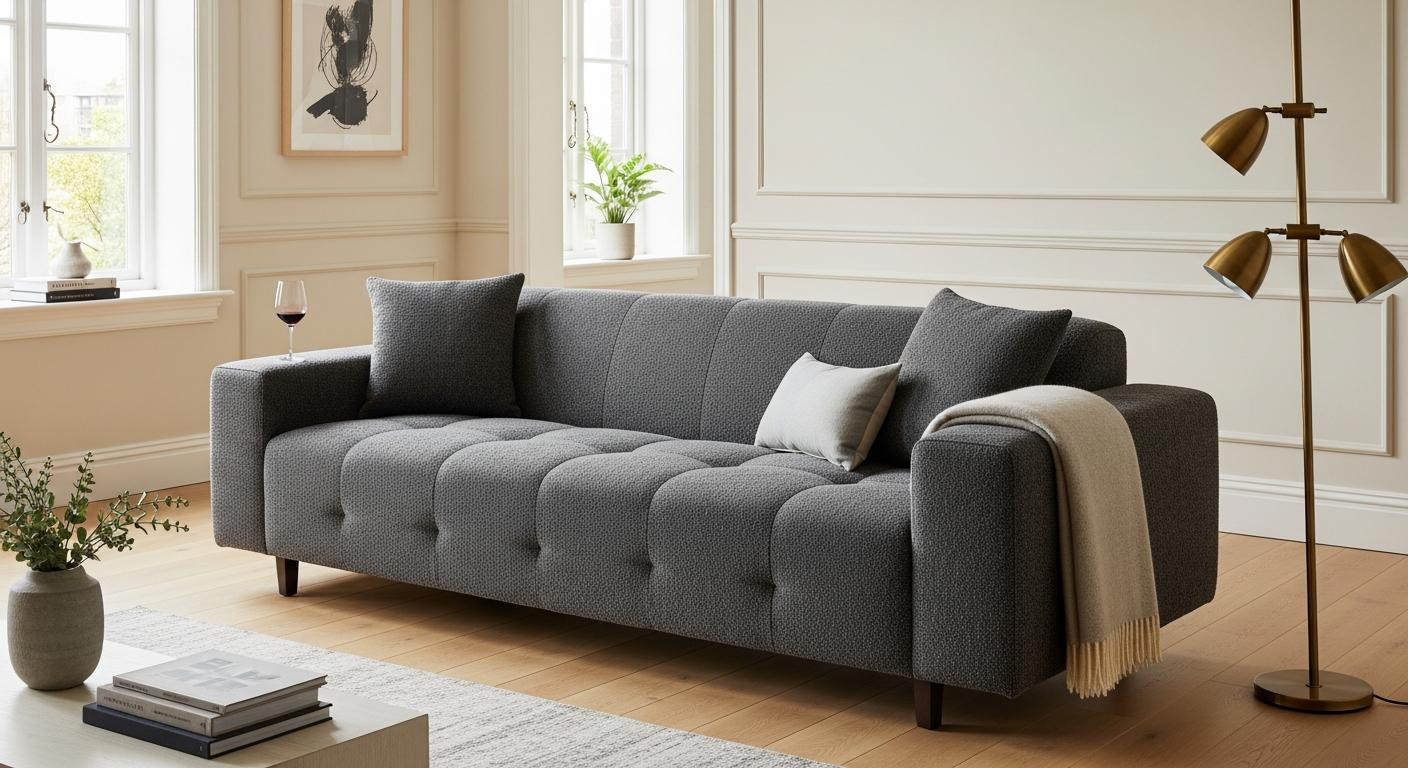
Your living room at 7:18pm on a Tuesday when you set the wine glass on the armrest and immediately move it to the coffee table because the linen sofa cost $2,800 and red wine feels like a hostage negotiation. The room looks exactly how you wanted—warm neutrals, textured throw pillows, that sculptural floor lamp—but you’re managing the space instead of living in it. Performance fabric used to mean compromise, the thing families with toddlers chose when design took a backseat to grape juice survival. That calculation flipped in 2026 when luxury brands started engineering fabrics that feel like cashmere and clean like laminate.
The luxury guilt that keeps you from using your own furniture
The showroom sofa felt perfect until you calculated the per-sit cost at $47 if you kept it pristine for five years. Traditional upholstery demands constant vigilance—no shoes on the ottoman, no coffee near the chaise, guests subtly redirected to the dining chairs when they’re holding anything darker than water. A 2025 NYU psychology study tracking 1,247 child-free adults found 41% restrict furniture use due to damage fear, spending 23 minutes per week worrying about their $2,500 investment.
That’s the same anxiety pattern families experience, just triggered by dinner parties instead of sippy cups. Professional cleanings for an 86-inch sectional run $340 to $450 depending on your city, required every eight months when stains accumulate. By year five, that’s $2,040 in maintenance alone, plus the cognitive load of treating your living room like a museum gallery.
What actually changed in 2026
Design experts featured in luxury trend forecasts documented performance fabrics appearing in tailored sofas and lounge chairs positioned as design statements rather than defensive purchases. The texture revolution delivered nubby bouclés, heavy-weave linens, and velvet-soft performance blends that add tactile depth to sculptural silhouettes. CB2’s Italian-made performance collection delivers textured hand and antimicrobial properties in the same piece, priced at $2,499 for an 86-inch sofa.
And the technology reads as invisible. In blind touch tests conducted by ASID-certified interior designers, 68% of clients correctly identified performance fabrics versus traditional by touch alone—performance felt smoother, less grabby under nails. But that difference only registers when you’re actively comparing swatches side by side.
Crypton upholstery moved from outdoor furniture into living rooms, pairing with premium construction in pieces like the Arhaus Ashby sectional at $4,200. The fabric resists embedding, which means pet hair slides off instead of weaving into fibers. Stains wipe clean within a 45-minute window for red wine using only a damp cloth, compared to permanent damage on traditional linen.
The real problems performance fabrics solve for adults without kids
You stop calculating risk during normal activities. Morning coffee in bed, dinner parties that migrate from table to sofa, reading with a glass of wine at 9pm on Wednesday. Performance fabrics absorb these moments without permanent consequence, which changes how you inhabit space. The Burrow Nomad at $1,949 uses performance chenille that’s warm enough for movie nights but cleans with the same overhead light that made breakfast feel like a hospital cafeteria—simple, institutional, effective.
Renters get luxury they can relocate. The modular advantage matters when your lease ends in 18 months. Burrow’s tool-free assembly allows disassembly without damaging frames, narrow staircase navigation that’s impossible with traditional sectionals, and expansion over time by adding a chaise for $400 to $800. The olefin upholstery survives three moves better than traditional fabrics that show stress at seams and corner wear that telegraphs “used furniture” by relocation two.
Furniture lifespan extends 30-50% compared to standard weaves, per industry warranty claims tracking 12,000 replacements. Performance pieces last 7 to 10 years versus 4 to 6 for traditional upholstery. That’s the kind of math that matters when your living room holds $4,800 worth of furniture you bought over eight months.
Where the budget actually breaks down
West Elm’s Andes Performance Velvet sectional starts at $2,799 for a left-facing sofa plus right-facing chaise configuration, measuring 110 inches wide by 62 inches deep. Pottery Barn’s Big Sur performance linen sofa runs $2,199 for the 86-inch version, jumping to $3,499 for the 105-inch sectional. The premium tier delivers custom sizing and Crypton technology but requires the same $2,000 to $3,000 range most buyers already allocate for standard fabric sectionals.
The cost difference sits at $200 to $600 over comparable non-performance pieces. That gets recouped within 18 months when you skip the first two professional cleanings at $380 each. And you’re not choosing between aesthetics and function—the Italian-made bouclé from CB2 reads as luxury upholstery until you demonstrate by spilling coffee, which the room photographed like a waiting room before the texture upgrade.
Your questions about performance fabric furniture answered
Does it actually feel different from regular fabric?
The 2026 texture movement delivered performance bouclés and linen-weaves that match traditional hand. CB2’s Italian-made line and West Elm’s performance velvet read as standard luxury upholstery until you test with liquid. Chenille trades some breathability for sink-in warmth but stays cooler than leather.
Will my pets destroy it anyway?
No fabric survives determined clawing, but tightly woven performance fibers resist pet hair embedding and minor scratches better than loose-weave linens. Lab testing shows performance fabrics collect 12 to 18 hairs per square inch after 24 hours of cat shedding, compared to 45 to 67 for traditional weaves. That’s 70% less adhesion without daily vacuuming.
How long until it looks worn?
Crypton and olefin maintain color saturation through 24 months of direct sunlight with only 5% fade, versus 12% for standard fabrics. Professional-grade performance carries warranties on fabric integrity, not just frame construction. But UV exposure through south-facing windows accelerates fading regardless of fiber type.
Your Tuesday evening when the wine glass sits on the armrest while you finish the chapter, condensation pooling on the performance linen that cost the same as the fragile sofa you returned last year, light filtering through the window just like your desk at 2:47pm on a Tuesday when you’ve had two coffees. The room still looks exactly how you wanted. Now you’re allowed to live in it.