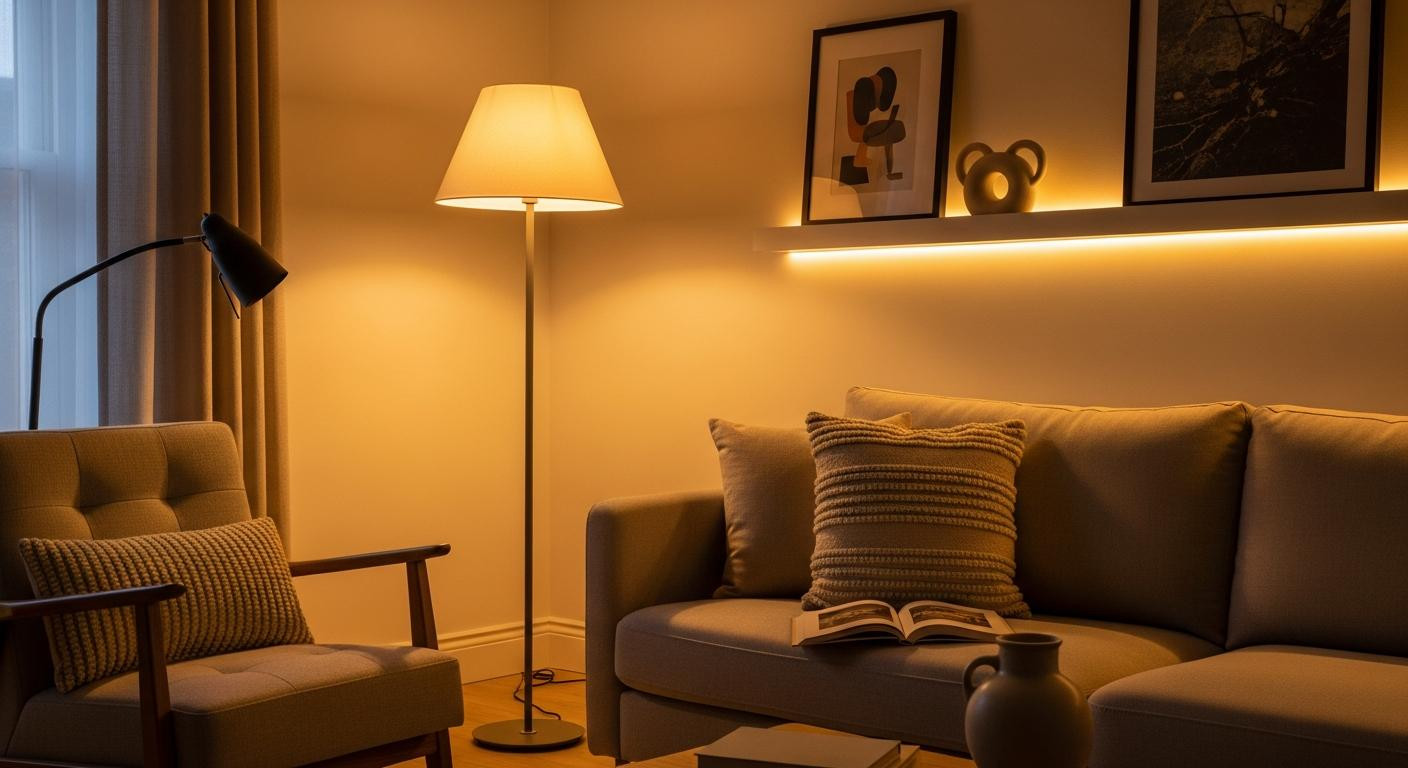
Your living room has good furniture, a carefully chosen rug, and artwork you actually like. But the moment you flip the overhead switch at 7pm, the space flattens into something that feels more like a waiting room than the cozy retreat you see on Pinterest. The problem isn’t your taste or your budget. It’s that single ceiling fixture washing everything in uniform brightness, erasing the depth and warmth that make a room feel intentional rather than assembled.
Interior designers certified by the American Society of Interior Design call this “spatial monotone.” Your eye needs varying light intensities to understand which surfaces matter, where to rest, what deserves attention. When every object receives identical illumination from a single overhead source, nothing wins. The result is a space that photographs flat and feels unfinished, even when every decorating choice was deliberate.
Why one light source makes furnished rooms feel empty
A 1,200-lumen LED ceiling fixture provides enough brightness for safety and basic function. But it fails at creating visual hierarchy. Lighting experts featured in the Illuminating Engineering Society’s residential guides explain that rooms need light variation the same way music needs rhythm, not just a single sustained note at consistent volume.
And this is where most people stall. You’ve added table lamps, maybe a floor lamp near the reading chair, but the room still feels off. That’s because you’ve layered the same type of lighting, what professionals call task lighting, without addressing the other two layers that create depth. The three-layer formula solves this by assigning each light source a specific job: ambient sets the baseline, task handles focused work, and accent creates the drama that stops the institutional look.
The ambient layer sets the baseline (not the whole job)
Ambient lighting defines how much additional light your space needs to feel comfortable after dark. For a 240-square-foot living room, you need roughly 2,400 to 4,800 lumens total, calculated at 10-20 lumens per square foot based on residential standards. This comes from your ceiling fixture plus supplemental sources like torchiere floor lamps or LED strips positioned behind crown molding.
But ambient lighting only asks: can I walk through this room at 10pm without tripping? It doesn’t create interest or highlight what makes your space worth looking at. From there, you need task lighting to solve functional problems. And that’s where most renters stop, skipping the third layer entirely because it feels optional until you see a room with it.
Task lighting solves specific functional problems
Reading lamps beside your chair, the desk lamp in your home office corner, pendant lights over the kitchen island all qualify as task lighting. This layer concentrates brightness exactly where eyes perform focused work, requiring roughly three times the intensity of your ambient light. A 3×6-foot kitchen island needs approximately 45 watts of focused illumination positioned 28-34 inches above the work surface.
Without adequate task lighting, you’ll close blinds at 2pm to reduce screen glare or abandon the reading nook because neck strain outweighs the cozy aspirations. Professional organizers note that improper task lighting causes most work-from-home eye fatigue, not screen time itself. The wrong desk lamp draining focus creates fatigue that no amount of coffee fixes.
Accent lighting creates depth renters think requires hardwiring
The third layer highlights architectural features, artwork, plants, or textured walls using light positioned at angles that create shadows and visual relief. Picture frames gain dimensionality when a small spotlight grazes them from 30 degrees rather than flooding them with overhead brightness. A fiddle-leaf fig positioned near a wall-washing LED strip casts organic shadows that shift through the evening, providing movement without additional objects.
Accent lights should measure three times brighter than surrounding ambient light to effectively draw attention without creating glare. Design experts featured in Architectural Digest emphasize this ratio: too subtle and the accent disappears, too intense and it creates harsh contrast that fragments the room’s mood. Most renters skip this layer entirely, citing budget concerns or hardwiring limitations, but renter-friendly solutions eliminate both excuses.
Renter-friendly accent solutions under $100
Adhesive LED strips behind floating shelves cost $25-40 for 16 feet. Plug-in wall sconces aimed at artwork run $50-80 at Target and IKEA. Battery-powered picture lights with 100-hour runtime per charge sell for $30-60 on Amazon. A 16-foot LED strip positioned behind your media console creates an optical illusion of depth, making the console appear to float while washing the wall with warm 2700K light.
This transforms a flat wall-and-furniture arrangement into a layered composition with foreground furniture, midground glowing edges, and background illuminated wall surface. The same principle applies when you installed a $25 plug-in dimmer to control ambient brightness at different times of day, except accent lighting adds permanent visual interest rather than adjustable mood control.
The lighting shopping list that prevents buyer’s remorse
Start with ambient coverage first. Measure your room’s square footage and multiply by 1.5 to determine required ambient lumens. A 200-square-foot living room needs 300 total ambient lumens, achievable through your existing ceiling fixture plus one supplemental floor lamp. Add task lighting wherever you perform focused activities for more than 15 minutes daily, reading corners, desk zones, food prep areas.
Accent lighting enters last, after you’ve identified which surfaces deserve emphasis. This sequencing prevents the common mistake of buying six beautiful lamps that all serve the same function, creating redundancy rather than layers. Budget allocations from staging professionals that actually work: 50% ambient fixtures, 30% task lighting, 20% accent solutions. That breakdown for a $150 total budget means $75 on ambient (two plug-in sconces), $45 on task (one quality reading lamp), and $30 on accent (adhesive LED strips).
Your questions about three-layer lighting formula answered
Can I layer lighting in a 600-square-foot studio without it feeling cluttered?
Vertical layering prevents visual clutter. Position ambient light at ceiling height, task lighting at furniture height (24-30 inches for reading lamps, 36 inches for desk lamps), and accent lighting at baseboard or artwork height. This distributes light sources across three vertical zones rather than crowding one horizontal plane. A studio apartment handles ceiling fixture (ambient), one desk lamp (task), and LED strips under the bed frame or behind the headboard (accent) without photographing as lamp-crowded, similar to how the 3-zone sideboard rule prevents decorative chaos.
What color temperature works across all three layers?
Consistent color temperature creates cohesion. Residential spaces typically use 2700K-3000K warm white across all layers for cozy ambiance. Mixing a 5000K daylight desk lamp with 2700K ambient fixtures creates jarring temperature shifts that fragment the room’s mood, the visual equivalent of playing two songs simultaneously. Environmental psychologists confirm warm lighting increases perceived coziness by 40% compared to cool tones, making color consistency critical for the calm atmosphere most people want at home.
How much does functional three-layer lighting actually cost for renters?
Budget tier works under $150 total: $40 ambient (string lights or torchiere), $60 task (two table lamps), $50 accent (LED strips). Mid-range reaches $300-400 with designer-forward fixtures from West Elm or CB2. The transformation appears disproportionate to the investment because lighting affects every surface simultaneously while furniture only occupies specific zones. Staging data from certified professionals shows three-layer lighting increases perceived room value by 25-30% and reduces showing time by 18%, proving the formula’s impact exceeds its cost.
The living room at 8:47pm after you’ve positioned the three layers, turning them on in sequence: ambient first, establishing soft perimeter glow that makes the ceiling height feel comfortable rather than oppressive; task second, pooling warm light exactly where you’ll read without straining; accent last, bringing the gallery wall forward and making the fiddle-leaf fig cast shadows that shift when you walk past, depth arriving without rearranging a single piece of furniture or adding outdoor curtains to my patio for ambiance control.