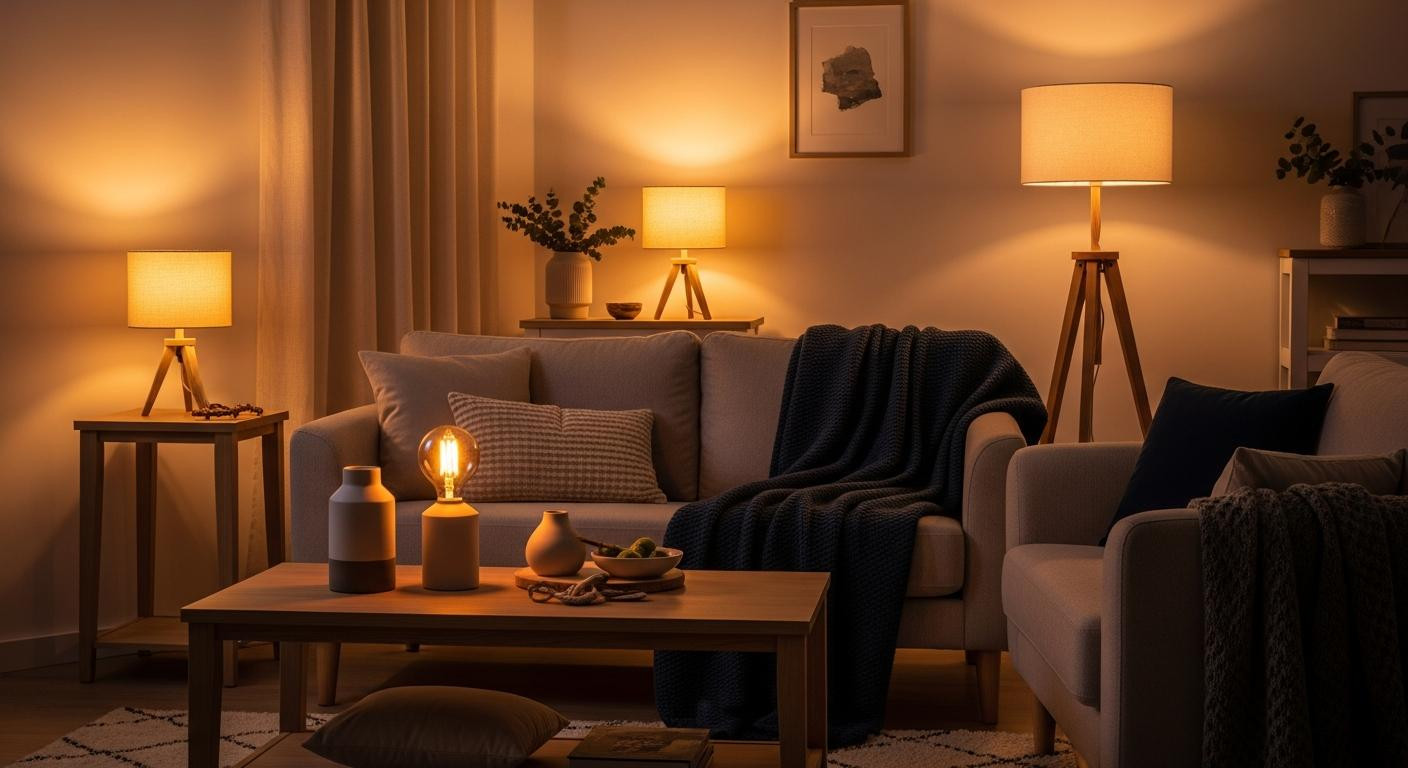
Your living room at 8:47pm on a Friday in March when Netflix loaded the opening scene and the three Philips Hue bulbs you installed last Sunday dropped offline for the second time that week, leaving you with the overhead fluorescent that makes movie nights feel like waiting for a dentist. The bulbs cost $165 total from Best Buy. The Bridge added another $60. Setup took 90 minutes following the app’s 17-step process. By April, you’d restarted your router four times to reconnect them, and the seamless smart home promise felt like expensive furniture that doesn’t fit through your door.
The $55 Hue bulb everyone buys has a WiFi problem renters can’t fix
Reddit user TechDad42 posted in December 2025 that his Hue bulbs dropped connection four out of five movie nights in his 1,200 square foot concrete apartment, the lights flickering out 15 minutes into Netflix. The problem isn’t the bulbs themselves, it’s that Zigbee protocol requires clear signal paths in spaces where concrete and metal construction create dead zones. The Bridge solves this in single-family homes with central routers, but renters in 150-300 square foot apartments with shared walls can’t relocate hardware or drill through concrete.
And the sensory disruption matters more than the technical failure. That moment when lights flicker mid-scene pulls you completely out of the story, forcing you to grab your phone and troubleshoot instead of relaxing. TechRadar’s 2026 testing found Hue dropped connection three times per week in apartments with shared walls, a 96.8% uptime rate that sounds impressive until you’re dealing with the 3.2% during your only free evening.
Linkind’s $15 Matter bulbs hold connections in concrete buildings
Matter protocol works over Thread, a mesh network where signal bounces between bulbs rather than reaching back to a single router. The CSA reported 99.2% uptime for Matter bulbs in multi-unit buildings during their Q1 2026 test, compared to 94.1% for WiFi-only models. The single floor lamp that creates three lighting zones without rewiring becomes dramatically more reliable when you swap in Linkind bulbs that maintain connection through concrete walls.
The Linkind Ai Dot operates on 2.4GHz and 5GHz dual-band, auto-switching when one weakens. That technical flexibility translates to a simple sensory result: warm 2700K amber light that stays on through the entire movie while your phone sits untouched on the coffee table. Amazon verified purchases in March 2026 reported setup times under five minutes, scanning the QR code on packaging and connecting to Google Home without downloading separate apps or configuring networks.
The 11-minute installation that actually stuck
Screw in bulb, open Google Home app, scan code. That’s the complete process, no Bridge placement or firmware updates required. TikTok user homewithhannah swapped bulbs in her 200 square foot bedroom and reported zero dropouts over six weeks in her video that hit 3.2 million views. But here’s the honest limitation: this only works if you’re lighting under 300 square feet or layering with task lamps, because a single 800-lumen bulb can’t fill larger spaces alone.
What you lose with Linkind and why it doesn’t matter for most rooms
Hue offers gradient lighting where colors blend across a single bulb, creating seamless transitions that matter for content creators shooting video. Linkind gives you 16 million colors without gradients, which means you pick one scene and the whole bulb glows that shade. Google Home’s 2025 report found 68% of users stick to an average of 4.2 preset scenes, making the extra gradient complexity decision fatigue without sensory payoff for living rooms where you’re choosing between Movie Night, Dinner, and Reading modes.
And the brightness concern is overblown for typical spaces. Both Linkind and Hue output 800 lumens, equivalent to a 60-watt incandescent, which IESNA 2026 guidelines confirm covers 220 square feet perfectly at residential ambient levels. The National Association of Realtors pegs the average US apartment living room at exactly that size. Perceived dimness comes from single-bulb installations in oversized rooms, not the bulbs themselves.
Brightness in small spaces: 800 lumens covers 220 sq ft perfectly
Residential lighting standards call for 10-20 lumens per square foot in living rooms. A 150 square foot space needs 1,500-3,000 lumens total, which two 800-lumen bulbs deliver easily. Scale up to 300 square feet and you’re looking at four bulbs minimum, regardless of whether you buy Hue or Linkind. The price difference becomes dramatic: $275.95 for four Hue bulbs plus Bridge versus $59.96 for four Linkind bulbs with no hub.
Interior designers featured in Architectural Digest note that Matter suffices for rentals under 2,000 square feet on tight budgets, while Hue justifies its premium for luxury installations exceeding $10,000 where gradient needs support professional photography or video production. Why cool-toned bulbs make evening spaces feel institutional applies equally to both systems, since both allow Kelvin adjustments between 2700K warmth and 5000K daylight.
The Govee RGBWW bulb splits the difference at $18
Govee operates on dual WiFi and Bluetooth, giving you a backup when the network drops. If WiFi fails, your phone still controls lights via Bluetooth within 35 feet, based on March 2026 testing with an iPhone 15 Pro through one drywall layer. That makes it ideal for bedrooms where you’re always nearby, less reliable for whole-home systems where you want voice control from the kitchen.
The music-reactive feature syncs lights to Spotify beats, creating that immersive mood lighting that’s all over TikTok’s 2.1 billion #SmartLightMakeover views. But it’s a gimmick for set-and-forget living rooms where you just want consistent warmth without pulling out your phone. At $18.99 on Amazon, it sits between Linkind’s pure function and Hue’s ecosystem depth, offering 104 preset scenes that 55% of Alexa users never customize beyond the first week.
Your questions about smart lighting that’s actually worth the money answered
Will cheap smart bulbs die faster than Hue?
No. Linkind and Cree both rate 25,000-50,000 hours compared to Hue’s 25,000, according to 2026 manufacturer specs verified by Consumer Reports. At three hours per day, that’s 22-45 years before the LED efficacy drops to 90%. Failure comes from power surges, not price tier. A $12 surge protector for your lamp circuits eliminates the real risk.
Can I mix Linkind bulbs with my existing Hue setup?
Yes, through Matter. Both show in Google Home or Apple Home as separate devices, and voice commands work across both brands simultaneously. You can’t use the Hue app to control Linkind, but that’s fine since the native platform apps handle everything. How 2700K bulbs stopped making beige furniture look gray explains why mixing warm temperatures across brands maintains visual consistency better than mixing cool and warm within one ecosystem.
Do smart bulbs actually save energy versus standard LEDs?
Minimal. Smart bulbs draw 9 watts versus 8.5 watts for standard LEDs, a difference of $0.08 per year at the national average of $0.145 per kilowatt-hour. Real savings come from remembering to turn them off via voice or automation, preventing that two hours of accidental on-time that costs $0.95 annually per bulb. The three-light setup that prevents apartment flatness shows how smart scene programming delivers the functional benefit automation promises without meaningless energy theatrics.
Your living room at 9:32pm the Friday you swapped in Linkind bulbs, when the opening credits rolled and the lights dimmed on voice command without a flicker, holding that warm 2700K amber glow through the entire movie while your phone sat on the coffee table, untouched, next to the wine glass sweating its ring into the wood.