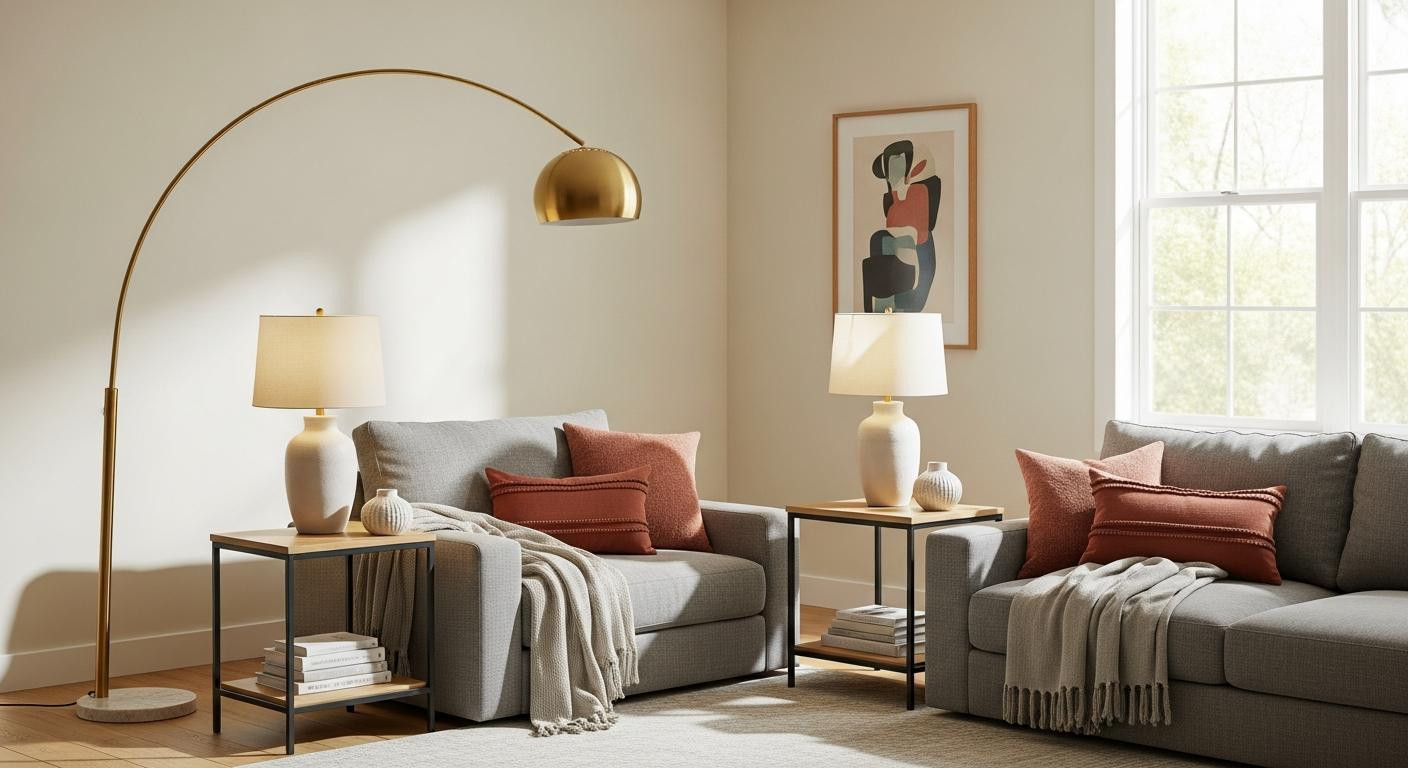
Your living room at 7:18pm on a Tuesday in early May when you flip the single floor lamp on and half the sectional disappears into shadow while the reading chair gets flooded with glare. The space holds $2,400 worth of furniture arranged exactly how the West Elm catalog showed, but the lighting makes it photograph like a hotel lobby after closing. The lamp triangle rule positions three light sources at specific heights to create even illumination without institutional flatness. When your ceiling height cooperates, it transforms dark corners into balanced rooms.
But when it doesn’t, the geometry falls apart.
The 27-inch table lamp height that creates eye-level glow without glare
The bottom of lampshades needs to sit at 24 to 26 inches from the floor when you’re seated on a standard 18-inch sofa. This puts light at eye level without shining directly into your pupils when you turn your head. Design experts featured in House Beautiful specify 27 to 31 inches total lamp height for this exact positioning.
The geometry works because human eye level while seated measures 40 to 42 inches from the floor. Diffused light from shades positioned 16 inches below that creates ambient glow rather than task lighting. And the soft linen or fabric shades scatter light outward, warming the walls instead of drilling a bright spot onto your coffee table.
Why floor lamps need 58 to 62 inches of total height
Arc and tripod floor lamps complete the triangle at 58 to 62 inches, positioning their shades above standing eye level. This height prevents glare when you walk through the room while directing light downward toward seating areas. The Target Threshold Arched Floor Lamp at $69 hits this range perfectly, which explains why it’s collected 1 million Instagram saves since early 2026.
Taller than that and you get ceiling bounce in standard 8-foot-ceiling apartments. Shorter and the lamp reads as a table lamp on a stick, creating visual confusion.
The spacing rule that prevents one lamp from canceling another
Position the three lamps 6 to 8 feet apart in an actual triangle shape, not a straight line. ASID-certified designers note this spacing creates overlapping light pools that eliminate the harsh shadows single lamps cast at furniture edges. The result is a room where you can see faces during conversation without the interrogation-room feel overhead fixtures produce.
In the average 330 square foot US living room, this means one lamp in the darkest corner, one on the opposite side of your sofa, and the floor lamp filling the third point.
The $250 budget split that makes triangle setups feel expensive
Spend 60% of your lamp budget on the floor lamp because it covers the most square footage. The Target Threshold Arched Floor Lamp at $69 handles this role for renters, while the Pottery Barn Spencer Arc at $899 serves homeowners planning to stay 5+ years. Table lamps take 40% of budget split between two units.
The IKEA REGOLIT at $49 each creates the triangle geometry for $167 total. Article Sven lamps at $299 each push the total to $667. That’s a $500 gap for what amounts to textured linen shades versus paper globes, but the visual weight difference is real when you’re trying to stop apartments from looking institutional.
The Wayfair dupe that saves $440 on sputnik triangles
The Wayfair LumiSource Sputnik Floor Lamp at $199 creates Googie-inspired triangles for $527 total when paired with two $164 Amazon Basics ceramic tables. This undercuts the West Elm Gilded Clamp at $599 by $440 while maintaining the sculptural drama Pinterest users save. And the brass finish warms up neutral walls in a way that white plastic simply can’t.
When HomeGoods beats direct brands by $150
HomeGoods stocks West Elm and CB2 overruns at 40 to 60% discounts. The same textured linen shades that cost $299 at Article sell for $149 at HomeGoods locations in Dallas, Atlanta, and Phoenix. But inventory rotates weekly, so you’re gambling on what’s available the day you walk in.
The 8-foot ceiling height where triangles collapse into clutter
Standard builder-grade 8-foot ceilings create a geometric problem. A 62-inch floor lamp leaves 34 inches of vertical space above the shade, but the light it casts hits the ceiling and bounces back as flat institutional glare rather than directional ambiance. Professional stagers with NKBA certification recommend asymmetrical triangles in these spaces: one 52-inch floor lamp positioned off-center plus two 28-inch table lamps.
This drops the tallest light source 10 inches, preventing ceiling bounce while maintaining enough height variation to avoid the “three stumps” look that makes rooms feel shorter. The trade-off is less dramatic vertical sweep, but that’s preferable to the fluorescent-office vibe ceiling glare creates.
The corner position that stops triangles from feeling random
Place one table lamp in the room’s darkest corner, typically the spot diagonal from your largest window. This anchors the triangle and gives you a fixed starting point. The second table lamp goes on the opposite side of your primary seating area, usually 8 to 10 feet from the first.
The floor lamp fills the third point, positioned to light the seating area’s center without blocking traffic flow. Interior designers with 2 million YouTube subscribers call this the “conversation triangle” because it lights faces during evening gatherings. And it works because the three light sources create overlapping pools that fill in the shadows a single overhead fixture leaves around furniture edges.
But you need side tables or console surfaces for the table lamps. Without furniture to anchor them, the lamps feel like they’re floating in random spots.
Your questions about the lamp triangle rule answered
Can you use all floor lamps instead of mixing heights?
No. Three floor lamps at matching heights create a straight horizontal line of light that flattens the room rather than layering it. The eye needs vertical variation to perceive depth. Mixing one floor lamp with two table lamps creates the high-medium-medium pattern that mimics natural outdoor light, where sun comes from above and reflected light bounces from surfaces at mid-level.
Do lamp shades need to match for triangles to work?
Lighting designers recommend one common element: either matching shade shape (all drum, all empire) or matching base finish (all brass, all ceramic). Mismatched everything reads as random rather than collected. The IKEA REGOLIT all-white globe system solves this for $147 total, which is why it’s become the viral dupe for West Elm’s $400 versions.
How do you triangle-light rooms with no side tables?
Use floor lamps with adjustable height arms. The Target Threshold Arched lamp bends to create table-lamp-height light without requiring furniture. Position two of these at $69 each with one traditional 62-inch floor lamp for $207 total triangles in furniture-free spaces. The arc creates the height variation you need while the adjustable heads let you aim light exactly where conversations happen.
Your living room at 8:47pm when you walk in from the kitchen and the sectional glows evenly from three directions, the throw pillows showing their actual terracotta color instead of the muddy brown the overhead light produced. The room feels larger because the corners aren’t black voids. The space finally matches the catalog image that made you buy the furniture.