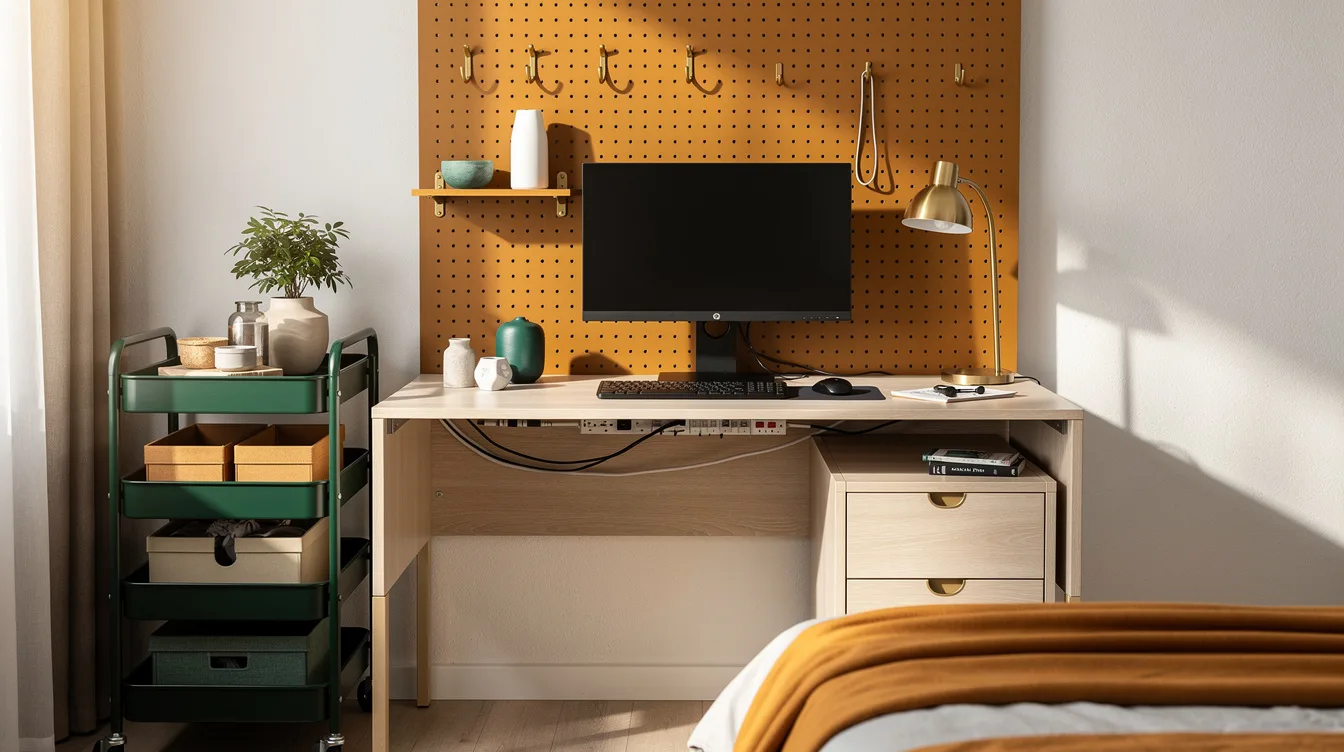
The desktop is rarely the real limit in a bedroom workspace. A desk around 120 cm wide can hold far more when the walls, underside, and closed furniture share the load.
The winning arrangement gives bulk supplies a drawer, daily tools a vertical home, and overflow a compact cart or bedside cabinet. That division keeps the room ready for sleep when the laptop closes.
Park a Drawer Pedestal Under the Desk
A desk around 120 to 160 cm wide gains far more capacity when a drawer unit occupies the empty space below it. The IKEA ALEX drawer unit, made from laminated particleboard and fiberboard, is typically around €60 to €90 and measures roughly 36 W × 58 D × 70 H cm.
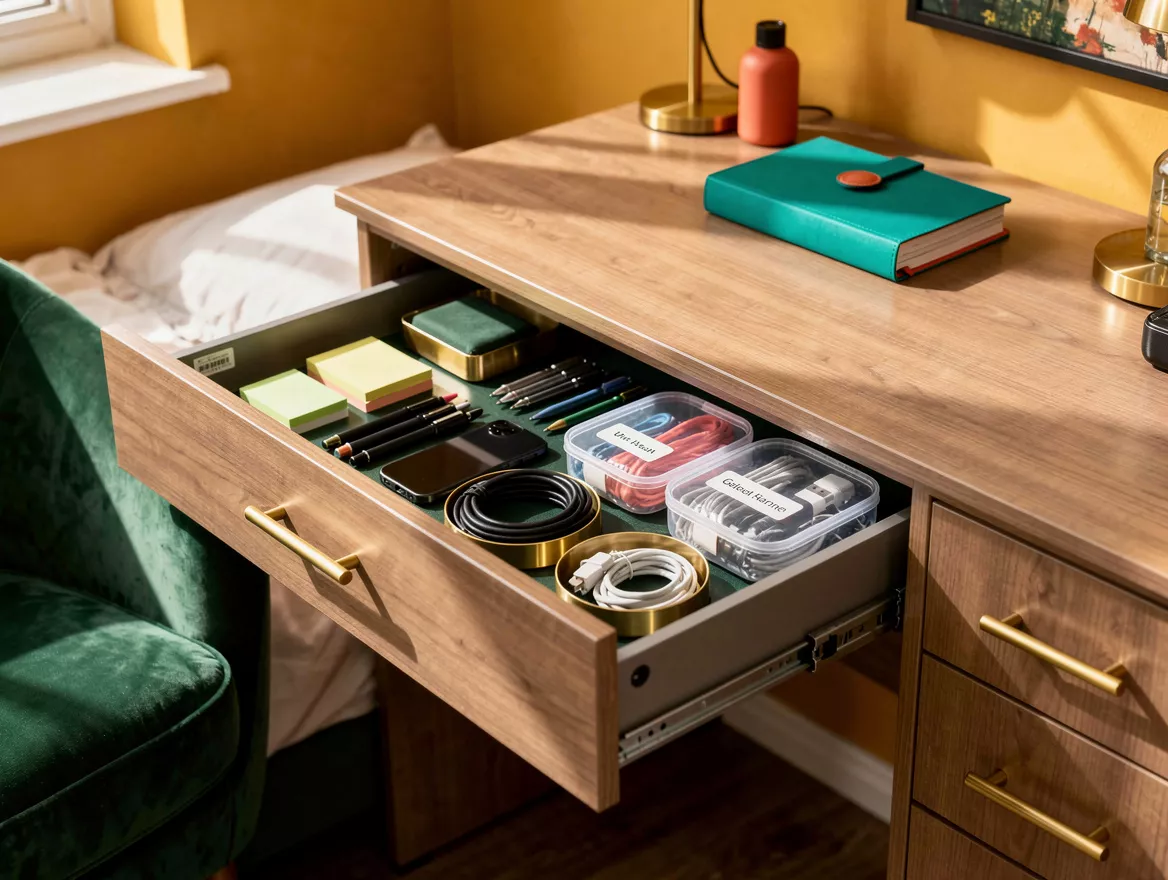
Use the top drawer for stationery and memory cards, the middle drawers for labeled cable pouches, and the bottom drawer for paper or spare notebooks. Add shallow inserts about 5 to 8 cm tall so adapters and cords stay separated instead of becoming one tangled pile.
Build a Vertical Command Wall
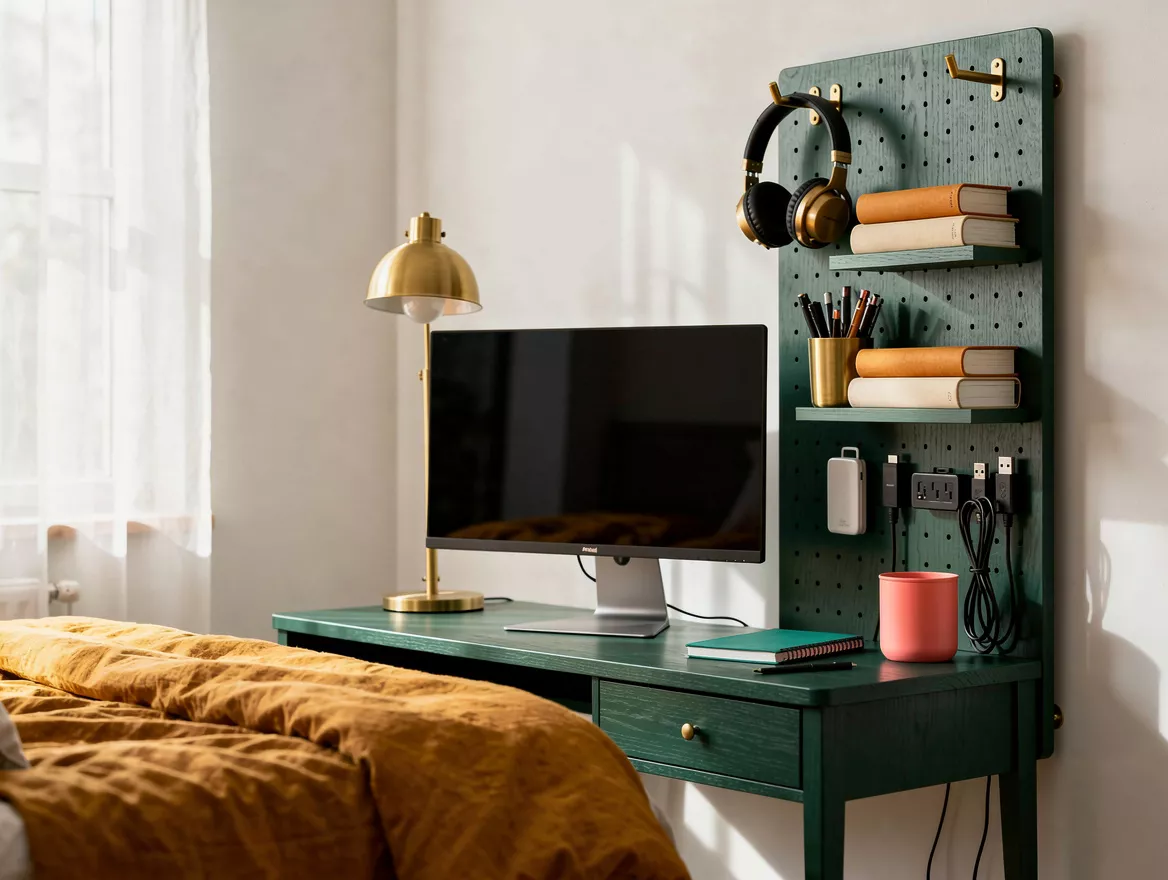
A wall-mounted board moves daily tools off the desktop while keeping them visible beside the screen. The IKEA SKÅDIS pegboard comes in useful sizes such as roughly 36 × 56 cm, 56 × 56 cm, or 76 × 56 cm, with typical prices from about €8 to €50 or more depending on the accessories.
Use steel hooks for headphones, small containers for pens, and narrow shelves for notebooks or solid-state drives. Keep the board inside the desk zone, because a storage wall that spreads across the bedroom quickly starts to look like office equipment.
Lift the Monitor and Claim the Surface
A monitor riser creates a second shelf where the screen used to sit, giving the keyboard, dock, and small bins a place to disappear after work. A bamboo, MDF, or steel shelf from Wayfair or Amazon is typically about €20 to €80, with common widths around 45 to 100 cm.
Choose a shelf roughly 15 to 30 cm deep and 10 to 20 cm high, then reserve the space below it for the keyboard and one notebook. The firmest setup keeps only active supplies there, while backup stock belongs in a drawer or closed cabinet.
Clamp Storage to the Desk Edge
When drilling is off the table, a clamp-on shelf turns the side of the desk into a useful vertical pocket. A powder-coated steel shelf from Home Depot or Lowe’s can cost roughly €27 to €60 and often uses a footprint around 30 to 76 cm wide.
Place it on the side opposite your writing hand so it holds charging blocks, a small notebook stack, or printer supplies without interrupting your main work area. Check the clamp depth before buying, especially on desks with a thick apron or a rear cable channel.
Roll Bulky Supplies Beside the Bed
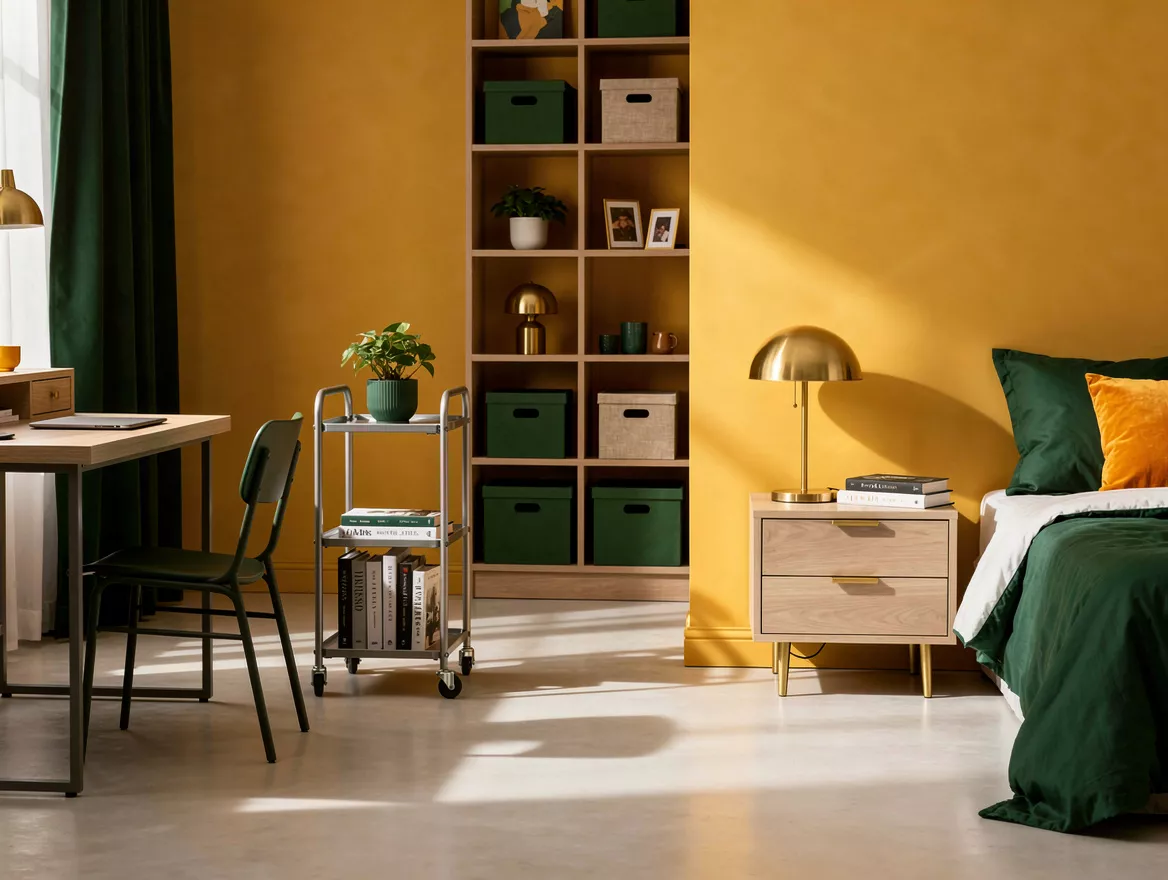
A slim cart handles the awkward items that do not belong on a desktop, including printer paper, camera gear, craft materials, and extra technology. The IKEA RÅSKOG cart or IKEA NISSAFORS cart is typically around €30 to €80, with a footprint of about 30 to 45 cm wide and 40 to 50 cm deep.
Choose two shelves for active supplies and leave the lowest level for heavier stock. A steel cart works best when it parks beside the desk or under a window, where its narrow profile does not make the bedroom feel crowded.
Close Archives Inside Cube Shelving
Open shelves are useful for books, but closed boxes make a bedroom workspace feel calmer when the supply list keeps growing. A IKEA KALLAX shelf measures roughly 77 W × 39 D × 112 H cm in the supplied format and typically costs about €45 to €75 before storage boxes.
Fill two cubes with fabric bins for documents and device accessories, then leave one open for the printer or a frequently used machine. Particleboard and fiberboard are suitable for ordinary office stock, while dense paper archives deserve a stronger filing cabinet.
Reclaim the Bedside Cabinet and Cables
A bedside cabinet can become evening reset storage for headphones, chargers, a tablet, or work items that need to leave the desk at night. A compact wood, MDF, or metal cabinet from Target or Walmart is typically about €35 to €150, with common dimensions around 35 to 45 cm wide and deep.
Finish the arrangement with a steel under-desk cable tray from Amazon, typically around €15 to €45, sized roughly 40 to 70 cm wide. Mount the power strip beneath the desktop, route one cable toward the wall, and keep the floor clear for the chair.
Start with the drawer pedestal if paper and cables are taking over, then add one wall zone for the tools you reach for every day. The room will feel more spacious once every supply has a return trip instead of a permanent place on the desk.
Mia Carter writes about small-space living and budget home makeovers. She has restyled three rentals and tests most ideas in her own 45 sqm flat.