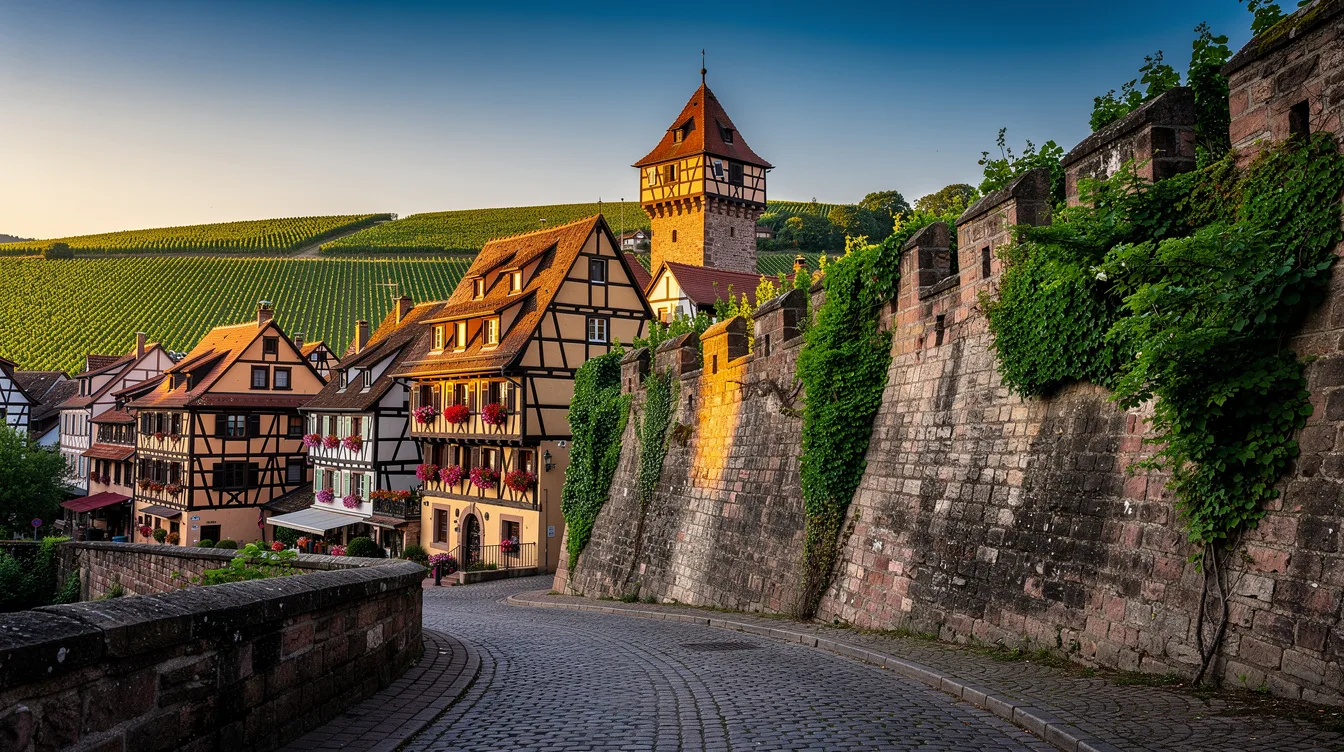
Riquewihr is only 6.8 miles from Colmar, yet it feels deliberately removed from the modern rhythm of Alsace. Its medieval walls still wrap around the village, and much of the street scene remains close to what it looked like in the 16th century.
That’s the promise here, and it holds. Riquewihr is touristy, certainly, but its stone gateways and timbered facades still make you slow down.
Medieval walls make the village feel contained
Riquewihr sits in France’s Haut-Rhin department, on the Alsace Wine Route near Colmar. The village is surrounded by medieval fortifications, so arriving feels less like entering another French town and more like passing through a threshold.
And the walls matter because they give the center a real edge. Streets don’t simply drift into newer neighborhoods. They tighten around old houses, shopfronts, cellar doors, and the occasional view toward the hills.
You can explore the historic core on foot without needing a formal route. That compactness is the appeal, though it also means the central lanes can feel crowded when visitors arrive at once.
A 16th-century look, without a museum hush
Riquewihr looks today much as it did in the 1500s, according to the supplied historical record. Half-timbered houses line the village streets, and the preserved architecture gives every turn an unusually coherent feel.
But this isn’t a sealed-off display. Restaurants, shops, bed-and-breakfasts, and wine cellars occupy those old buildings, so you’ll hear doors opening and glasses clinking behind the painted shutters.
The village has been tied to wine trading for centuries and was known as a Winzerdorf, or wine village. That history explains why wine remains central here, rather than a decorative add-on for visitors.
Can you taste wine in Riquewihr?
Yes. Numerous winegrowers offer cellar tours and tastings in the village, including Hugel & Fils. Riesling is among the wines associated with Riquewihr, and a tasting is the most direct way to understand why this small stop matters on the Wine Route.
And you don’t need to make it a grand production. A cellar visit fits naturally between a walk along the old streets and lunch at a traditional winstub.
The castle adds a harder edge to the charm
A medieval castle overlooks Riquewihr and now contains a museum. It changes the mood of the village, because the postcard-pretty facades are backed by a defensive history you can still read in the walls.
There is also a museum about Alsace during World War II, plus La salle de torture. Riquewihr was one of the few towns in the area not badly damaged during the war, which helps explain the unusual continuity of its historic center.
That preservation is the point. Plenty of places have old buildings, but here the fortifications and street fabric remain part of the same intact whole.
How Riquewihr fits into an Alsace day
Because it’s close to Colmar, Riquewihr works well as a focused stop on a wider Alsace itinerary. It is also near Ribeauvillé, Hunawihr, Eguisheim, and Kaysersberg, so you can pair it with other village visits if you have a car or local transport planned.
But don’t rush through it merely to collect another village name. Riquewihr has enough restaurants, shops, and cellar visits to fill a day, especially if you prefer wandering to checking off sights.
Colmar is the nearest train station mentioned in the research notes. From there, onward local transport or a car is needed, so the logistics require a little planning even though the distance is short.
Is Riquewihr worth visiting if you’ve already seen Colmar?
Yes, if you want a more enclosed and older-feeling setting. Colmar has its own pull, but Riquewihr gives you fortifications, wine-country context, and a village scale that makes an afternoon feel pleasantly narrow.
It is polished, and the main streets won’t feel secret. Still, the moment you look up at the walls or pause beside a cellar entrance, the place earns its reputation.
A small village with a long aftertaste
Riquewihr belongs to Les Plus Beaux Villages de France, an association for some of the country’s most admired villages. That designation brings attention, but the underlying reason is easy to see: its old center has not been broken apart by time.
And that makes the visit less about finding one famous viewpoint. It’s about walking through an intact frame of walls, timber, stone, and wine history.
By the time you leave the gate behind, the village still looks much the way it has for centuries, with the old fortifications holding the noise at the edge.