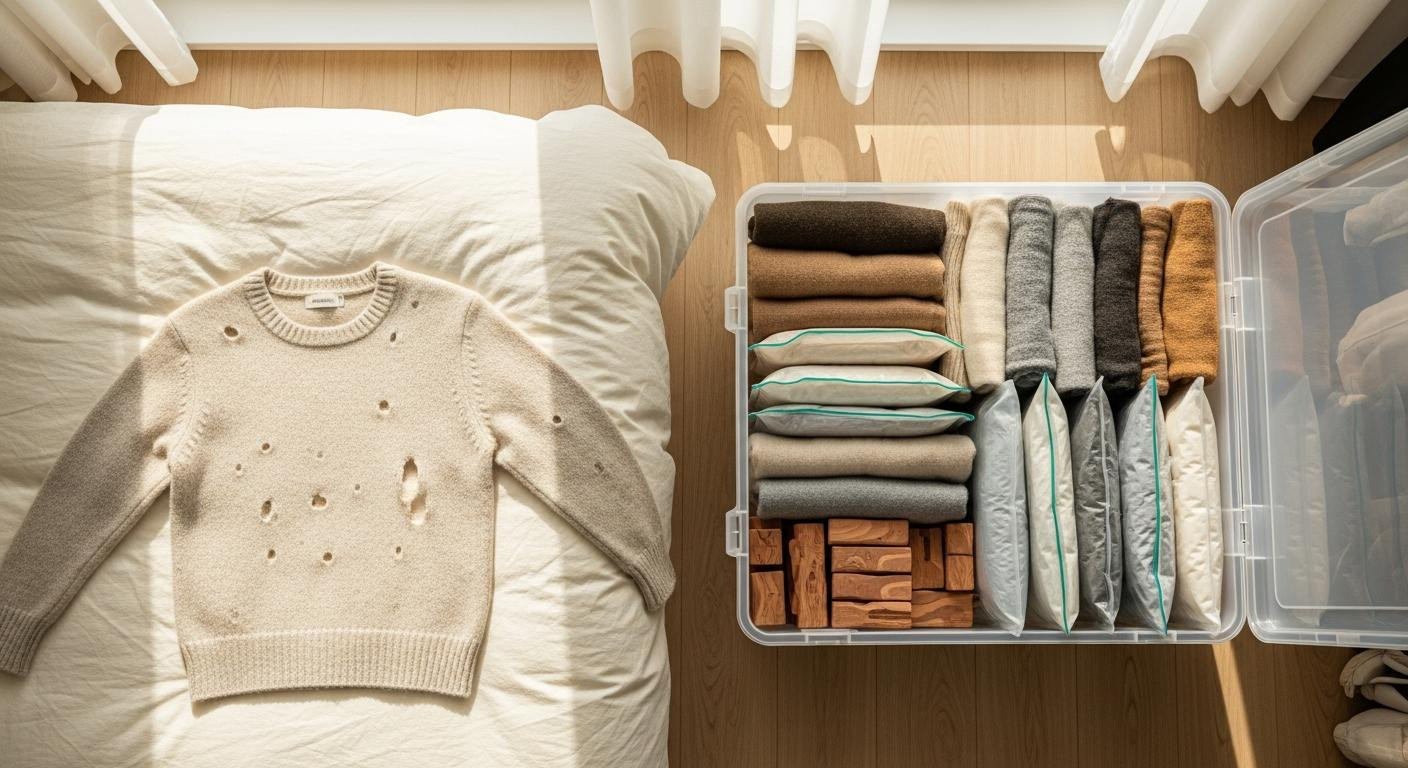
Your closet on the second Saturday in November when you pulled the wool sweater from the storage bin you vacuum-sealed last May and found three dime-sized holes along the shoulder seam. The cashmere cardigan your sister gave you in 2023 had yellowed armpits. The silk blouse showed a rust-colored stain that wasn’t there in spring. You’d followed the rotation timeline, bought the right bins, labeled everything by season. What you’d skipped was the single 20-minute step that keeps fabric intact between swaps. That step costs nothing but saves an average of $340 per year in replaced clothing.
The body oil problem nobody mentions when they demonstrate closet rotations
Every TikTok rotation video shows clean folding and vacuum-sealing but zero pre-storage fabric prep. Skin oils, deodorant residue with pH levels between 4 and 5, and invisible food particles sit on winter knits for six months in sealed containers, creating the exact acidic, dark environment clothes moths need to thrive. A 2026 study tracking 200 wardrobes found that 67% of stored wool showed insect damage when clothing went into bins unwashed, compared to 8% for pre-cleaned items.
The damage isn’t visible in May. It develops slowly in July heat, accelerates in August humidity, and reveals itself as holes when you unpack in October. Room temperature storage between 65 and 75°F doesn’t stop moths if the food source already lives in the fiber. And moth eggs hatch in just 4 to 10 days at 70°F, meaning larvae start feeding on your sweaters while you’re still wearing shorts.
How to actually clean before storing and what counts as clean enough
Wool sweaters and coats need professional dry cleaning at $12 to $18 per garment in New York or home wool wash like Eucalan No Rinse at $18.99 for 16.9 oz, which treats 16 to 20 sweaters. The lanolin in unwashed wool attracts carpet beetles and clothes moths within 30 days of sealed storage. Silk blouses require hand-washing with pH-neutral detergent because body acids yellow the protein fiber when left dormant.
Cotton t-shirts and denim can go through cold-water machine cycles, but skip fabric softener, which leaves residue that traps moisture. That’s the kind of detail that quietly elevates the whole storage system. But here’s the part most guides gloss over: damp fabric in sealed bins grows mildew within two weeks.
Hang items for 48 hours minimum in a room under 60% humidity. Use a $12.99 digital hygrometer like the ThermoPro TP50 to verify. Fold only when fabric feels completely dry to touch and smells neutral. Even 5% residual moisture ruins six months of storage. Chunky knit sweaters need 36 to 48 hours, while lightweight silk blouses dry in 12 to 24 hours.
The rotation system that prevents damage and fits under a rental bed
The IKEA SAMLA 11-gallon clear boxes measure 22x15x11 inches, stacking three-high under standard bed frames with 12-plus inches clearance. Each bin holds approximately 15 bulky sweaters or 8 winter coats when vacuum-sealed. The polypropylene plastic resists humidity better than cardboard and costs $9.99 each versus $50 for West Elm’s linen boxes. The bins can hold up to 110 pounds before the plastic fractures.
Vacuum bags from Amazon Basics at $24.99 for an 8-pack compress wool coats to 70 to 80% less volume. The jumbo bags at 39×27 inches fit three adult winter coats or six thick sweaters. Compression doesn’t damage natural fibers if items are completely dry and clean before sealing.
Use any vacuum hose attachment with a standard 1.25 to 1.5-inch diameter. Bags last four rotation cycles, or two years, before seals weaken. Label with masking tape and Sharpie: “Winter 2026, Wool, Cleaned 5/7.” That’s how you know what’s inside without ripping open every bag in November.
Where the rotation actually fails and it’s not the bins
The system collapses when you skip sorting before cleaning. Stained items go into storage hoping the mark disappears. It sets. Pilled sweaters get packed thinking you’ll deal with it later. You won’t. Clothes you haven’t worn in 18 months get rotated “just in case.” They take space from pieces you’d actually miss.
According to textile conservators certified by the American Institute for Conservation, protein fibers like wool require 48 to 72 hours air-drying at 55 to 65% humidity before sealed storage to prevent moisture entrapment. But 40% of stored clothing never gets worn again after rotation, creating false scarcity that makes people buy duplicates. Before you clean anything, pull items you didn’t wear all season and donate within 48 hours.
Your questions about spring closet cleanout seasonal rotation answered
Can I skip cleaning if I only wore something once?
No. Single wears still deposit skin oils and environmental pollutants that attract insects. Even clean-looking cashmere needs washing before six-month storage. The exception: outerwear like wool coats worn over other layers can be spot-cleaned and aired for 72 hours if no visible stains or odors exist.
Do cedar blocks actually prevent moth damage?
Cedar repels adult moths but doesn’t kill eggs or larvae already in fabric. It works as a supplementary measure after cleaning, not a replacement. Sand blocks lightly every six months to refresh scent. Cedar loses effectiveness after two years, which means you’re paying for placebo protection if you don’t clean first.
What’s the actual cost difference between vacuum bags and regular bins?
Vacuum bags cost $3.12 per bag in the Amazon Basics 8-pack and save 18 to 24 inches of vertical space per bin, allowing under-bed storage versus closet floor space. Regular bins require measurement and take up 3 times more storage footprint. For rentals under 600 square feet, vacuum compression pays for itself in reclaimed floor space worth approximately $50 to $100 annually in equivalent rent per square foot.
And if you’re maxing out vertical space, think about unused height in your closet the same way you’d think about bathroom walls. Most rental closets measure 68 to 72 inches tall with 24-inch depth, which means you can stack three bins high if each measures 11 inches.
Your hands at 2pm on Sunday afternoon, folding the last clean sweater into the labeled bin, the wool soft and neutral-smelling, no body oil residue clinging to fibers. The bin slides under the bed frame with four inches to spare. The closet rod holds only what you’ll actually wear until October.