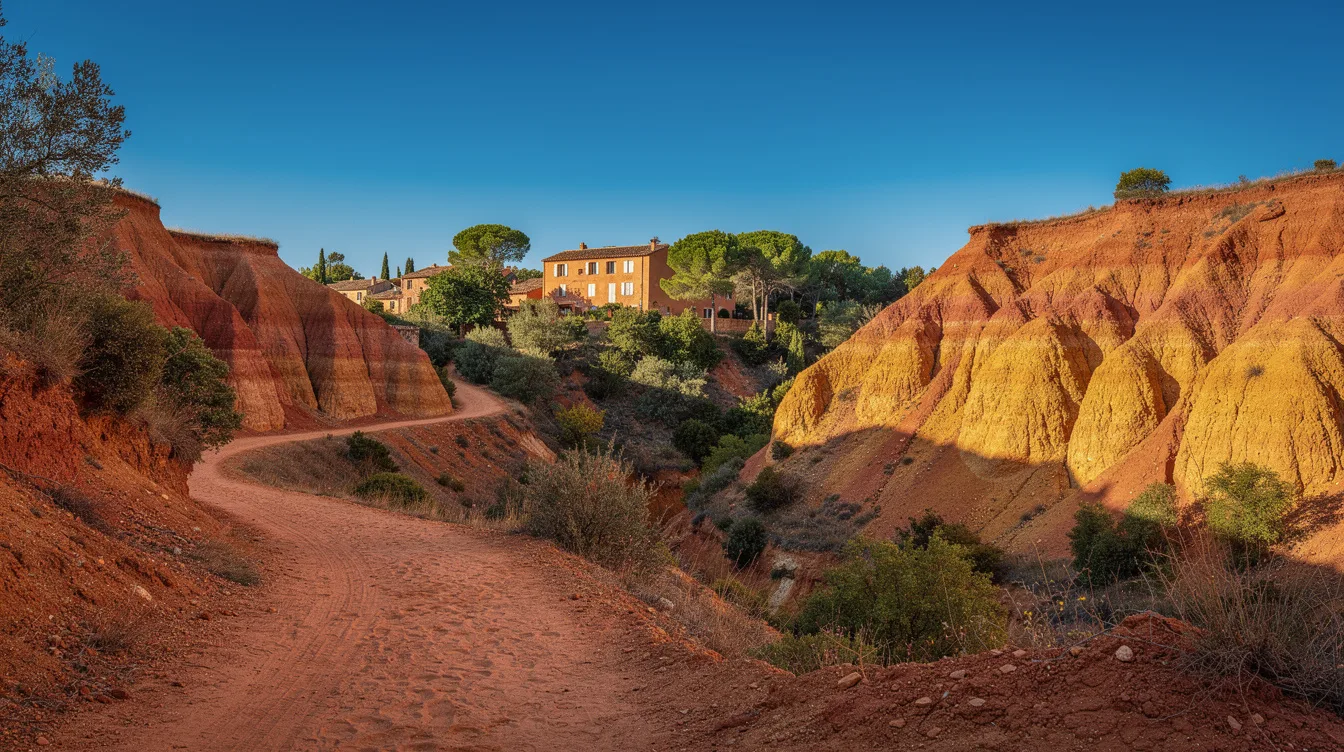
Roussillon puts its old quarries in plain sight. Le Sentier des Ocres crosses former ochre workings where red, orange, and yellow cliffs show the pigments that also color the village facades. You come for the color, but the evidence is under your shoes.
And that connection gives this Luberon village more pull than a pretty street ever could. The earth was processed into pigments for paint, textiles, and art, so the warm walls above the trail feel less decorative than geological.
The quarry walk explains the village’s color
Le Sentier des Ocres is the essential stop because it brings you directly into the former quarries. Choose a marked circuit of roughly 30 minutes or 50 minutes, then look back toward the village once the cliffs have reset your sense of its palette.
But don’t leave this walk for the middle of a summer day if you can avoid it. Early morning and late afternoon make the colors most vivid, and the lower light gives the red and yellow earth a softer, almost powdery glow.
You don’t need a grand explanation while you’re there. The cliffs are red, orange, and yellow. The facades are ochre-toned.
That simple repetition is why the village feels coherent rather than staged.
And the route makes a useful distinction: Roussillon’s color isn’t only an architectural choice. It comes from the local ground, which is why the walk should come before coffee, galleries, or the small squares in the old center.
Walk uphill after the cliffs
The village center is steep, so give yourself time to wander rather than treating it as a quick photo stop. Roussillon is listed among Les Plus Beaux Villages de France, but its appeal is stronger in the lanes than from a single viewpoint.
You’ll pass ochre-toned streets, artisan shops, galleries, cafés, and Saint-Michel church. It is touristy in summer, but the uneven climb keeps the experience from feeling like a flat procession through souvenir windows.
And the bell tower area and upper village viewpoints are worth the uphill effort. From there, the rooftops and warm facades make more sense as part of the same color story you saw in the quarries.
There’s a practical limit to the romance. The lanes are steep, and a half-day works best when you resist trying to turn every nearby village into one enormous itinerary.
Can you understand ochre beyond the trail?
Yes. Ôkhra, Écomusée de l’Ocre occupies a former ochre-processing factory and explains how local earth became pigment. Go if the cliffs leave you curious about the work behind the color rather than satisfied with the view alone.
But the museum is an add-on, not a substitute for the Sentier des Ocres. First see the raw colors in the old quarries. Then the processing story has weight, because you’ve already watched those same tones hold their own against sun and stone.
Getting there favors an unhurried plan
Roussillon sits about 31.1 miles from Avignon and around 37.3 miles from Aix-en-Provence. It is a village in the Luberon, within Vaucluse, and a car is the most practical way to reach it.
That matters because a car also lets you pair Roussillon with Gordes, Bonnieux, Apt, or Rustrel’s Colorado Provençal. But you don’t have to combine them. The quarry trail and upper village can easily hold a half-day.
Arrive before mid-morning and park outside the village. Then walk the ochre trail first, stop for lunch or coffee in the old center, and save the upper viewpoint for later when you’re ready for one more climb.
And don’t confuse this village with the historic Roussillon region around Perpignan. This is the small Vaucluse village with postcode 84220, where the name belongs to a hilltop of pigment-colored walls.
Spring and fall make the better case
Spring and autumn are the best seasons for milder weather and fewer visitors. You’ll have more room to move through the lanes, and the quarry colors can register without the feeling that everyone arrived at once.
Summer still works, but arrive early for parking and lighter crowds. The reward is simple: quieter streets, cooler light, and enough time to walk before deciding where to sit with a coffee.
Thursday morning adds the village market, generally held from 9:00 to 12:00 with Provençal produce and local products. It’s useful if it matches your plans, but don’t let it push the quarry walk later than it needs to be.
And that is Roussillon’s best rhythm. Start with red earth underfoot, climb back through orange facades, then pause as the light shifts across the yellow cliffs.