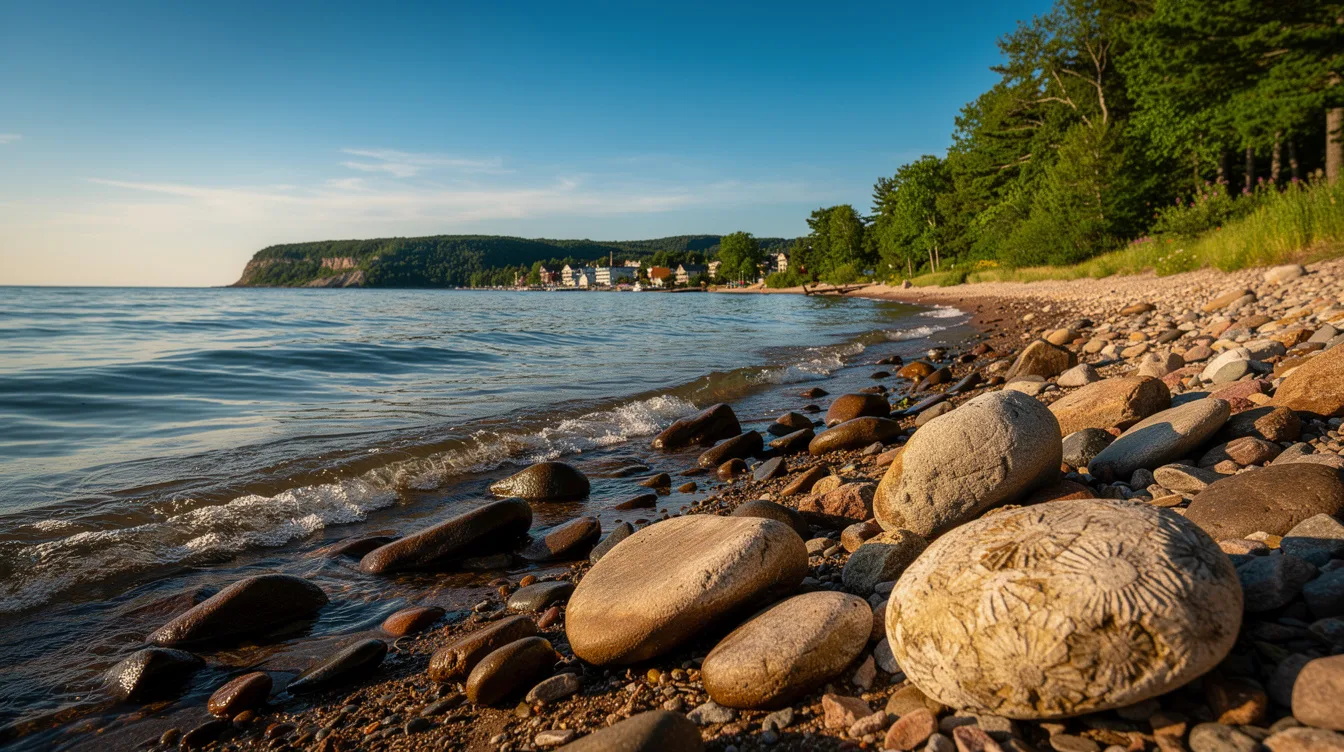
Petoskey sits on Little Traverse Bay in northern Michigan, where beachcombers scan the shore for coral fossils instead of shells. The town’s signature Petoskey stones became Michigan’s official state stone in 1965, and that odd distinction gives a lakeside walk an actual purpose.
These aren’t rare museum pieces behind glass. They’re fossilized coral with a honeycomb-like pattern, and wet stones show it best. Bring a little patience, because you’ll sort through plenty of ordinary gray rocks before one suddenly reveals its familiar cells.
A state symbol you can find at your feet
Petoskey has 5,877 residents according to the 2020 census, yet its name travels far beyond town because of those fossils. The stones make this place more memorable than a standard Great Lakes stop. You’re not just looking at Lake Michigan.
You’re looking down.
And the hunt works because the beach becomes part scavenger hunt, part slow-down ritual. The water darkens the stone and brings out the pattern. On a dry day, you may walk past the very one you came to find.
But don’t expect every stretch of shore to hand you a souvenir. The pleasure is in taking your time, feeling the cool stones shift underfoot, and catching that hexagonal pattern in the shallows.
Petoskey State Park gives the search room
Petoskey State Park has about 1 mile of sandy beach on Little Traverse Bay, plus two campgrounds and trails. That’s enough room to make a morning of it, especially when the lake is calm and the pale sand is still cool.
Late June through August is the busiest window for swimming, boating, beach time, and stone hunting. You’ll share the shoreline then. Still, the water and open bay give the place breathing room that a crowded resort strip rarely has.
Can you find Petoskey stones without making it a whole expedition?
Yes. Start at the park or search beaches around the area, then look closely at wet rocks near the waterline. You don’t need special expertise.
You do need to slow down, which is the point.
And if you’d rather not spend hours crouched over stones, walk the shore first and let the search happen naturally. The bay shifts from blue-green to silver as the light changes, so the stroll earns its keep either way.
The waterfront is closer than it feels
From downtown, follow the waterfront through Bayfront Park, past the marina, and out toward the breakwall. The route makes Petoskey easy to enjoy between meals or shops. You can move from old storefronts to open water without planning a full-day outing.
The Gaslight District is the town’s historic pedestrian center, with independent shops, galleries, cafes, and restaurants. It’s polished, but not overly precious. And that matters after a beach walk, when you want lunch without changing out of practical shoes.
Beyond the harbor, the Bear River Valley Recreation Area cuts through town for a more wooded walk. It’s a useful contrast to the exposed waterfront. You can hear the river instead of rigging and boat engines.
Come in summer, then return for the trees
For a first trip, summer makes the case clearly. Late June through August brings the beach season, lake outings, bike rides, and active patios. But it’s also high season, so Petoskey feels more social than secluded.
Autumn changes the calculation. The colors arrive, scenic drives become the main event, and the roads feel less busy. Take the route toward Harbor Springs and continue to the Tunnel of Trees if you want the day to lean scenic rather than sandy.
Winter has skiing and snow activities in the surrounding north, though conditions can be serious. The Petoskey State Park day-use parking often closes from early November into spring, so don’t treat a cold-weather beach visit as a casual stop.
Getting here rewards a little planning
Pellston Regional Airport is about 30 minutes away. Traverse City offers more flight connections, but it’s roughly 1 hour 30 minutes by road. A car is strongly recommended, because the best nearby drives and towns sit beyond downtown.
Petoskey is also about four hours north of Detroit and around 40 minutes south of the Mackinac Bridge. That makes it reachable, but not accidental. You come because you want the lake, the small-town rhythm, and a reason to watch the ground.
By sunset, Little Traverse Bay turns quieter, and the stones at the edge of the water look almost ordinary again.