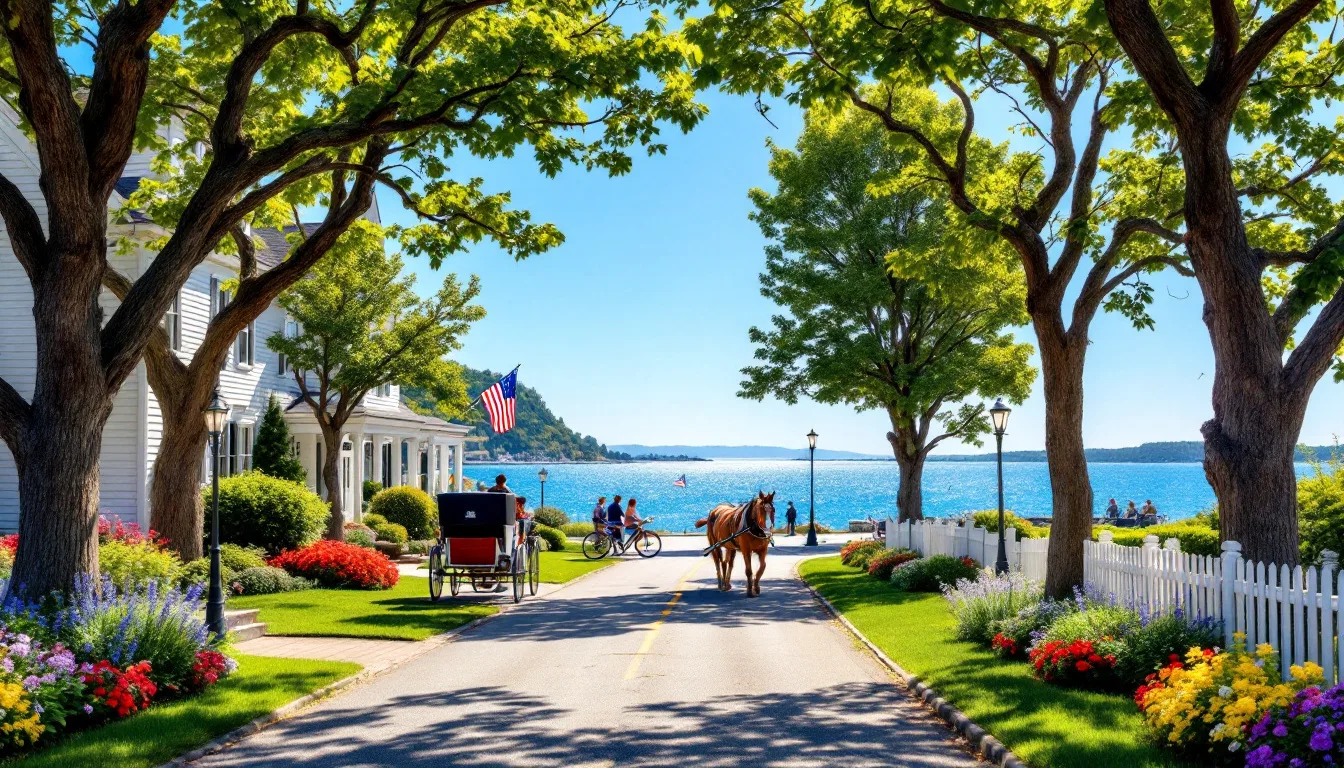
Mackinac Island makes its point before you’ve finished crossing Lake Huron: almost no motor vehicles are allowed here. You get around by walking, cycling, or climbing into a horse-drawn carriage, and that rule changes the whole rhythm of a visit.
The ferry from Mackinaw City or St. Ignace delivers you to a place where hoofbeats replace traffic noise. And because cars are largely absent, you notice small things faster: bicycle bells, water against the harbor wall, the sugary smell drifting from fudge shops.
A car-free rule that reshapes the day
This isn’t a town where you drive to the next attraction. You walk there. Or you ride there.
Most motor vehicles are prohibited, with exceptions for emergency, city service, state park vehicles, and winter snowmobiles.
That can feel inconvenient if you arrive with a packed itinerary. But it’s also the island’s best feature, because every errand turns into time spent outdoors rather than time spent looking for a parking space.
You’ll want shoes that can handle more than a short harbor stroll. The streets invite wandering, yet carriages share the routes, so paying attention matters. Lively, but never rushed, the town feels designed for people who don’t mind letting an afternoon loosen up.
Eight miles around the water, without a windshield
The island’s clearest answer to “what should I do first?” is the roughly 8-mile shoreline circuit on M-185. It runs around much of the island, with Lake Huron close enough that the changing light becomes the entertainment.
Take it by bike if you want to cover ground, or on foot if the point is to linger. And don’t treat the route as a workout with scenery attached. The water, limestone edges, and passing carriage wheels make it the kind of loop that encourages stops.
Beyond the road, the island has named sights that reward a slower plan: Arch Rock, Sugarloaf, British Landing, Skull Cave, and limestone bluffs. You can fit them into a single ambitious day, but spreading them out is the better call.
Arch Rock gets the attention, understandably. Still, the appeal is less about ticking off a landmark than arriving without an engine’s hum behind you. The island’s quiet has texture, especially when the wind carries across the water.
More than 80 percent stays parkland
Over 80 percent of the island is preserved within Mackinac Island State Park. That protection keeps the built-up harbor area from swallowing the island, so a walk can move quickly from Victorian-era streets to park ground and open views.
And that’s why the no-car policy doesn’t feel like a gimmick. It works with the park rather than against it. You’re not just avoiding traffic; you’re traveling through an island where private development has been restricted in the state park.
The scale helps, too. Mackinac Island covers about 4.35 square miles, and it had roughly 583 year-round residents in the 2020 census. It is touristy during the main season, but the island’s physical limits keep it from feeling like a conventional resort strip.
Fort Mackinac makes the quiet feel complicated
Fort Mackinac was built by the British in 1780, on the island’s bluffs during the American Revolutionary War. You can visit for the buildings and the setting, but its history is the sharper reason to go.
The island was the site of two battles during the War of 1812. One came with the British capture of the fort, and another followed in 1814 when American forces failed to retake the island.
But don’t expect history here to stay sealed behind fort walls. The harbor, the bluffs, and the ferry routes all make clear why this spot at the eastern end of the Straits of Mackinac mattered. Location made the island strategic long before it made it relaxing.
You may also hear the island’s name pronounced “MACK-in-aw.” It’s a useful thing to know before asking for directions, though the ferry terminal is hardly a place where anyone needs help identifying where you’re headed.
Go when the ferries and streets are part of the pleasure
The primary visitor season runs from late spring through early fall, and the annual June Lilac Festival falls within that stretch. If you’re planning around the central promise, arrive ready to leave your car behind before you board the ferry.
There are other ways to reach the island, including small aircraft and private boats. Still, the passenger ferry is the right introduction. It gives the island time to appear across the lake, then drops you into a place that operates at carriage pace.
Start with the harbor, then choose a direction and resist overplanning. By the time the ferry pulls away again, bicycle bells and hoofbeats are still carrying over the water.