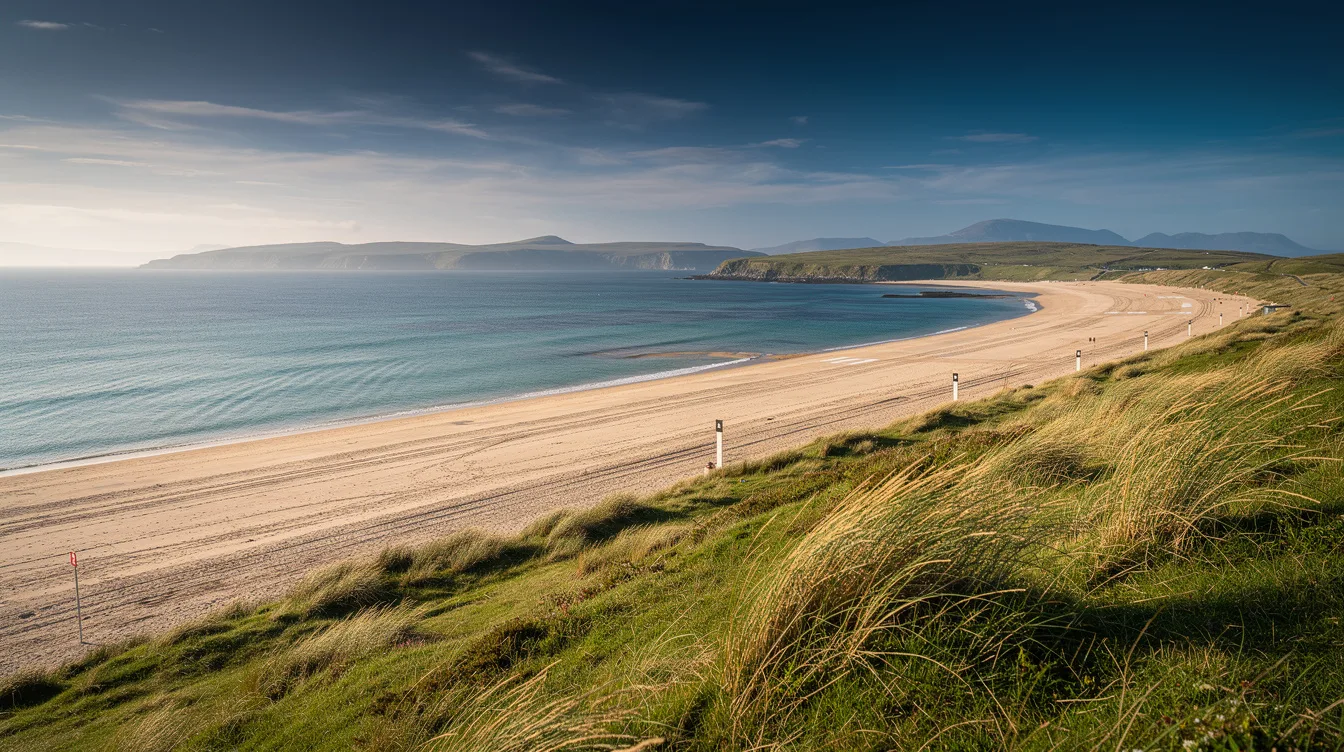
On Barra, scheduled flights land on Tràigh Mhòr, a tidal beach, not a strip of tarmac. Local tourism authorities present it as the world’s only place where scheduled flights land on a beach, so the tide controls the timetable.
But that’s the hook, not the whole island. And if you let the day unfold slowly, you’ll find a compact place where white-sand beaches meet a living Gaelic culture.
Tràigh Mhòr turns the tide into a flight time
And the beach runway works because the airport uses a wide tidal beach. Flights from Glasgow land there when tide and weather allow. The arrival feels like a small piece of theater, because the runway changes with the water.
But you can’t treat the beach like a normal airport. The operating window follows the tide, and beach-runway signs tell visitors where to keep clear.
Can you watch a beach landing?
Yes, you can watch an arrival or departure, as long as you respect the signs and tidal restrictions. And that uncertainty is the charm: the sand can look like a beach one moment, then become an airport when conditions align.
And the oddness is practical rather than theatrical. Because flights follow the tide and weather, the airport waits for its next safe window.
Castlebay sets the pace, and the hill earns your afternoon
Beyond the runway, Castlebay is the island’s main village and harbor. Kisimul Castle sits on a rocky islet in the sheltered bay, so you can see the island’s history before leaving shore.
And the walk up Heaval is worth the effort when the weather opens. It gives you the best all-round panorama over Castlebay and Vatersay, with the southern island chain beyond.
But Barra is compact enough to explore without turning the day into a driving project. You can drive or cycle between beaches and small settlements, stopping whenever the wind eases.
From shore, Kisimul Castle is close enough to anchor the view without dominating it. Check locally for boat access and opening arrangements, because the castle sits offshore and your timing matters.
Gaelic gives Barra a voice you can hear
Barra has about 1,200 residents, and Gaelic remains part of everyday life alongside English. In 2011, 62% of the population spoke Gaelic, so place names can sound as important as road signs.
And the island’s predominantly Roman Catholic character adds another layer to Castlebay and its surrounding settlements. You’ll notice a place that feels lived in, but the visitor pace stays slow.
Tourism and fishing support the local economy, while distilling is increasingly important. But you won’t find a dense sightseeing circuit here, and that’s part of the appeal.
No, the beach is only the beginning. You can cross the causeway to Vatersay for broad beaches and coastal walks, then return to Castlebay with salt on your jacket. That simple rhythm is my favorite way to spend an afternoon here.
Getting to Barra takes a little planning
The island lies at the southern end of the Outer Hebrides. You can fly directly from Glasgow, and ferries run from Oban to Castlebay, so access is remote but not difficult.
But the timetable matters. Atlantic weather can affect ferry services, while inter-island sailing patterns may change by season.
Can you fly in and ferry out?
Yes, and that combination can make the beach landing your memorable first or final leg. Check the live timetable before booking accommodation or onward transport, because one delayed connection can rearrange the whole stay.
And a practical itinerary gives you two or three nights on Barra before you continue toward Eriskay and the Uists. Leave room in the plan, because Atlantic weather can have the last word.
The ferry route gives the island a slower arrival than the flight. From the deck, the crossing becomes part of the trip, but schedules and Atlantic conditions still control the day.
Late spring brings longer days, while summer brings more services
Late spring through early autumn gives you longer days for walking and cycling. Summer has the fullest visitor offering. But wind and rain can interrupt plans, and sheltered areas may have midges.
On the west, white sand meets machair grassland; on the east, rocky Atlantic coast and hills change the mood. You can cover the island quickly, but you shouldn’t rush it.
And this is where Barra earns my vote. You get a slower island pace and a beach airport unlike any other, but you must accept that tides and weather set the terms.
But after an aircraft leaves Tràigh Mhòr, the beach returns to its ordinary work. The wind crosses the sand, and the water takes back the runway, leaving the shoreline quiet again.