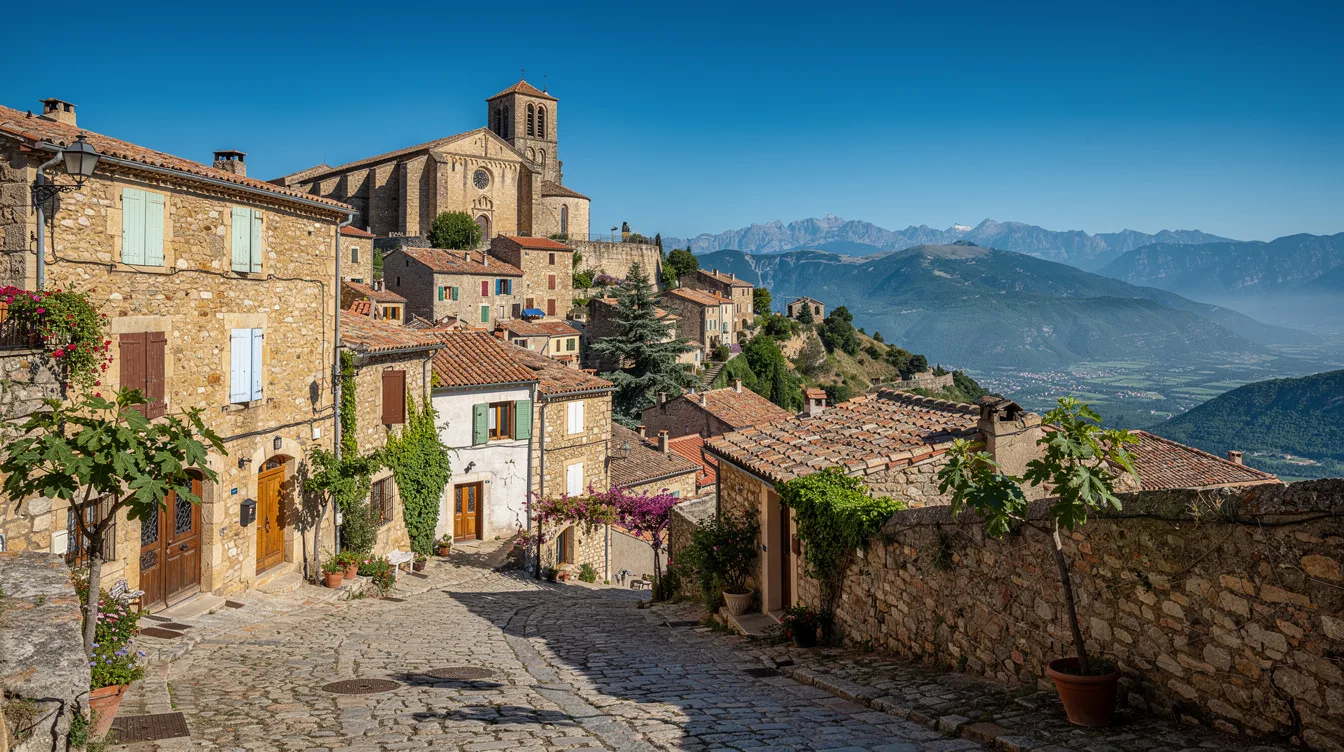
Eus joined Les Plus Beaux Villages de France because its hillside streets still make the climb feel earned. This small Conflent village rises above the valley near Prades, where stone houses, vaulted passages, and the Canigó hold your attention longer than expected.
And the designation makes sense once you start walking. Eus is compact, but its lanes keep turning upward, so each stairway reveals another terrace, another old façade, or a wider view across the Conflent.
Why Eus made the list
Les Plus Beaux Villages de France is not the sort of label Eus wears lightly. The village has the details visitors hope for in southern France, stone walls warmed by the sun, steep cobbles underfoot, and a setting that gives the built village a real sense of shape.
But it isn’t a place for rushing. The heart of Eus is all slopes and stairs, which is why the village works best on foot and at an unhurried pace. You’ll notice the quiet shifts between narrow passages and open views.
From the lower streets, the houses seem to climb toward the summit. At the top sits Saint-Vincent Church, a focal point that pulls the whole visit uphill.
The 18th-century church gives the walk a finish line
The church at the top was built in the 18th century on the site of a former castle. That history explains its position. You don’t arrive by accident, and the final approach gives the village’s steep design a satisfying logic.
And there is also the lower Saint-Vincent Church, medieval in origin and marked by Romanesque elements. The two churches create a useful rhythm for a short visit, one near the lower part of town and one waiting above.
The climb is worth it if your shoes can handle it. Uneven cobbles, strong inclines, and frequent staircases are part of the experience, but they also make most lanes difficult for strollers and visitors with limited mobility.
Can you explore Eus without a long hike?
Yes, if you allow 1 to 2 hours and accept that the uphill section is the point. Park in the free lot below the village, then walk through the center at your own pace. You can stop often, and you probably will.
But don’t mistake short for effortless. This is a village where stone steps can feel longer, especially when the sun is bright and the lanes offer little room to avoid the grade.
Thirty-five minutes from Perpignan, then a different pace
Eus is about 35 minutes from Perpignan, according to the supplied local summary, and just northeast of Prades. That makes it an easy detour for travelers based in the region, though the village itself feels more deliberate than a quick stop suggests.
Because you leave the car below, the arrival is refreshingly simple. The noise drops away as you enter the old center, and stone under your soles replaces the practical business of driving and parking.
Look for the vaulted passages and terraces rather than chasing a fixed route. The appeal is visual but also physical: cool shade under an arch, rough walls close to your shoulder, then a sudden opening over the valley.
Spring is the season that suits Eus best
Spring is the strongest time to visit, when vegetation and blooms soften the stone and the Canigó is often still snowy. The contrast is the reward: a sunlit village in the foreground, with a colder-looking mountain beyond it.
And Eus is known for its sunshine, so start earlier if you want the uphill walk to feel pleasant. The village is lively in its own visual way, but it never asks you to race from sight to sight.
You can spend longer, of course, yet a short visit has its own charm. Walk up slowly, pause at the terraces, and let the view toward the Canigó massif settle in before you turn back downhill.
By the time you reach the free parking below, the pale stone is above you again, stacked against the slope as if the village had been built to catch the last clear light.