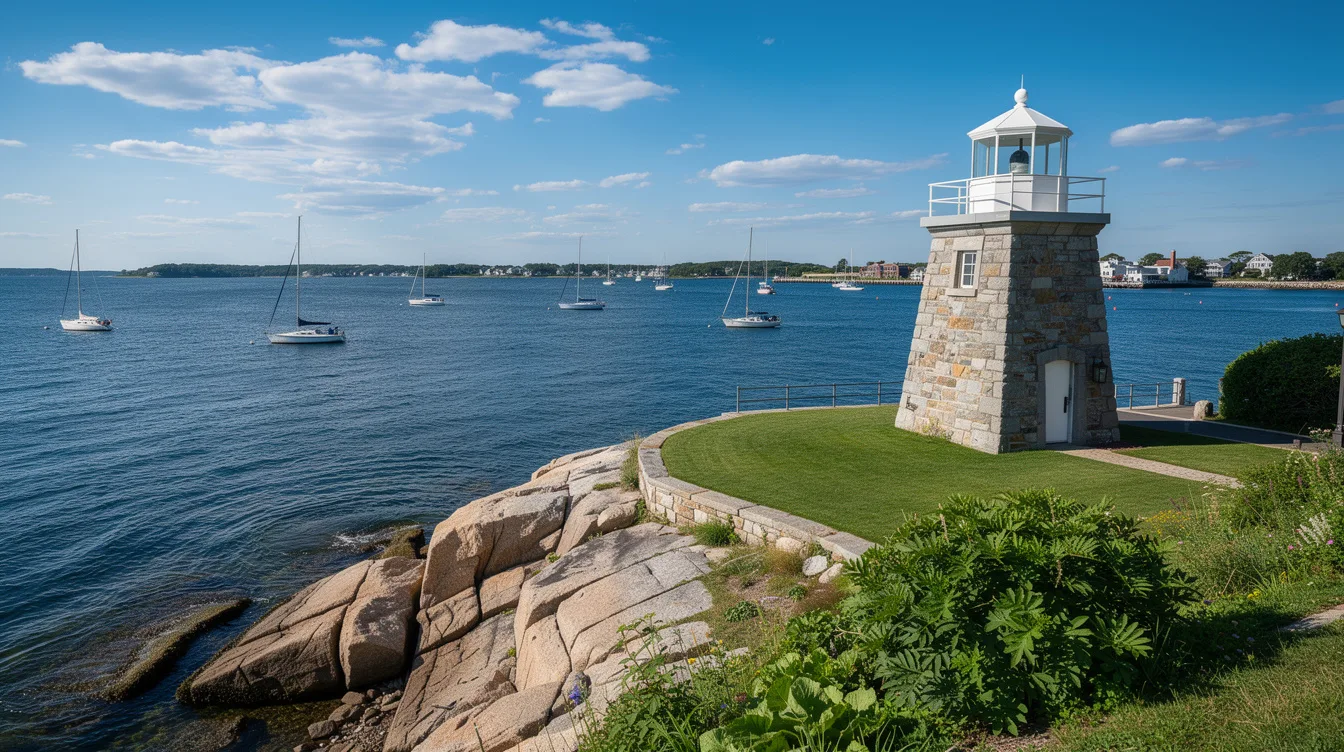
Stonington Harbor Light was built in 1840, then became America’s oldest lighthouse museum in 1925. That switch is the reason to come: this is not a tower you admire from a distant overlook, but a low stone building at the edge of a working Connecticut harbor.
And the setting matters as much as the distinction. Stonington Borough occupies a point of land between Little Narragansett Bay and Fisher’s Island Sound, so water keeps appearing at the end of streets and around the next corner.
Why a low stone light became a museum first
The light was already an old harbor landmark when the Stonington Historical Society made it its flagship museum in 1925. That decision gave the building a different afterlife, because visitors could come for its maritime past instead of treating it as one more piece of waterfront scenery.
But don’t expect a dramatic, tall beacon. The structure is described as a low stone building, which feels right for this harbor. Its appeal is compact and plainspoken, more salt-stained New England than postcard spectacle.
You can understand the museum’s place here by looking toward the water. Throughout the 19th century, Stonington supported fishing, whaling, and sealing fleets, with direct trade to the West Indies. In 1842, that activity was substantial enough to make the town a port of entry.
And that is why the museum designation lands with more force than a date on a plaque. The harbor was a workplace before it became an attractive stop, and its remaining fishing and lobstering activity keeps the Borough from feeling frozen behind glass.
Water Street makes the history feel close
Start along Water Street, where the waterfront walk brings you through the part of town that still faces the harbor. Independent shops, galleries, and restaurants give it movement, but the pace stays measured. You’ll want to wander rather than race between stops.
The Borough has preserved colonial, Federal, and Greek Revival architecture in part because it avoided heavy traffic and modern industry. But it was also a fashionable summer residence after the Civil War, so the streets carry both practical harbor history and a quieter residential polish.
Cannon Square and Wadawanuck Square anchor the two main streets. The latter takes its name from the former Wadawanuck Hotel, a useful reminder that visitors have been arriving here for a long time, even when the harbor was the stronger draw.
You’ll also find a granite Customs House facing Main Street just north of Cannon Square. It is small, but that modest scale suits Stonington. The Borough doesn’t overwhelm you with monuments, which makes each maritime remnant easier to notice.
A borough shaped by water, not crowds
Chartered in 1801, Stonington is Connecticut’s oldest borough. Its 2020 population was 976 people, and the entire borough covers about 0.7 square miles, roughly half of it water. That compact geography is why a short walk can feel so tied to the shore.
But small does not mean silent. One of Connecticut’s last commercial fishing fleets works here, and the harbor’s fishing and lobstering identity remains visible. You may come for the lighthouse, then find the boats are what hold your attention longest.
The Borough is lively, but never built around hurry. Its streets are densely settled, while the peninsula opens outward toward the bay and sound. On a clear day, the air has that sharp marine feel that makes even a simple walk seem worth extending.
There is a trade-off. This is a small historic village, not a destination packed with large attractions. If you need constant activity, pair it with nearby Mystic.
If you prefer a harbor where you can slow down and look, the limited scale is the point.
How to fit Stonington into a Connecticut day
Stonington Borough is in southeastern Connecticut, about a 10-minute drive from Mystic. That proximity makes it an easy detour, yet the peninsula setting changes the mood quickly. You leave Mystic’s bustle behind, then arrive at streets that seem to end in water.
And give the lighthouse more than a rushed photo stop. Walk the waterfront, pass through the Borough’s shops, and make time for Dubois Beach if you want to stay near the shore. The experience works best when you let the harbor set the schedule.
The oldest lighthouse museum in America is a fine reason to turn off the main route. By the time you reach the water’s edge, the low stone light is still there, facing a harbor that has never quite stopped working.