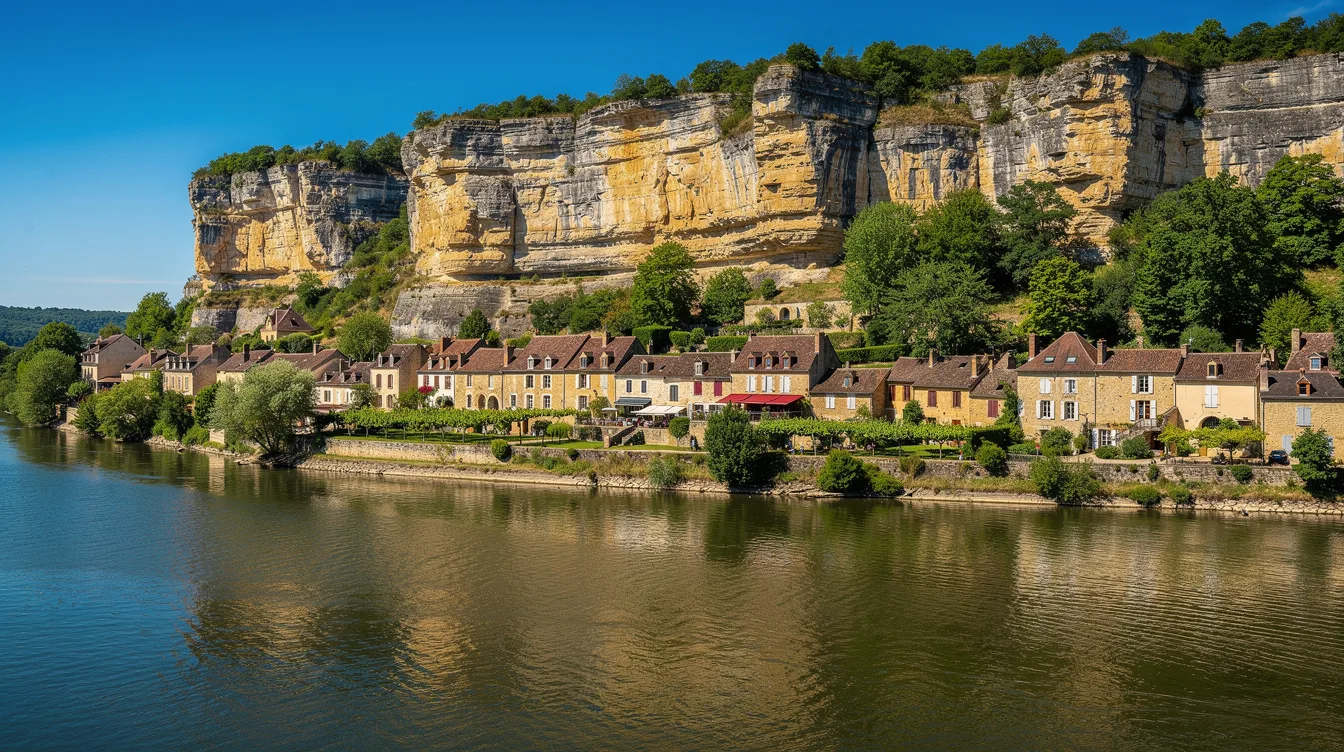
La Roque-Gageac makes its case in one glance: pale houses press against a limestone wall, and the Dordogne bends directly below. This is the quieter side of France promised by the view, but it is not empty in summer.
The village sits in the Périgord Noir, about 7.5 miles from Sarlat-la-Canéda via the D703. Come in May, June, or September, when you can still hear water against the bank between passing cars.
A 394-foot wall changes the whole village
The limestone cliff rises about 394 feet behind the village. It faces south, so the streets feel unexpectedly mild and palms, bamboo, and Mediterranean plants appear beside stone walls.
And that setting is why La Roque-Gageac feels so compressed. You walk with the river on one side and rock on the other, with little room for anything casual or sprawling.
The houses carry blond stone, lauze roofs, and brown tile. In late light, the facades pick up a warm color that makes the riverbank stop feel less like sightseeing and more like an excuse to linger.
But the narrowness has a cost. Some lanes slope upward, and the climb to the fort includes stairs. If mobility is a concern, keep to the riverside and take in the village from below.
The Dordogne gives the village its best angle
A gabarre cruise is the move here, because the river explains the village better than the road does. These traditional flat-bottomed boats once carried wood, wine, and other goods along the Dordogne.
Today, the boats mainly take visitors on sightseeing cruises that generally last about an hour. From the water, you see why the houses were built so close together and why the cliff dominates every view.
And you do not need to treat the ride as a box to check. The river slows the day down, while the village becomes a long strip of roofs below the pale rock.
The boat also puts the valley’s castles into the wider scene. It is tourist-facing, certainly, but it does not feel loud if you choose a less crowded time of day.
Go up to the troglodyte fort, then come back down
The troglodyte fort is built into the rock and traces back to a medieval defensive system. Its main reward is the overlook across the Dordogne valley, not a long museum-style visit.
But start before the heat does. The ascent has steps and inclined passages, and you will enjoy the view more if you are not arriving already tired from the village lanes.
Up there, the river’s curve becomes clear. You can see the settlement pinned between water and cliff, which is the central fact of La Roque-Gageac rather than a decorative backdrop.
Back at street level, look for the Manoir de Tarde, Notre-Dame church, and the Château de la Malartrie. Do not rush between them. This is a village best read at walking speed.
Friday mornings and the case for shoulder season
From May through September, a producers’ market takes place Friday morning at the foot of the village. It gives you a reason to arrive early, before the riverside parking fills and the D703 gets busy.
July and August are the compromise. The place is popular, and gabarre reservations can require advance planning if you want a specific departure time.
And that is why May, June, and September are the smarter months. You still get the south-facing warmth, but the village has more room to breathe.
Give La Roque-Gageac two to four hours for the lanes, the fort, and a boat ride. Add nearby Castelnaud-la-Chapelle, Beynac-et-Cazenac, or the gardens of Marqueyssac, and the day becomes a valley itinerary.
A small stop that rewards restraint
If you have a car, the D703 makes the approach straightforward from Sarlat-la-Canéda. But park early or later in the afternoon, because the spaces by the water disappear quickly in peak summer.
You could follow an easy rhythm: arrive around 10, walk the village, climb to the fort, then take a gabarre after lunch. It is a full day only if you add the neighboring sites.
The riverside itself is the easy part, while the upper lanes ask more of your knees. That contrast is useful: you can choose your version of the village without pretending every corner is effortless.
By late afternoon, the cliff holds its shadow over the roofs, and the Dordogne keeps moving past the stone.