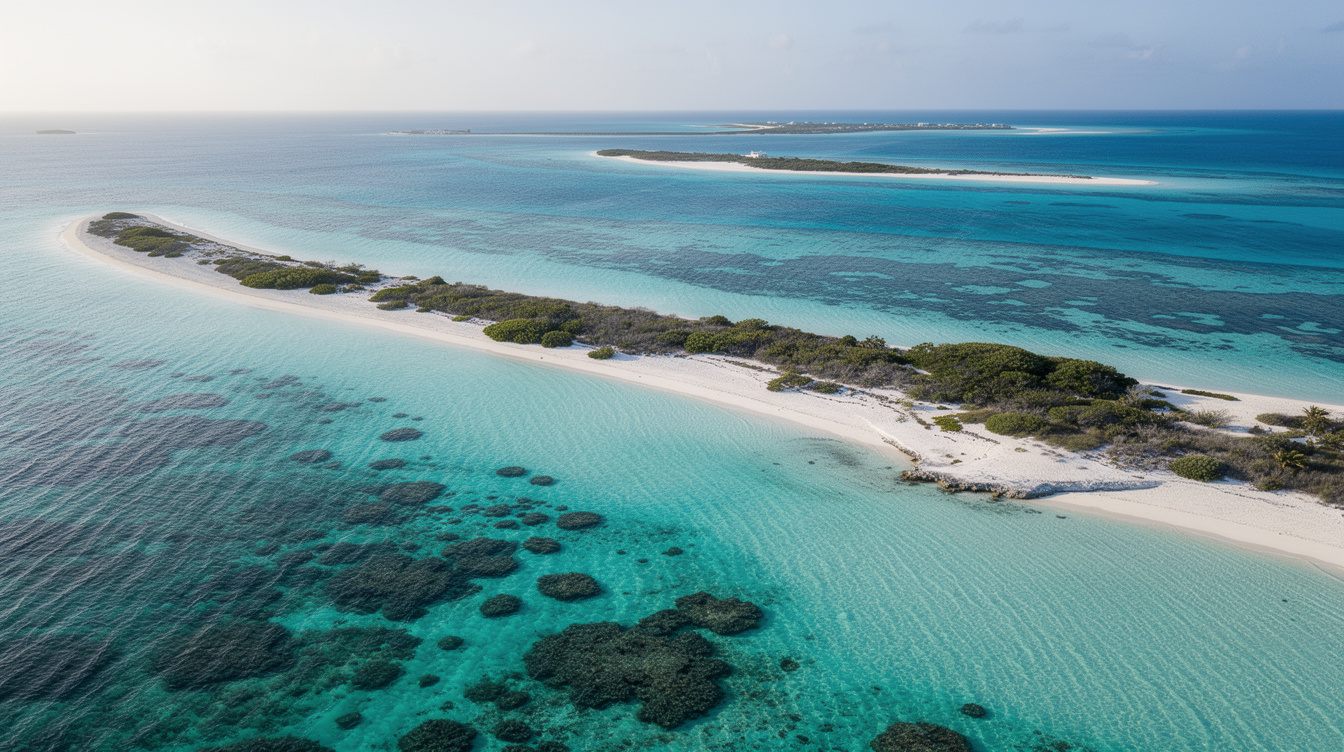
You step out of Providenciales International Airport into 84-degree air and the first thing you see is a resort billboard. Then another. The Grace Bay strip is 10 minutes east, and it delivers exactly what those billboards promise. The problem isn’t what’s on that island. The problem is that Turks and Caicos is 40 islands wide, stretching roughly 90 miles east to west, and most Americans spend their entire trip on 7 miles of one of them.
Why Providenciales works, and what it can’t give you
The barrier reef running parallel to Provo’s north shore is the physical reason Grace Bay’s water looks the way it does. Atlantic swell hits the reef and stops. The shallow sand bottom scatters light upward and produces that electric turquoise that genuinely doesn’t need a filter. And it’s honest about being a polished machine: nightly rates at Grace Bay resorts run $500-$1,200 in peak season (December through April), dropping to $250-$600 from May through November.
Provo has grocery stores, four-lane roads near the airport, and a proper hospital. But it doesn’t have salt flats, near-silence, or the humpback whales that pass through the Turks Island Passage, 22 miles to the east, between January and April. That’s where the archipelago gets interesting.
The outer islands run on a different clock
Salt Cay: 80 people, one road, and a major whale corridor
Salt Cay has a permanent population of roughly 80 people and one paved road. The island was the center of the Turks Islands salt trade, and the stone windmills and salinas built in the 18th century still stand, still filling with brine each season. Because the Turks Island Passage runs between Salt Cay and Grand Turk as a deep-water channel, an estimated 2,500 humpback whales use it as a migration corridor between January and April, moving between winter breeding grounds near the Dominican Republic and feeding waters farther north.
Local dive operators run whale-swim excursions from roughly $150 per person. The island has three guesthouses, and they book out weeks in advance during whale season. But you’d never know any of this existed if you only looked at the Provo resort brochure.
Grand Turk: the capital that cruise ships visit for five hours and leave
Cockburn Town, on Grand Turk, is the territorial capital. The British colonial streetscape, grid layout and pastel clapboard buildings, survives intact because large-scale resort development never arrived. Cruise ships dock at the purpose-built pier and spend roughly 4-6 hours before departing. After 4pm, the streets belong almost entirely to the island’s permanent residents. And the dive wall off Grand Turk’s western shore drops from about 35 feet to over 7,000 feet within a quarter-mile of the beach. Guesthouses run $120-$200 per night.
Getting there is the actual decision
Turks and Caicos Airways operates inter-island turboprop service between Providenciales, Grand Turk, and Salt Cay. The flight to Grand Turk takes 20-25 minutes. One-way fares typically run $150-$200 per person. A ferry also connects Grand Turk and Salt Cay, a crossing of roughly 45 minutes, though the schedule varies and weather in the passage can delay it. Because Provo meets every need a resort traveler has, most visitors never look up either option. That’s the logistics gap that keeps the outer islands empty.
South Caicos sits on the edge of the Caicos Bank and operates almost entirely around the conch and lobster fishing industry. The wall dive on the bank’s eastern edge runs through clear water with near-zero boat traffic. There is one place to eat. It doesn’t keep consistent hours. The same pattern plays out across the Caribbean: a short crossing separates a packed island from a near-empty one, and most travelers never take it.
What you trade when you go
The outer islands aren’t a better version of Provo. They’re a different thing entirely. Salt Cay has no pharmacy. If a flight cancels because of weather in the passage, you’re staying another night whether you planned to or not. A boat captain who has run the Salt Cay route for decades puts it simply: you’re on island time, and the island decides.
The dive sites are world-class and empty. The silence after dark is the kind that makes you notice your own breathing. And that is either exactly what you came for, or exactly what you didn’t. The Bahamas raises the same question, and TCI answers it the same way: knowing which experience you want is the only planning that matters.
Your questions about Turks and Caicos answered
How do you get between the islands?
Providenciales (PLS) receives direct flights from Miami, New York JFK, Charlotte, and Atlanta, with flight times of 2.5-3.5 hours depending on origin. Turks and Caicos Airways connects Provo to Grand Turk (GDT) and Salt Cay (SLX) on turboprop aircraft. The Grand Turk-Salt Cay ferry runs on a local schedule posted on-island. Drive on the left on Provo. The outer islands require no vehicle.
When is the best time to visit?
December through April is peak season: dry, consistent trade winds, calm water. And if the outer islands are your target, January through April is the only window for the humpback migration through the Turks Island Passage. May through November brings lower rates but real hurricane risk, with the Atlantic season running June through November.
How much does a trip to Turks and Caicos cost?
Provo resorts run $250-$1,200 per night depending on season. Outer island guesthouses on Salt Cay average $120-$200 per night. Budget $150-$200 per person each way for inter-island flights, on top of your main airfare. Timing your Caribbean trip right can cut Provo resort costs nearly in half.
By 7pm on Salt Cay, the salinas have gone dark pink in the last light. The brine algae does that, catching something between coral and rust. Out past the windmills, the Turks Island Passage is already black.