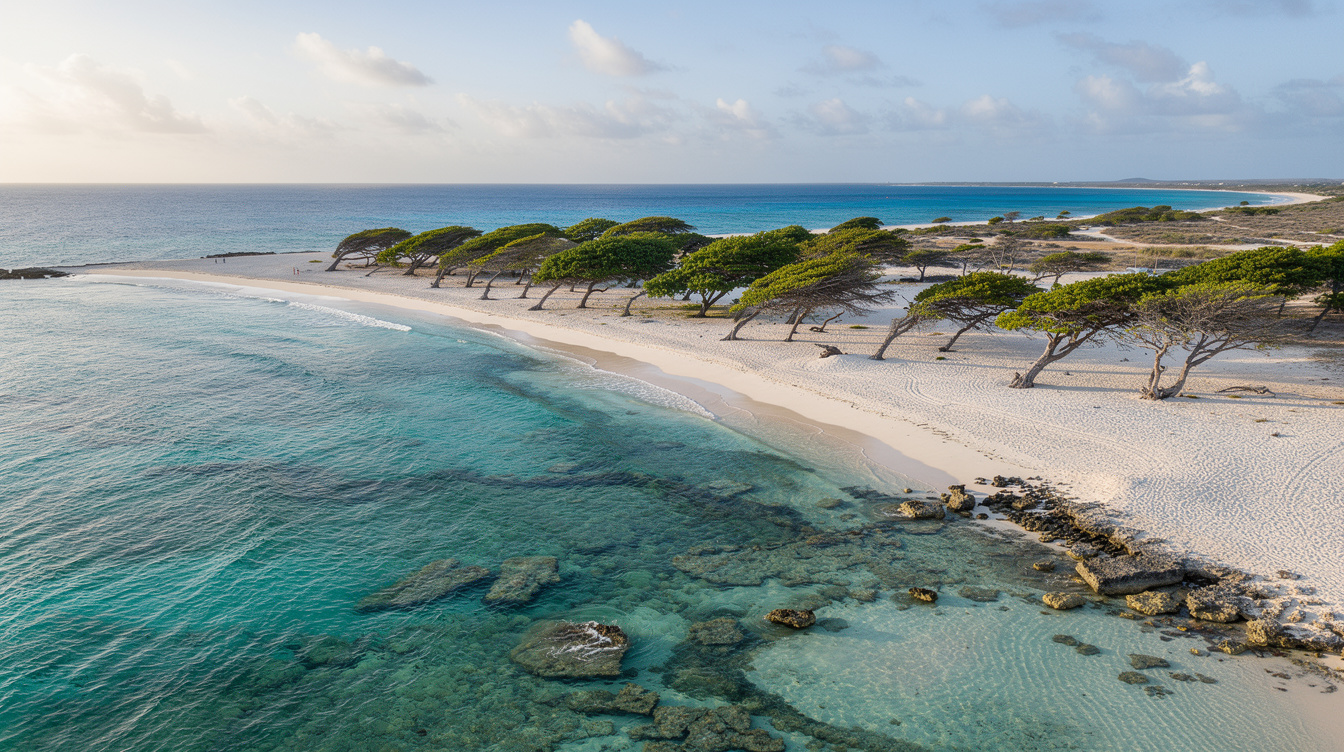
Every divi-divi tree on Aruba leans southwest. Not most of them all of them. The northeast trade wind blows at 15 to 25 mph virtually every day of the year, bending those trees so permanently that locals call them living compasses. That consistency isn’t a curiosity. It’s the physical explanation for why Aruba logs roughly 22 inches of rain per year and has no recorded direct hurricane strikes in modern history. The wind explains everything.
The wind doesn’t vary, and that’s the whole point
Aruba sits at approximately 12°N latitude, about 15 miles north of the Venezuelan coast and well south of the main Atlantic hurricane track. Storms typically form and travel between 15°N and 20°N, which means Aruba sits outside that belt by a meaningful margin. Because the trade wind arrives from the same direction nearly every day, the island’s weather is as close to guaranteed as the Caribbean gets.
And that consistency reshapes every practical decision you make before you land. Which beach you book, which watersport makes sense, which side of the island to sleep on all of it flows from one meteorological constant. Barbados has its own single geographic fact that runs the whole island, but Aruba’s version is purely about wind direction and what it does to 20 miles of coastline.
Two coasts, one island, completely different water
Eagle Beach runs roughly 1.5 miles of white sand along the leeward west-southwest coast, about 3 miles from the capital Oranjestad. Because the trade wind blows northeast-to-southwest, this coast sits protected in the lee. The water stays flat and shallow for 50 to 100 yards out, warm by 8am, and that particular pale green-blue color is a product of the sandy bottom catching sheltered light, not a marketing trick.
But drive 20 minutes east and the same island looks nothing like the brochure. The windward northeast coast at Boca Grandi faces the trade wind directly. Waves run hard against volcanic rock, the wind carries enough blowing sand to make sitting still uncomfortable, and the water runs deep green rather than turquoise. Kitesurfers launch here because the conditions are powerful and consistent. The “which side matters” logic applies here just as clearly as it does in Jamaica.
Both faces of the island are accurate. Knowing which one you’re booking toward is the only decision that matters before you confirm the hotel.
What the wind means for your timing and budget
Because Aruba sits outside the hurricane belt, the Caribbean’s late-summer risk calculus doesn’t apply here. Most travelers avoid the Caribbean from June through November. On Aruba, that probability is historically near zero, which creates a real value window. A mid-range Palm Beach resort room that runs $300 to $350 per night in February can land at $200 to $250 in June, with thinner crowds and the same trade wind at the same speed.
And the wind keeps summer temperatures in the mid-80s°F rather than the humid 90s that wetter islands produce in July. Grace Bay follows a similar late-spring logic for value timing, but Aruba’s window runs longer because the weather guarantee is stronger.
The trade-off the wind doesn’t fix
Baby Beach, on the island’s southeastern tip about 13 miles from Oranjestad, is genuinely the calmest water on the island. It’s a near-enclosed bay, shallow and wind-sheltered. But the drive passes within a half-mile of the Valero oil refinery. The water is clean. The approach is not scenic. Both things are true, and any honest boat captain who has run island tours for decades will tell you the same.
Arikok National Park covers roughly 20 percent of Aruba’s total land area along the windward interior. The trail to the Natural Pool (Conchi) runs 3.2 miles round trip over loose volcanic rock. Yamanota Hill, the island’s highest point at 617 feet, gives you both coasts simultaneously on a clear morning. It’s not a casual walk, and there’s no shade for the first mile. The famous beach isn’t always the right one, and the same logic applies to Aruba’s interior: most visitors never reach it.
Your questions about Aruba answered
How do you get to Aruba and get around?
Queen Beatrix International Airport sits about 2.5 miles east of Oranjestad, with nonstop service from Miami (roughly 4.5 hours), New York JFK (about 5.5 hours), Atlanta, Newark, and Boston. Car rentals start around $45 to $65 per day. The fixed government taxi rate from the airport to Palm Beach runs approximately $27. A public bus line covers the north-south hotel strip between Oranjestad and the high-rise zone.
When is the best time to visit?
Peak season runs mid-December through April, with February prices and crowds at their highest. But late May through early July is the practical sweet spot: rates drop 20 to 30 percent, beaches thin out, and the trade wind doesn’t care what month it is. One caveat: Saharan dust (calima) can reduce air quality for a few days at a stretch in summer months, though it affects the whole Caribbean region, not Aruba specifically.
How much does a trip to Aruba cost?
Aruba prices in USD, which simplifies budgeting. Eagle Beach properties run 10 to 15 percent less than comparable Palm Beach hotels. Lunch at a local spot in Oranjestad costs $12 to $20. Pastechi (savory pastries) near the main market run $2 to $3 each. Snorkel gear rental at Eagle Beach operators runs about $15 to $25 per session. Budget travelers who avoid resort dining and book June will find the island more affordable than its reputation suggests.
By 6am at Eagle Beach, the sand is still cool and the trade wind has already started. It comes in at a steady 18 mph, just enough to lift the tops of the low waves and carry a faint salt mist across the flat water. The divi-divi trees don’t move. They gave in to the wind years ago.