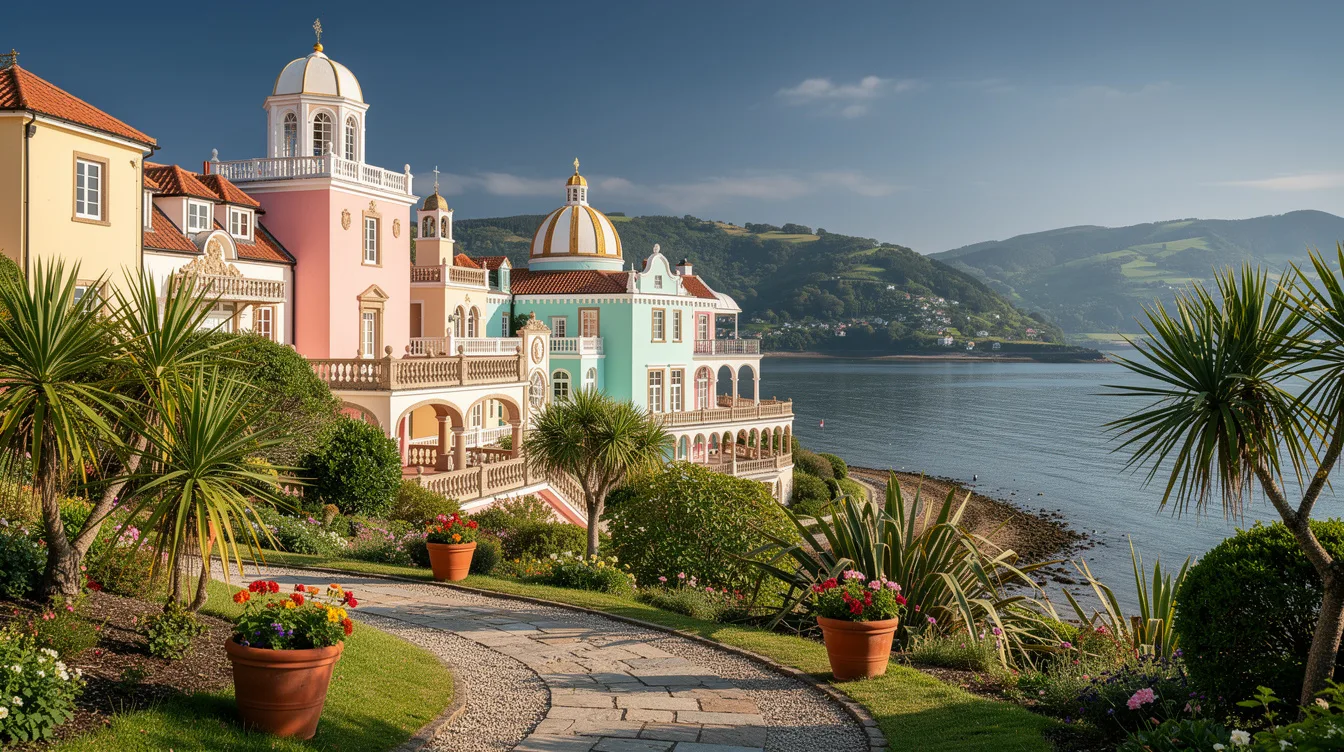
Portmeirion sits just 2 miles from Porthmadog, but it feels far removed from ordinary Wales. Built in an Italian style between 1925 and 1975, this private tourist village turns pastel facades, piazzas, and a campanile toward the Dwyryd estuary. You arrive expecting a curiosity and find a place with enough visual confidence to rearrange your afternoon.
Two miles from Porthmadog, Wales turns Italian
And the setting explains why Portmeirion works. The village overlooks the Dwyryd estuary, so its Mediterranean references sit against Welsh water, wooded hills, and coastal air. That tension is the point, and in my view, it’s far more interesting than a faithful replica of an Italian town.
But the details keep the illusion lively. The Central Piazza, the campanile, the Town Hall, and the Pantheon create a theatrical route through the village. You can pause beside a bright facade, hear footsteps crossing the paving, then turn a corner and see the estuary beyond it.
1925 to 1975: a long argument with ordinary architecture
And the dates matter: 1925-1975 was the span in which the architect designed and built Portmeirion. His idea was practical as well as fanciful, showing that architecture could improve a setting instead of damaging it. Recovered architectural fragments and trompe-l’oeil details give the village its playful, assembled character.
But Portmeirion became famous for another reason. The 1960s television series The Prisoner used the village as “The Village,” turning its pleasant surroundings into a strange place of surveillance and confinement. If you know the show, the colorful buildings carry a second meaning; if you don’t, the setting still feels deliberately theatrical.
Y Gwyllt adds wild space beyond the piazzas
And you shouldn’t stop at the central buildings. Y Gwyllt, the gardens and woods, extends toward the coast with subtropical vegetation, walks, and views across the estuary. The mood shifts quickly from painted architecture to leaves, salt air, and the quieter edges of the peninsula.
But the gardens aren’t a quick photo stop. Allow a half-day if you want to see the village and its grounds without rushing. The front of Portmeirion feels social and composed, while the wooded paths give you space to slow down.
That contrast is what makes the visit hold together.
Can you reach Portmeirion without a car?
And yes, the village is easy to place on a North Wales itinerary. Portmeirion lies in Gwynedd, 1 mile from Minffordd railway station and near the A487 at Minffordd. You can also park near the entrance, which makes a visit straightforward if you’re driving through the region.
Can you visit all year?
But check the day’s details before setting out. Portmeirion is open all year except Christmas Day, with general visitor hours listed as 09:30 to 17:30 in winter and up to 18:30 during the high season. Admission is paid, and booking online is generally sensible before you go.
How much time should you allow?
And a simple visit takes half a day, especially if you want the gardens as well as the central village. Day visitors usually leave by late afternoon, while overnight guests can explore more quietly afterward. You don’t need a full weekend, but you do need more than a hurried photograph from the entrance.
Stay overnight, and the village changes after the crowds
And staying on site is the better choice if you want Portmeirion at its calmest. The estate has two hotels, rooms spread through the village, and 13 cottages, along with cafes, restaurants, shops, and a gelateria. You pay for that atmosphere, but you gain time when the day visitors have gone.
But the village isn’t trying to feel authentically Welsh or authentically Italian. It’s a carefully made fantasy, set above Welsh water and backed by gardens. By evening, the piazza quiets, the pastel buildings lose their glare, and the Dwyryd estuary becomes the view you remember.