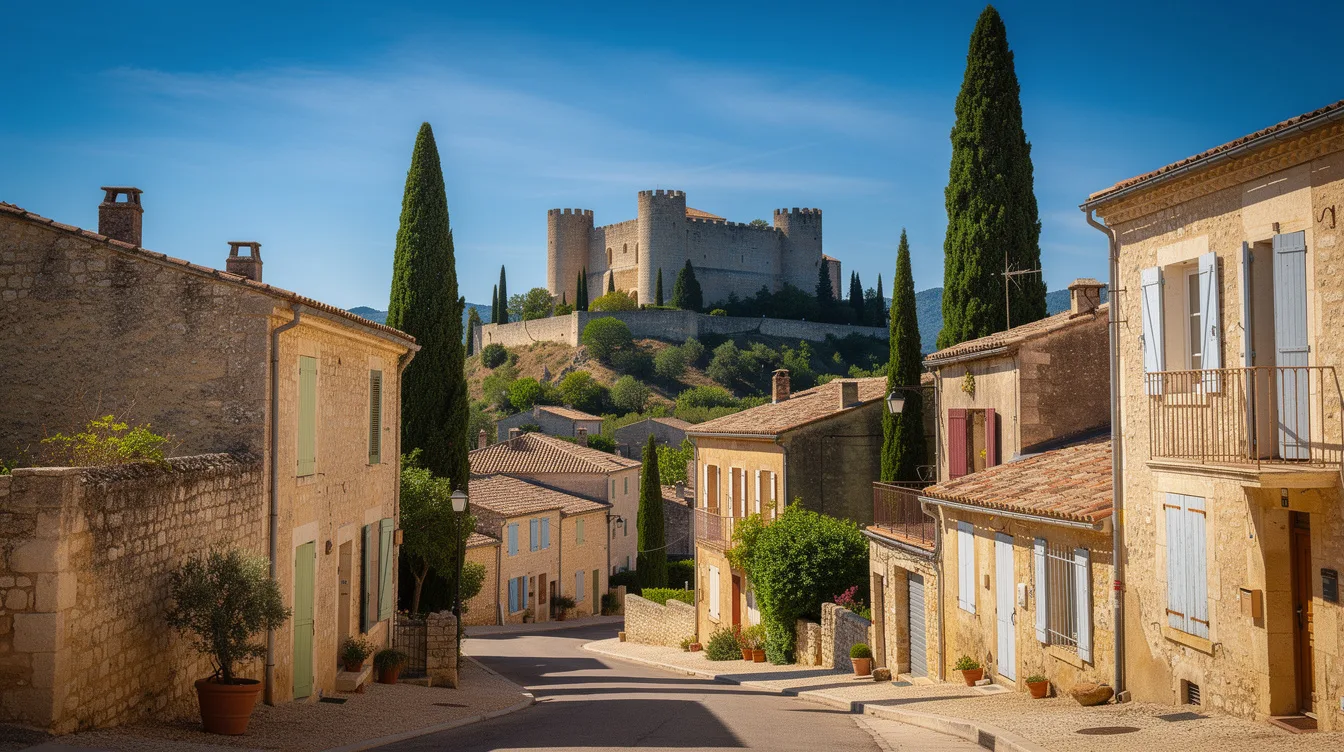
Ansouis sits about 15.5 miles north of Aix-en-Provence, yet it feels built for a slower afternoon. In the South Luberon, this Vaucluse village rises around a castle whose walls began as a fortress in the 10th century.
That fortress is the point. You come for the lanes and stone façades, then look up and realize the village has been arranged beneath its highest, hardest-edged landmark for centuries.
The fortress explains the village
Château d’Ansouis occupies the village summit above the Aigues valley. A fortress was first built here in the 10th century, then altered in the 13th, 15th, and 19th centuries, so its long history is written into the building itself.
And this isn’t a castle you glimpse from a highway and forget. Its position pulls you uphill through the old center, which makes the approach feel earned even on Ansouis’s compact scale.
The private château is a listed historic monument, with guided visits depending on the period. Check directly before you go, because seasonal opening times vary and a closed gate changes the rhythm of a small village quickly.
But you can still understand its hold on the place from outside. The fortress crowns the slope, while narrow streets fold below it in pale stone and warm ocher.
Walk 0.7 miles, then linger
The old village is best explored on foot. The “Entre ruelles et calades” route runs about 0.7 miles, takes roughly an hour, and is very easy, so you don’t need hiking shoes or a grand plan.
Start near Place de la Vieille Fontaine, then head up Rue de France and Grande Rue toward the château. You’ll pass calade lanes, small squares, old ramparts, and passages that turn a short walk into an excuse to stop often.
And don’t rush the final climb. Église Saint-Martin, a medieval Romanesque church near the château, gives the top of the village another reason to pause before you wander back down.
The descent through Rue des Remparts and Rue du Grand Four is gentler in spirit than the climb. Stone underfoot, shutters overhead, and the occasional terrace make this feel lively enough for an afternoon, but never loud.
Can you do Ansouis in half a day?
Yes, and that’s arguably the right amount of time. Ansouis has just over 1,000 residents, so its appeal is concentration rather than a long checklist of sights.
Give yourself time for the château area, the village circuit, and a terrace stop. There are limited dining options, though, so reserve lunch ahead if eating here matters to your day.
Beyond the center, vineyards and olive groves frame the South Luberon. The area’s AOC Luberon wines, olive oil, and seasonal truffles give the village a working rural context, not merely a carefully preserved backdrop.
A good stop near Pertuis
Pertuis is about 5 miles away, and a car is the practical choice for seeing this corner of the Luberon. Ansouis is also easy to pair with Com/search? Q=Cucuron+France”>Cucuron, Lourmarin, Sannes, or La Tour-d’Aigues if you want a fuller day.
But let Ansouis set the pace. Its streets are made for walking, while the surrounding roads invite detours through vines and olive trees after you’ve had your fill of stone walls.
Sunday has its own appeal: the village market normally runs from 6 a. M. To 1 p.
M. At Place de la Vieille Fontaine. Parking can be tighter then and during high season, so arrive early if you dislike circling for a space.
And if the market isn’t your plan, that’s fine. The village doesn’t need an event to work. It needs a little unhurried time and shoes that can handle uneven lanes.
The details worth checking first
Ansouis is part of Les Plus Beaux Villages de France, a designation it has held since 1982. That label brings attention, but the village remains small enough that the experience still depends on timing and patience.
Before setting out, confirm château tours, museum hours, and restaurant openings directly. The Musée Extraordinaire has works, fossils, marine objects, and other curiosities, while Château Turcan focuses on wine trades and old cellar tools.
Those are worthwhile detours if they’re open. Still, the fortress remains the essential sight because it gives every lane below it a destination.
By late afternoon, the château holds the high ground above the village, and the last warm light settles on the calade stones below.