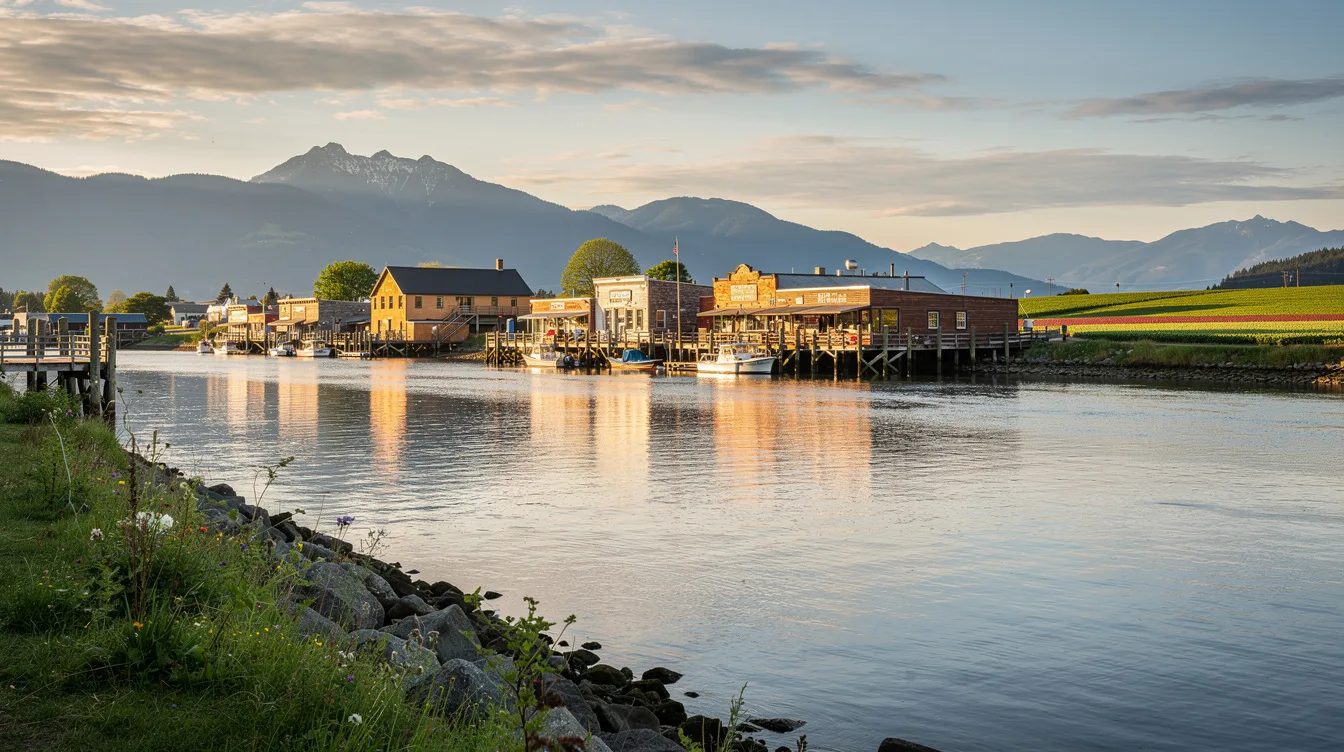
La Conner has 965 residents and sits at the edge of Washington’s Skagit Valley, the world’s largest tulip-growing region. That makes it a useful base in April, when the annual Skagit Valley Tulip Festival brings color to the fields between Mount Vernon and La Conner.
But the town isn’t merely a place to sleep between flower-field visits. Its historic center, waterfront, galleries, and museums make it the kind of small-town stop where you can abandon the schedule for an afternoon. Visit during a festival weekend, and expect more people than the population suggests.
April puts La Conner beside the biggest flower show
The best reason to come is April, when the tulip festival fills the Skagit Valley with broad bands of color. The fields are outside town, so La Conner works better as a calm base than as the main event itself. You’ll get the flowers, then return to a village with places to eat and wander.
And the timing creates a clear trade-off. Festival weekends can be crowded, while the town’s slower rhythm returns outside the peak bloom period. If you’re planning a Washington getaway, this is an easy seasonal choice, especially if you prefer art and water views after a morning among the tulips.
First Street gives the village its easy rhythm
First Street concentrates much of La Conner’s appeal, with independent shops, cafes, galleries, wine tastings, and a brewery. The street also opens toward the waterfront, so you can move from browsing to views of the channel without turning the day into a complicated excursion.
But La Conner stays small, and that’s part of its appeal. You won’t find the energy of a major city or a resort town here. Instead, you can walk, pause over lunch, and watch the water along the Swinomish Channel.
The mood is lively in April, but rarely frantic.
Can you make it a full day without rushing?
Yes, especially if you like a loose itinerary. Start along the waterfront, continue through First Street, then choose a museum or gallery before settling into a meal beside the channel. And if you’re traveling with someone who dislikes packed schedules, La Conner gives you room to slow down.
Rainbow Bridge and the museums add substance
The orange-arched Rainbow Bridge is La Conner’s clearest visual marker, crossing the Swinomish Channel toward Fidalgo Island. It also gives the town a sense of connection beyond its compact center. You can photograph the bridge, then return to the historic district without needing a long drive.
And the Museum of Northwest Art gives the visit more weight than a quick flower stop. Its permanent collection focuses on artists from the American Northwest, with temporary exhibitions changing through the year. The Pacific Northwest Quilt & Fiber Arts Museum occupies the historic Gaches Mansion, while the Skagit County Historical Museum sits above town with a broad view.
What should you see besides the tulips?
Choose the museum that matches your mood. Art lovers should start with MoNA, while the quilt museum offers a more intimate setting. But the historical museum may be the best pause when you want context and a view rather than another shop.
Summer brings the water into focus
Summer is a good time to visit if flowers aren’t your priority. The waterfront, terraces, and channel become the center of the day, and the agricultural surroundings feel less like a spectacle. You can also use La Conner as a stop before or after visiting the San Juan Islands or Fidalgo Island.
And winter has its own reason to work. The region attracts snow geese, trumpeter swans, and sometimes bald eagles, giving bird-watchers a quieter season to consider. The town is remote in feel, but it’s still only about one hour north of Seattle, which keeps a weekend visit practical.
A coastal outing makes the village a wider escape
For a short outing beyond town, Kiket Island offers a coastal hike of about 2 miles.
But don’t treat La Conner like a checklist destination. Come in April for the tulips, summer for the waterfront, or winter for birds. By evening, the last light rests on the Swinomish Channel, and the village feels exactly as small as its population suggests.