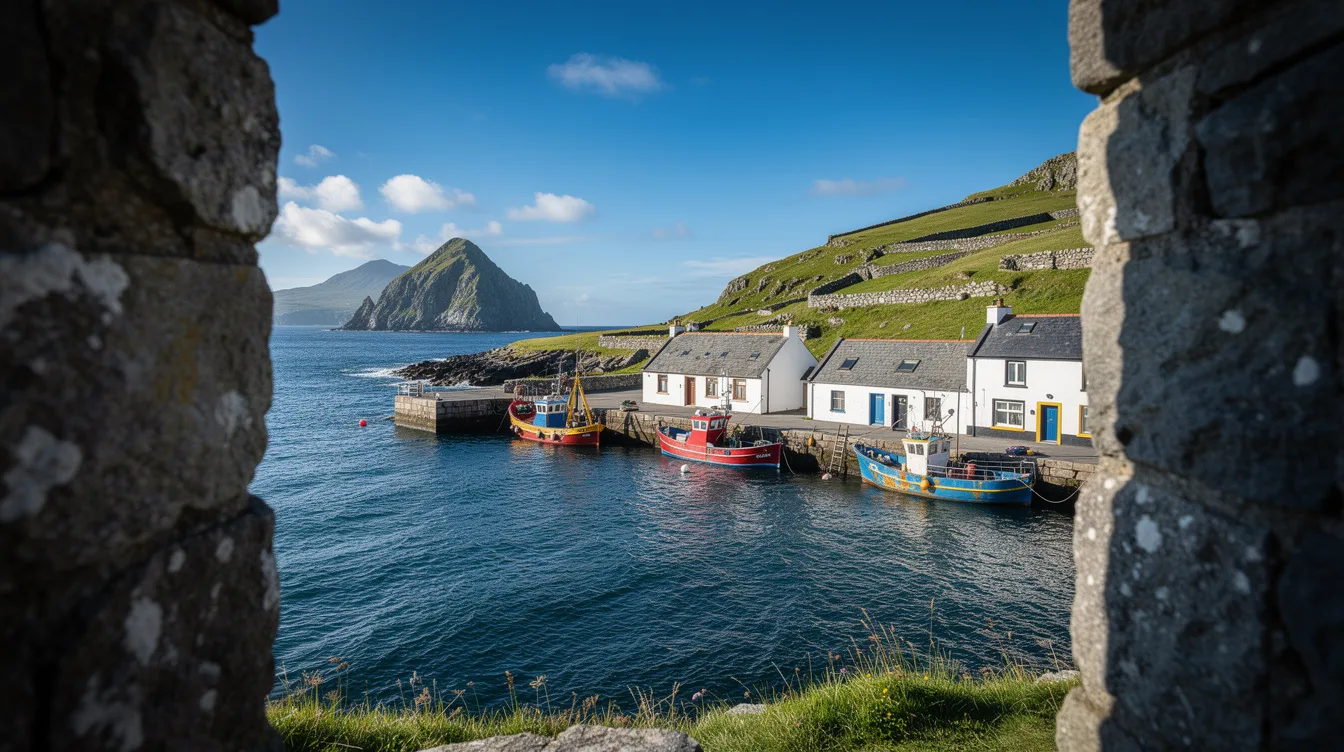
Portmagee is a small Kerry harbor with a very specific pull: it starts the boat journey to Skellig Michael. The island sits about 8.7 miles off County Kerry, and its Gaelic monastery clings near the top of a rock that rises 755 feet above the Atlantic.
You come here for an island that feels deliberately difficult. But Portmagee makes the departure feel human-scale, with boats leaving from a working harbor beside the bridge to Valentia Island.
The harbor where the Skellig journey begins
Portmagee sits on the Iveragh Peninsula, south of Valentia Island, and locals know it as An Caladh, or “the ferry.” That old name fits. Skellig Michael is the reason many visitors stop, because Portmagee is one of the main places to board a weather-dependent crossing.
And the weather matters more than any itinerary. Rough seas can cancel trips, so staying in the village the night before is the sensible move when departures are early. You may have a reservation, but the Atlantic still gets the final say.
The harbor has pubs and restaurants along its edge, with fishing-village texture rather than resort polish. It’s lively around departures, but it doesn’t need to manufacture atmosphere. The sound of rigging and the low movement of boats do that work.
A 755-foot climb into monastic Ireland
The payoff is not simply reaching the island. The monastery stands near the summit of a 755-foot rock, so the destination begins as a silhouette far out at sea and ends high above nearly vertical cliff walls.
Skellig Michael’s settlement was probably founded in the 7th century. Irish Christian monks lived there for roughly 600 years, in stone beehive huts called clochans, under conditions that were plainly spare rather than romantic.
But that severity is the point. The island’s remoteness discouraged visitors for centuries, which helped préservé a place where wind, stone, and open water still dominate the experience. You don’t arrive expecting ease, and you shouldn’t.
The monastery became a UNESCO World Heritage Site in 1996. Its status explains the draw, but the physical setting explains the memory: a cluster of early medieval stone shelters above a hard blue-gray sea.
Can you count on getting to Skellig Michael?
No. Boat trips depend on weather, and rough conditions can cancel crossings. That uncertainty is frustrating if you have one free day, yet it’s also honest proof that this isn’t an attraction arranged around your schedule.
Build your Portmagee stay around the possibility of change. If the sea stays rough, you still have Valentia Island immediately across the channel and the wider Skellig Ring nearby.
Valentia Island is the useful backup plan
The Maurice O’Neill Memorial Bridge connects Portmagee to Valentia Island. Built in 1970, it turns a cancelled boat day into an easy pivot instead of a long disappointment.
And that proximity is Portmagee’s quiet advantage. You can cross to Valentia Island for coastal scenery and the Skellig Experience Centre, then return to the harbor without treating the day as lost.
South of town, Kerry Cliffs add another reason not to rush away. Portmagee also works as an overnight stop on the Skellig Ring, a scenic detour from the Ring of Kerry. The village is small, but its location gives you options.
Getting there without making it complicated
From Killarney, Portmagee is a little over an hour by road. Take the N70 around the Ring of Kerry, then follow the R565 toward Portmagee and Valentia Island. The village lies roughly 9.9 miles off the N70.
If you’re arriving by rail, Killarney is the nearest connection. From there, a car makes the most practical sense, because the harbor, the bridge, and the Skellig Ring are best handled at your own pace.
But don’t treat Portmagee as a launchpad you only see through a windshield. Have time for the harbor before your crossing, especially when boats begin to gather and the water shifts from dark steel to silver. If the last departure is cancelled, the village is still there, facing the same sea.