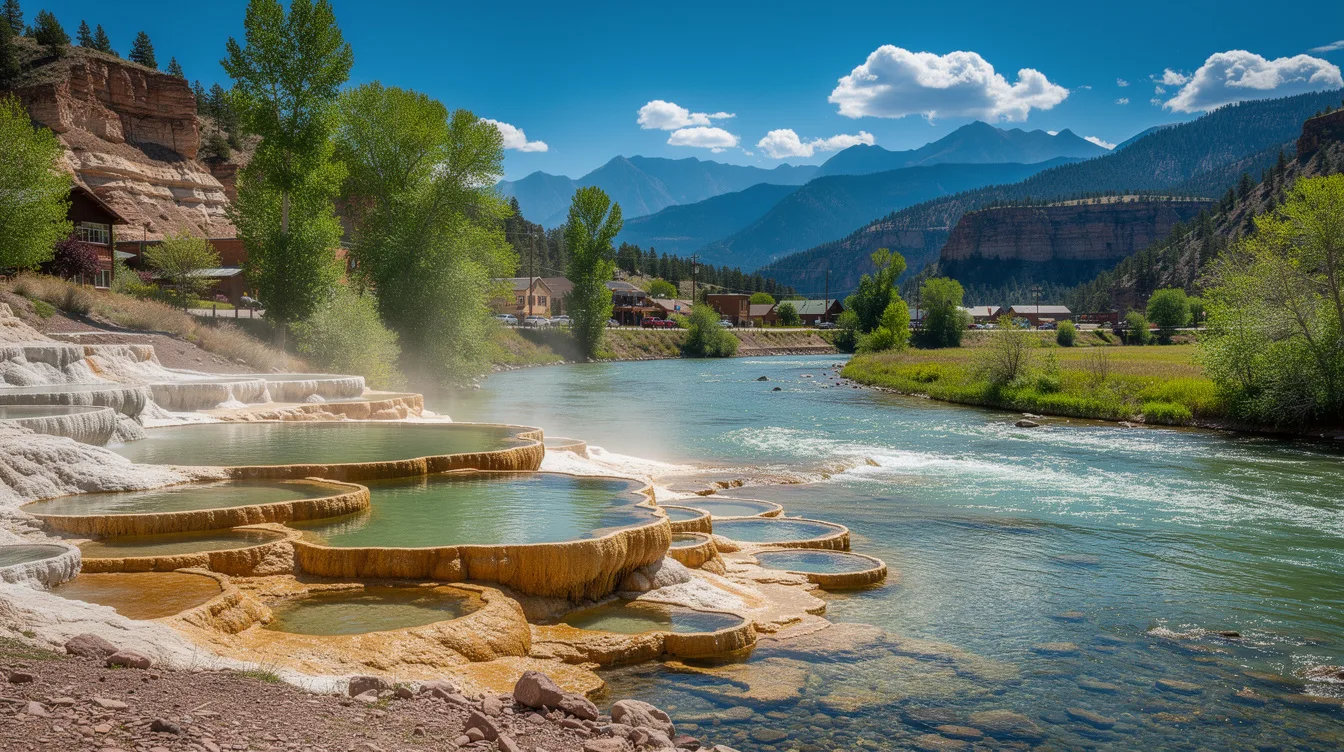
The town is named for the water, not the mountains. Pagosa Springs sits at 7,126 feet on the western slope of the Continental Divide, and the Mother Spring underneath it has been measured past 1,002 feet deep without anyone hitting bottom.
That makes it the deepest known geothermal hot spring in the world. The water comes up at 144 °F, far too hot to touch where it surfaces.
And the sun does the rest. Pagosa gets around 300 days of sun a year, which is why a January soak here feels less like endurance and more like reward.
Three soaking spots, all inside town limits
The Mother Spring feeds pools at three privately owned soaking locations, all within the town itself. The Springs Resort & Spa is the big one, right on the river, with a long run of pools.
Overlook Hot Springs Spa is smaller and more central, closer to a spa than a resort. Healing Waters Resort & Spa is the third, and the oldest in feel.
There are also primitive springs on the upper banks of the San Juan River, free and open to the public. Look, don’t climb in. The water temperature there is not a suggestion.
An important warning before you book
On October 11, 2025, the San Juan River flooded after heavy overnight rain. It damaged several bridges, broke a sewer line mounted on one of them, and pushed muddy water and sewage into the soaking pools at The Springs.
A section of Highway 160, the main road through town, closed as a result. The road was already torn up for work on the town’s water, sewer, geothermal and storm drainage lines.
So call Visit Pagosa Springs before you commit to a soaking trip. I can’t tell you the pools or the road are back to normal, and you shouldn’t assume it.
The road down from Wolf Creek Pass drops 3,730 feet
US Highway 160 comes into town off Wolf Creek Pass, losing 3,730 feet of elevation on the way down. C. W.
McCall put it in a 1975 country song called “Wolf Creek Pass,” and called it hairpin county and switchback city.
That drop is also your ski access. Wolf Creek Ski Area sits up over the pass, known for how much snow it gets. Ski, then drive down, then soak.
That’s the whole itinerary in winter.
How do you actually get here?
Fly into Durango-La Plata County Airport (DRO), then drive about an hour and fifteen minutes. Pagosa Springs is roughly 300 miles southwest of Denver and about 35 miles north of the New Mexico border, on Highway 160 in Archuleta County.
A town of 1,571 people surrounded by forest
The 2020 census counted 1,571 residents. This is the county seat and the only incorporated municipality in the whole county, which tells you how empty the rest of it is.
About 65 percent of Archuleta County is San Juan National Forest, the Weminuche and South San Juan wilderness areas, or Southern Ute reservation land. The town sits inside a 3-million-acre national forest, next to the largest wilderness area in Colorado.
Quiet, but not isolated. You’ll feel that in how fast the noise drops once you leave the highway.
What the springs meant long before 1881
Local Indigenous people used these springs for centuries, and the ground was considered sacred. In Navajo cosmology this is the place where the Diné emerged from the Fourth World into the Fifth, this one.
The Ute name, Pah gosah, is usually translated as healing waters. A Ute elder once gave a blunter version: water that has a bad smell. Both readings are honest.
The sulfur is real.
A white settler “discovered” and developed the springs in 1859. The first bathhouse charging paying customers went up in 1881, and simple wooden bathhouses followed along the riverbanks.
Is there anything to do besides soak?
Plenty, and it’s mostly outdoors. Summer brings hiking, camping, fishing and floating the San Juan River. Chimney Rock National Monument has ancestral Pueblo remains and long views.
Come for the calm, not the nightlife
Summer highs run near 79 °F, winter highs near 39 °F. At this altitude, go slow the first day or two and drink more water than you think you need.
What Pagosa doesn’t have is a real bar scene or a wide range of restaurants. That’s the trade. You come here for the river, the forest, and the water that never stops coming up hot.