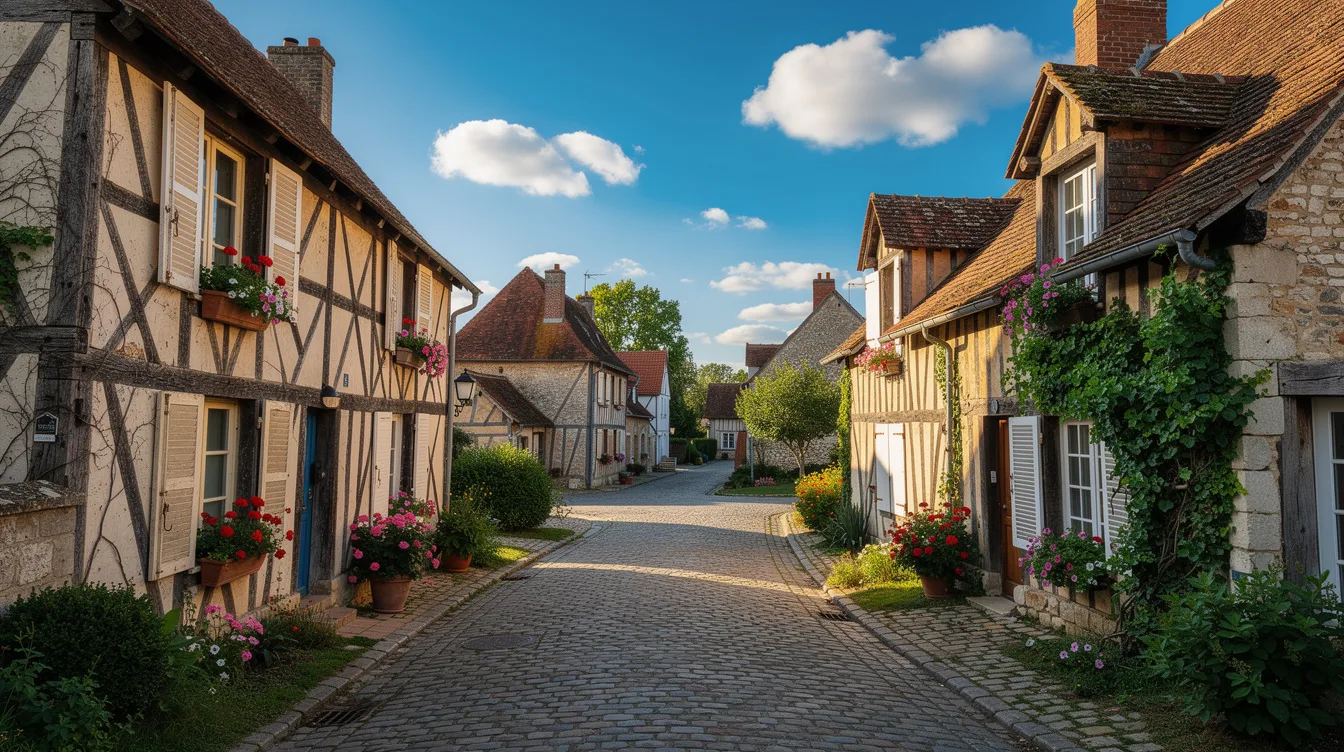
Beuvron-en-Auge keeps its timbered homes from the 16th through 18th centuries, and that is the reason to pull off the larger Normandy route. Around Place Vermughen, the old center feels compact enough to absorb on foot before your coffee cools.
This is a village of about 200 residents in Calvados, within the Pays d’Auge. But it doesn’t feel staged if you arrive without trying to rush it. The painted timber fronts, narrow lanes, and small storefronts give you a clear reason to linger.
Timbered houses make the first hour count
The central promise is right in front of you: Norman half-timbered houses dating from the 16th to 18th centuries gather around Place Vermughen. You can walk the core quickly. And you shouldn’t, because the details are the point.
Look up at the dark beams and pale panels, then let the lanes pull you beyond the square. Galleries, antique dealers, craft shops, and restaurants fill the village center, so there’s enough to do after the first round of photographs.
Les Plus Beaux Villages de France includes Beuvron-en-Auge among its affiliated villages. That label brings visitors, of course. But the scale stays manageable, and the center is more rewarding when you slow down instead of treating it as a checklist stop.
What should you see beyond the square?
Start with the restored market halls, rebuilt using old materials, then seek out Saint-Martin Church, which dates to the 17th century. The village also has three historic manor houses, including Manoir du Lieu Hocquart and Manoir de la Hogue.
But don’t expect a packed museum circuit. Beuvron-en-Auge works best as a short, observant walk, with time for a shop window or a table in town. You’re here for the street-level texture, not a full day of formal sightseeing.
The Route du Cidre gives the village a larger purpose
Beuvron-en-Auge sits on the 24.9-mile Route du Cidre, a route through the Pays d’Auge. That makes the village more than a pretty pause. It can anchor a cider-focused drive through this corner of Normandy.
And autumn is the season with the strongest reason to come. The Fête du Cidre brings apple pressing and tastings, so the village’s cider connection becomes something you can smell and sample rather than just read about.
You can also head toward the chapel at Clermont-en-Auge for a view over the Pays d’Auge valleys. The shift from close timbered facades to open country is part of the appeal. Still, the notes don’t promise a signed hiking route, so keep plans simple.
Is Sunday worth planning around?
Yes, if antiques are your thing. Beuvr’Antiques takes place on the second Sunday of each month, turning a small village visit into a more focused browse. If you prefer quieter streets, choose another day and take your time around the square.
The trade-off is obvious: a tiny village has a finite amount to hold you. Most visitors will find one to three hours is enough, especially if they are continuing along the cider route or toward another Normandy stop.
Getting there is simple, staying longer takes intent
Beuvron-en-Auge is in Calvados. That makes it an easy addition to an itinerary through the Pays d’Auge.
But it’s not a place to race through between appointments. Give yourself room to circle Place Vermughen twice, once with the camera out and once without it. The timber frames look different when you stop hunting for the next view.
For US travelers, the appeal is straightforward: this is a compact Norman village where the architecture tells the story without demanding much logistics. It’s tourist-friendly, but not built around a big attraction. Your reward is the pace.
By autumn, apple pressing adds a sharp, sweet smell to the old center. Then the village settles back around its timbered homes, with the road ahead waiting beyond the square.