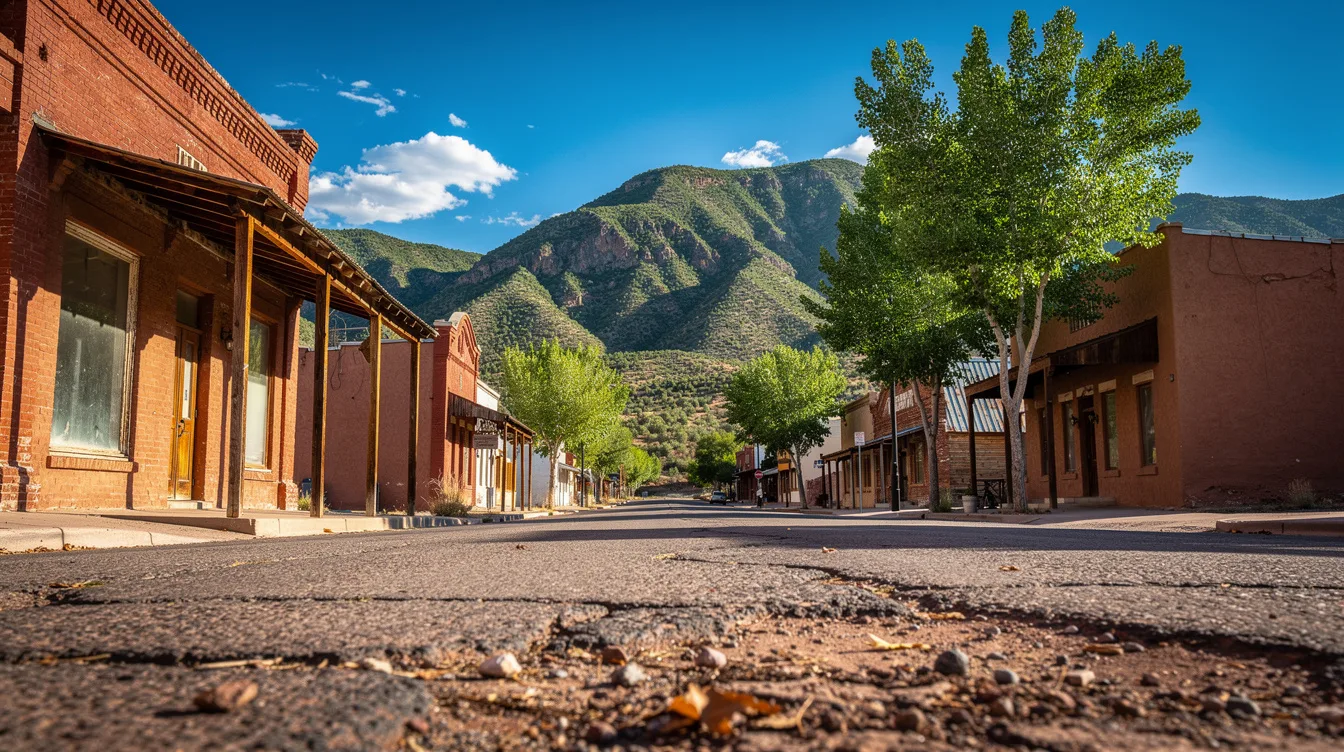
Silver City began with a silver discovery in 1870, and that origin still shapes the town in Grant County, southwestern New Mexico. You won’t find a polished resort version of the Southwest here. What you get is a former mining town with old commercial streets, working art spaces, and a practical relationship with the wild country beyond town.
Silver came first, then copper, gold, lead, and zinc helped build the local economy. That mining history remains visible in the town’s character, even as Silver City now draws people for galleries, university life, and access to the Gila. It feels lived-in, but it doesn’t ask much of visitors beyond curiosity.
1870 is more than a date here
At roughly 5,900 feet, Silver City sits in a high, semi-arid setting near the Mogollon Mountains. The elevation makes summer feel less punishing than lower desert country, so you can actually enjoy an afternoon walk when hotter Southwestern towns feel like a dare.
But don’t mistake cooler air for a mountain resort mood. Nights can turn cool, and winter weather can bring cold and snow to the surrounding higher ground. If you come for open-road freedom, pack for changing conditions instead of assuming New Mexico always means dry heat.
The town is also the seat of Grant County, which gives it more everyday purpose than a preserved mining stop. Western New Mexico University brings students and cultural activity into a place that otherwise moves at a distinctly rural pace. You can feel both rhythms on the same block.
Broadway keeps the mining-town story close
Start in historic downtown, especially Broadway and the nearby streets. Old buildings now hold independent shops, cafes, galleries, and artist studios, so the mining-era bones haven’t been sealed behind velvet ropes. You can browse slowly, then sit down before deciding what comes next.
There are more than 30 galleries and artist studios mentioned by the local tourism office. That is a real concentration for a town of about 9,700 residents, based on the 2020 census. Lively, but never built around big-city expectations.
And the Silver City Museum is the better stop if you want context instead of atmosphere alone. It occupies the historic H. B.
Ailman House and covers mining, pioneer life, regional culture, and the town’s development. Go before wandering downtown, because the streets make more sense afterward.
The Gila is why many travelers stay longer
Gila National Forest begins the larger argument for spending time here. Silver City works as a supply stop and overnight base for hiking, camping, mountain biking, birding, and scenic drives. The town is modest, but the territory around it is enormous.
And that contrast is the point. You can have coffee among murals and old storefronts, then head toward pine forest, canyons, hot springs, and wilderness areas. If you like places that don’t separate town life from outdoor access, Silver City makes an unusually convincing case.
The Gila Cliff Dwellings National Monument adds another layer. Its cliff homes were built by Mogollon people, and the trip requires mountain-road driving, so give it a full day and check road and weather conditions first. This isn’t a casual detour between lunch and dinner.
Come for the trade-off, not the polish
Silver City is reached from Deming on US 180 or from Lordsburg near Interstate 10 on NM 90. NM 152 from the east is notably scenic, but its tight curves can be a poor fit for a large vehicle. You should choose the road for your vehicle, not for bragging rights.
Fort Bayard offers another nearby look at the region’s military and medical history. But Silver City isn’t Santa Fe, and it doesn’t need to be. There is no promise of major-city nightlife or luxury services, which is precisely why the town feels less managed than many Southwestern stops.
Stay two to four nights if you want downtown, the forest, and the cliff dwellings without treating each as a box to check. By evening, the old streets quiet down, and the high-desert air turns cool enough to make the next day’s Gila plans feel close.