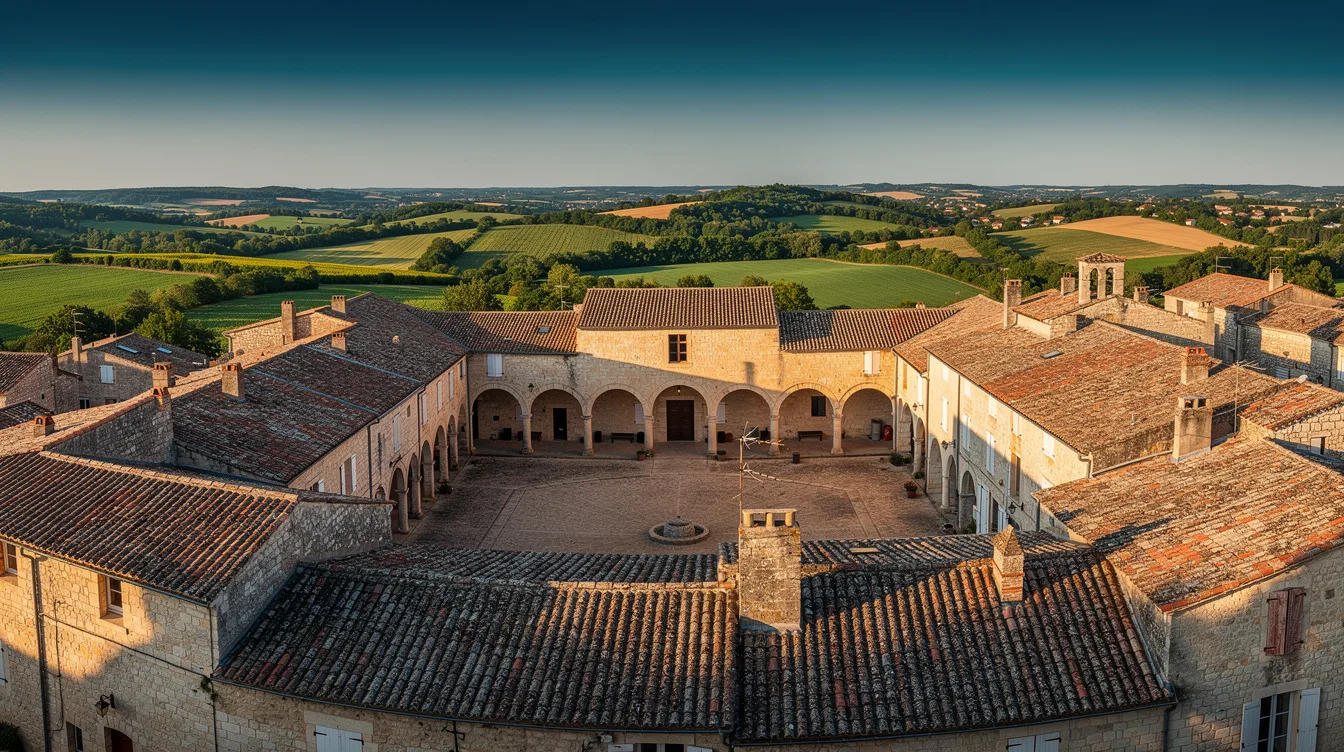
Monflanquin was founded in 1256, and its medieval plan is still easy to read today. The French village has an arcaded central square, regular streets, and a grid layout that makes its history visible under your feet.
And that clarity is the appeal. Many historic villages feel like puzzles after one turn, but Monflanquin lets you understand its design almost immediately. From the broad square, streets extend in a measured pattern, while stone houses and half-timbered façades keep the setting tactile and human.
A 1256 foundation you can still read
Monflanquin stands on a height in the Lot-et-Garonne, near the borders of Périgord and Quercy. Its elevated position helped shape the town’s role as a military bastide, while the planned streets gave the settlement a practical order.
And the grid plan matters because it changes how you walk. You’re not simply following a winding medieval lane toward the next view. You can pause, look across the square, and see how the town was organized around movement, trade, and defense.
The place des Arcades is the center of that design. Its covered edges frame the open space, creating a strong contrast between shade and sun. This is the kind of square where you’ll want to slow down, because the architecture explains the village better than a hurried checklist can.
But Monflanquin isn’t preserved as a silent stage set. The square remains the village’s architectural and social heart, with the tourism office located there. You’ll find a calm rural destination rather than a dense urban center, which is precisely its strength.
Why the square tells more than the walls
Monflanquin belongs to Les Plus Beaux Villages de France, a distinction tied here to its arcaded square and unusually legible medieval plan. The label may bring visitors, but the town’s structure is what gives the visit substance.
And the best way to experience it is on foot. Follow the regular streets, look up at the timber framing, and notice how the stone buildings meet the arcades. You don’t need a packed itinerary when the town’s main attraction is the way its pieces fit together.
The Musée des Bastides adds context when the geometry alone leaves questions. It helps explain the history and urban planning of bastide towns, so you can return to the square with a sharper eye.
But there are limits. Monflanquin is better suited to a quiet heritage stop than to travelers seeking a broad restaurant scene or constant city energy. That trade-off is real, and it makes the village feel more coherent, especially when you sit beneath the arcades and hear the square settle around you.
A quiet base near Villeneuve-sur-Lot
Monflanquin is about 9.3 miles from Villeneuve-sur-Lot, in a part of southwestern France shaped by rural scenery and historic bastides. That distance makes it useful as a base for exploring the area without giving up the feeling of a small village.
And you can pair the visit with excursions toward the Périgord, Bergerac, or nearby bastides. The regional appeal is broad, but Monflanquin works best when you give it time to stand on its own rather than treating it as a quick photograph between larger destinations.
Can you understand the village without a guide?
Yes. The damier plan, or checkerboard layout, is clear from the central square and surrounding streets. A visit to the local tourism office can add practical information about tours, activities, and the wider Cœur de Bastides area.
But bring patience instead of a crowded schedule. The town’s pleasure comes from small changes in texture: shaded arcades, pale stone, timber above the street, and the broad geometry of the square. By late afternoon, Monflanquin feels less like a historical lesson and more like a place quietly keeping its original shape.