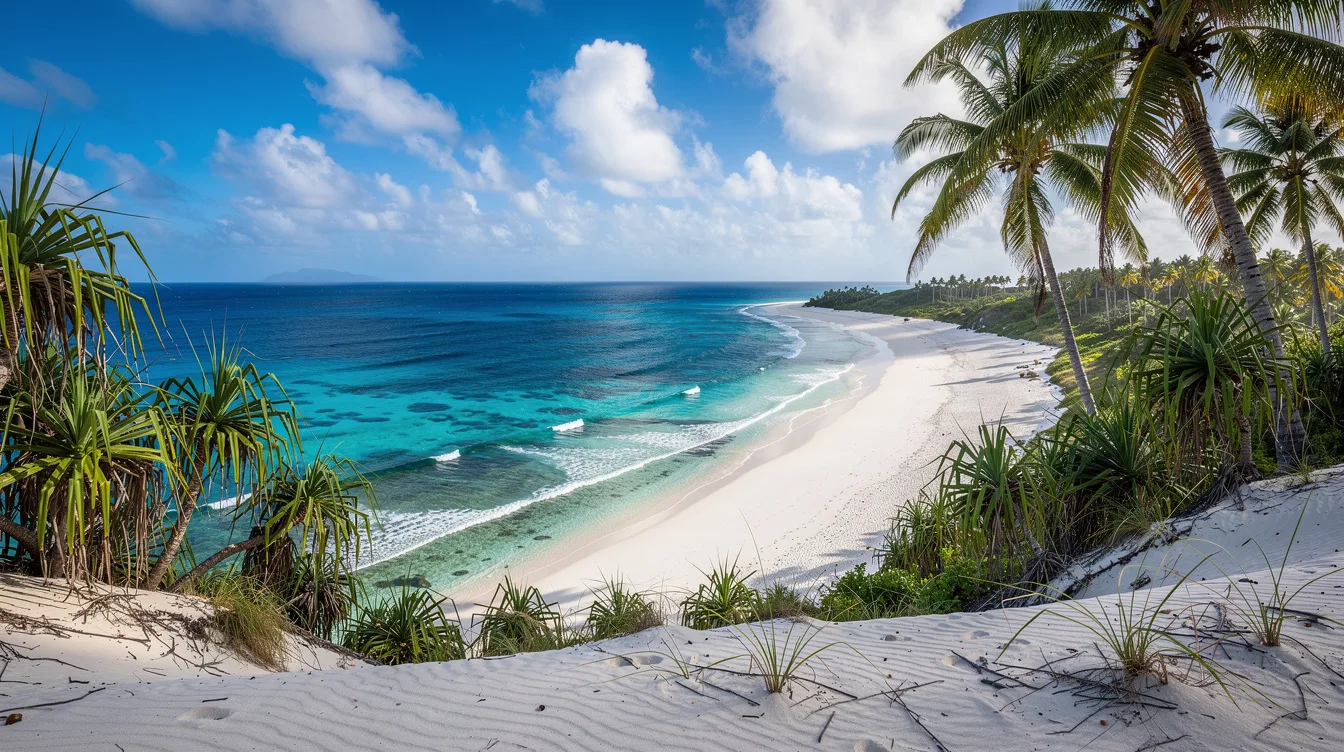
Ouvéa makes its case in one long, pale curve: Fayaoué’s beach runs for about 15.5 miles along the lagoon. That’s enough sand for a real walk, not a quick hotel-beach loop, and the shallow water keeps the horizon close and bright.
But this isn’t an island for cramming into a busy itinerary. Ouvéa asks you to slow down, arrange transport early, and let the day stretch out with the trade winds and the soft scrape of feet on sand.
Fayaoué is where the long walk becomes the whole plan
At Fayaoué, white sand follows the lagoon for roughly 25 kilometers. You can walk until the coconut palms thin out and the beach feels less like an attraction than a route with no particular finish line.
And that length changes the mood. On a short beach, you keep checking where to put your towel. Here, you can keep moving, with warm-looking shallows on one side and a quiet strip of island behind you.
The beach is the title promise, and it delivers in the first hour. But it’s also one of Ouvéa’s limits: there aren’t endless cafés, shops, or late-night options waiting along the sand.
You’ll want to bring what you need before settling in. The payoff is a beach day with room to breathe, rather than one built around reservations and crowds.
The UNESCO lagoon has a quieter kind of scale
Ouvéa, Beautemps-Beaupré Lagoon has been part of New Caledonia’s UNESCO World Heritage-listed lagoons since 2008. That designation matters because the water and reefs are not just scenery for a beach walk, but a fragile marine place with real boundaries.
And the lagoon is why the island’s colors can seem almost excessive, from pale sand to clear blue-green water. Still, it’s not a place to treat casually. Choose reef-compatible sunscreen, carry a reusable bottle, and use operators who respect protected marine areas.
Boat trips can reach the Pléiades and Beautemps-Beaupré islets and reefs. Conditions can change the plan, though, so don’t build a visit around one fixed excursion and assume the sea will cooperate.
This is travel with a little friction. The reward is that the water doesn’t feel packaged for you.
Mouli Bridge and Lékiny bring a sharper edge
The island is more than one long strand. At Mouli Bridge, the channel between Ouvéa and Mouli is known for intense water colors, and turtles, rays, or sharks may sometimes be visible from the bridge.
But “may” is the useful word. Wildlife is never a guarantee, and the bridge works even without a sighting because it gives you a clean view of the lagoon’s shifting blues.
Beyond the lagoon side, Lékiny Cliffs offer the counterpoint: coral cliffs and a wilder ocean-facing feel. Ouvéa is flat and lightly developed, so that abrupt change from long sand to coral edge lands harder than you’d expect.
You should also ask before entering private land or using certain coastal access points. Kanak customary practices matter here, and that small courtesy is part of traveling well on an island with limited space.
Getting there is easy enough, moving around takes planning
A domestic flight from Nouméa-Magenta to Ouvéa-Ouloup takes about 40 minutes. Ouvéa sits in the Loyalty Islands, northeast of New Caledonia’s mainland, so the flight is the practical doorway to a noticeably slower place.
And once you arrive, arrange the rest. There’s no real public transportation network, which means you’ll need to reserve a car or scooter, request a lodging shuttle, or coordinate transfers and boat outings ahead of time.
The island has one road across much of its length, and that simplicity is appealing. But limited availability is real, especially for flights, vehicles, and places to stay, so last-minute freedom can become last-minute inconvenience.
Three to five nights is the sensible rhythm. A day trip from Nouméa can show you the lagoon, but it leaves little room for the farther corners or for doing almost nothing well.
April through November gives you the better odds
The more comfortable, drier period for outdoor time is generally April to November. Early in the year is wetter and more exposed to cyclonic conditions, so January through March is the period many travelers try to avoid.
But weather still sets the terms for dives, snorkeling, and boat trips. Keep your plan loose enough for a changed sea day, then take the beach walk when the light and conditions line up.
Ouvéa has no need to fill every hour. By the time the sun softens over Fayaoué, the sand holds only a few sets of footprints, and the lagoon goes quiet again.