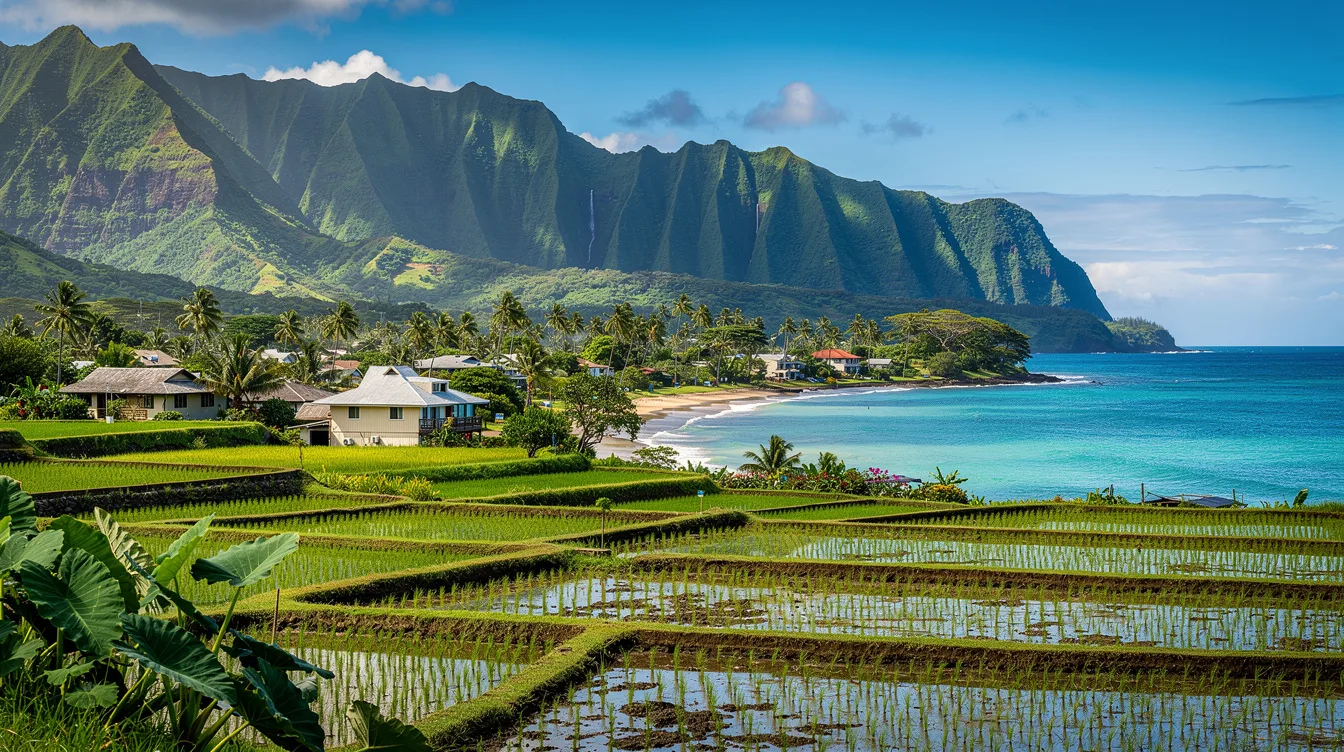
Hanalei has just 444 residents, yet it occupies one of Kauaʻi’s most dramatic positions: between a crescent-shaped bay and the taro fields of Hanalei Valley. You don’t come here for a packed itinerary. You come because water, mountains, and working fields sit unusually close together.
And that contrast is the point. Hanalei feels open at the bay, then intimate again in its small-town center, where cafés, galleries, shops, and historic sites break up the quiet. It’s a place that makes a slow afternoon feel like the correct plan.
A crescent bay gives Hanalei its shape
Hanalei Bay is where the village faces outward. Its crescent shape frames swimming, surfing, and paddleboarding, while the mountains toward Nā Pali country rise behind the water. You can spend time here doing very little, which is often the best use of the bay.
But the bay isn’t only for looking at. The water draws swimmers and paddlers, while surfers give the shoreline a moving, watchable rhythm. It can feel active without turning into a scene, and that’s a distinction travelers often appreciate.
Hanalei Pier gives the waterfront a clear focal point. It’s a landmark on the bay and is listed on the National Register of Historic Places. Walk toward it when you want the village’s geography to make immediate sense: curve of sand ahead, green slopes behind.
Can you swim or paddleboard in Hanalei Bay?
Yes. Hanalei Bay is known for swimming, surfing, and paddleboarding. That range matters because you can choose the pace that suits you, rather than treating the waterfront as something to photograph from a distance and leave behind.
The taro fields keep the village grounded
Beyond the bay, Hanalei Valley shifts the mood completely. The valley is known for taro fields and green ridgelines, with a long taro-growing tradition. You’re still close to the village, but the view feels agricultural rather than resort-like.
And that’s Hanalei’s strongest argument. The coast gets your attention first, but the fields explain why this isn’t simply another beach stop. The taro landscape gives the village a working purpose, even when you’re only passing through as a visitor.
The ridgelines and fields make a sharp visual contrast with the broad bay. But don’t flatten that into a postcard idea. Hanalei is small, and its appeal comes from seeing these parts together: ocean recreation near a valley shaped by cultivation.
The 35-mile drive is part of the arrival
Hanalei sits on Kauaʻi’s North Shore, about 35 miles from Līhuʻe Airport. The usual drive takes roughly 45-50 minutes via the winding Kuhio Highway. That isn’t a long transfer by island standards, but it asks you to slow down.
From Līhuʻe, the route passes through Princeville before crossing the one-lane Hanalei Bridge. You’ll notice the pace change before you reach town. The highway’s curves and narrow crossing make arrival feel more deliberate than a simple airport-to-hotel run.
Is Hanalei easy to reach from the airport?
It’s reachable by a normal drive, though the road is winding and the bridge has one lane. Plan around the 45-50 minute typical travel time from Līhuʻe Airport. And give the route your attention, because rushing would miss the point.
A small center, without the rush
Hanalei’s town center has galleries, cafés, shops, and historic sites, all within a village of 444 people. That modest scale is a real advantage. You can move between the bay and town without feeling like you’ve entered a separate destination.
But it isn’t a place to demand endless options from. Hanalei works best when you let its few distinct settings carry the day: the pier, the bay, the village streets, and the valley beyond. The setting does more work than any itinerary could.
By the time you return from the bay, the taro fields are still there behind the village, green and steady beneath the ridgelines.