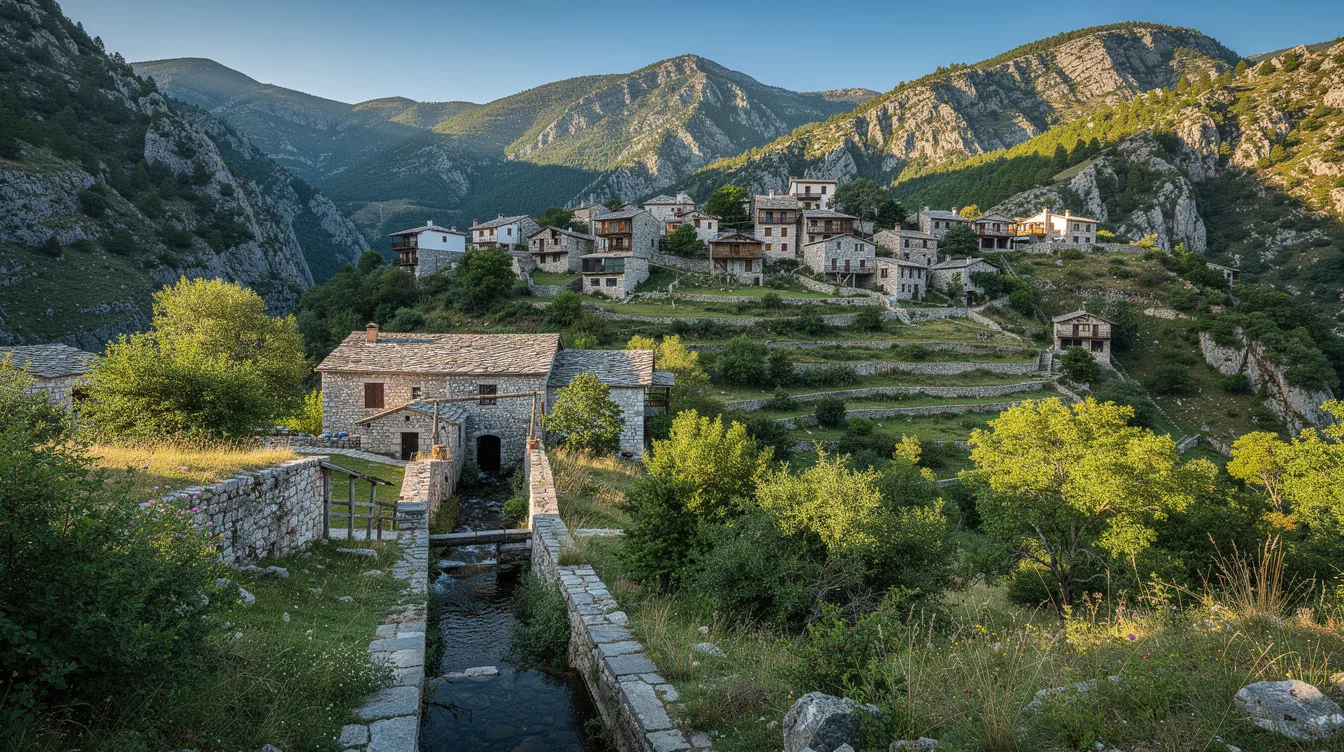
Dimitsana ran 14 powder mills day and night during Greece’s War of Independence. That history still shapes the village, where stone lanes climb above the Lousios Gorge and the mountain air feels far removed from coastal Greece.
And this isn’t a place to rush through between Athens and the beach. You come for the story, stay for the walking, and discover a mountain village with enough substance for two nights.
Fourteen mills made Dimitsana a wartime power center
And the central fact is hard to miss: 14 powder mills worked around the clock during the independence struggle. Their gunpowder helped supply Greek fighters, earning Dimitsana the nickname “the nation’s powder keg.”
But the story reaches back further. The village’s public historical library traces its institution to 1764, when books from a monastery were gathered here. During the war, fighters used much of that paper in the mills, a practical loss that makes the history feel unusually physical.
You can follow that story at the Open-Air Water Power Museum, where traditional hydraulic technology includes a flour mill, a tannery, and a gunpowder mill. I think it’s the strongest first stop because it explains how water, machinery, and wartime necessity met in one narrow mountain valley.
Stone lanes lead to the Lousios Gorge
And Dimitsana’s setting gives the history its force. Built amphitheatrically on a mountain slope at about 3,117 feet, the village looks across wooded reliefs toward the Lousios Gorge.
But the views aren’t the whole point. Pavement rises beneath your shoes, old stone houses tighten the lanes, and small churches appear between traditional roofs. You should wander without a fixed route, because the village reveals itself through turns rather than landmarks.
Can you hike there without rushing?
Yes, but plan for real walking. The Lousios Gorge has trails along its floor and slopes, with the Old and New Filosofou Monasteries among the area’s main stops.
And you need proper shoes, water, and an offline map. I prefer the shoulder seasons here because the trails become the day’s main event, not a hurried break between drives.
The drive from Athens is part of the bargain
And access is straightforward if you have a car. From Athens, allow 2 hours 30 minutes to 3 hours by road before the route turns into narrower mountain roads.
Dimitsana sits in Arcadia’s mountainous interior. You can reach Tripoli by public bus and continue by KTEL connection, but schedules are limited and may change with the season.
But driving has a cost. Local roads are narrow and winding, so arrive before dark if mountain driving makes you uneasy. The reward is flexibility, especially if you want to connect Dimitsana with Stemnitsa, Zygovisti, and the gorge.
Spring and early autumn make the trails worthwhile
And the best walking conditions arrive in spring and early autumn. April through June brings green hills and fuller rivers, while September and October usually offer gentler weather and autumn color.
Summer is warmer than the altitude suggests, though evenings are generally easier. Winter can bring snow and a stronger alpine mood, but you should expect a quieter mountain routine and plan around conditions.
My choice would be September and October if hiking matters most. The village remains practical rather than polished, which is exactly why it feels convincing.
Stay two nights, then let the village slow you down
And two nights is the sensible minimum. One night leaves little room for the museum, the gorge, and the old center unless you turn the visit into a checklist.
You can use Dimitsana as a base for walks toward Stemnitsa and Zygovisti, then return to mountain tavernas and cafés in the old village. Beyond the lanes, the open view toward the Lousios keeps pulling you back outside.
But don’t expect a resort schedule. Dimitsana’s appeal is its steep roads, limited transport, and working sense of place. By evening, the stone streets hold the last light above the gorge, and the powder mills’ old machinery has gone quiet.