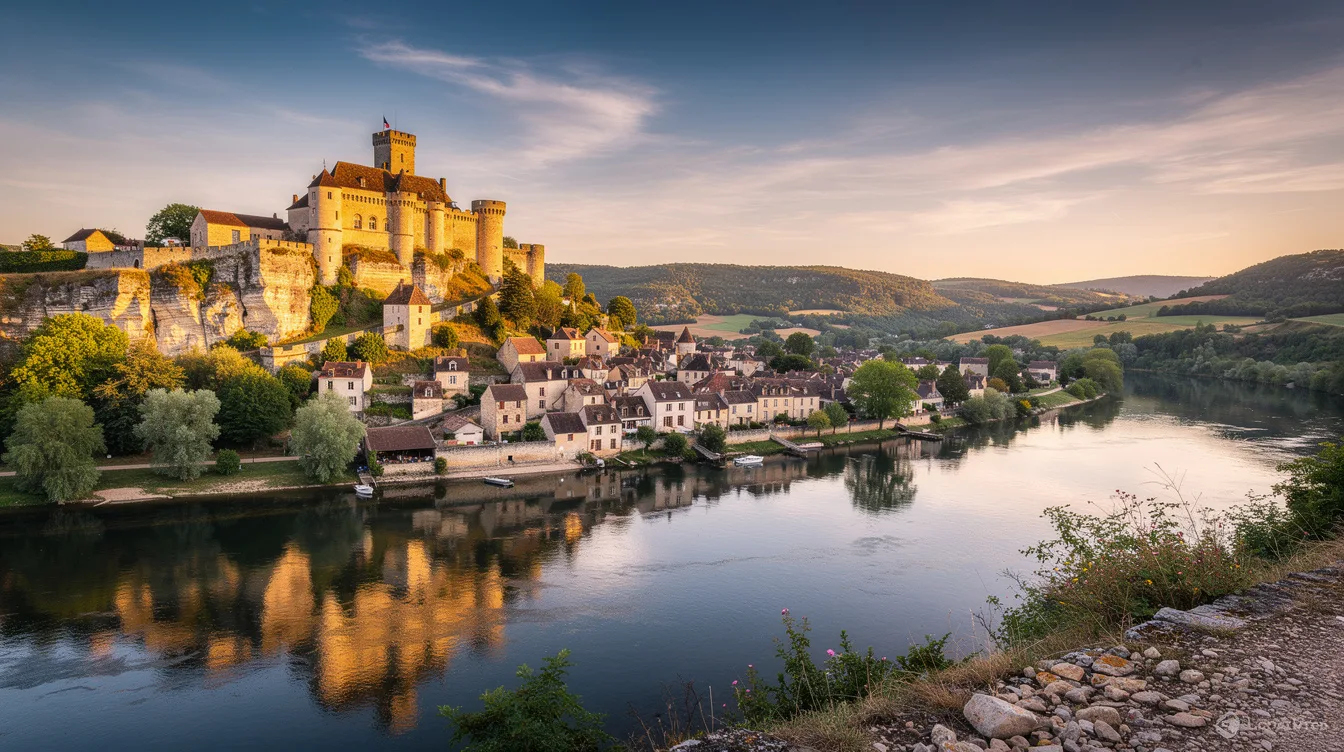
Beynac-et-Cazenac gives you a rare reason to slow down in France: its 12th-century Château de Beynac is one of the Dordogne Valley’s best-preserved fortresses. The village sits about 6.2 miles southwest of Sarlat-la-Canéda, above the Dordogne River.
And the castle is visible almost everywhere, rising above the stone roofs and steep lanes. You’ll understand its importance before reaching the entrance, because the village climbs toward the fortress in a tight series of paved streets.
A 12th-century castle above the Dordogne
The 12th-century Château de Beynac dominates the valley from a rocky spur. Its position explains the village’s shape, with houses pressed against the slope and the river opening below.
But this isn’t a quick photo stop. Plan 1 to 1.5 hours for the castle, where thick stone walls and high views make the climb feel worthwhile.
And you should arrive with comfortable shoes. The route from the riverfront is short but steep, so the village is easier at the bottom and more rewarding as you gain height.
The climb is short, but the lanes are serious
Beynac’s old streets are paved and sharply inclined, with pale stone houses leading toward the castle. The light catches the walls late in the day, when the village feels quieter and the rock takes on a warm glow.
But the slope is the trade-off. If walking uphill is difficult, you can reach the top by car, while the lower village remains more accessible on foot.
And you’ll want to pause as the view opens toward the Dordogne, Castelnaud across the river, and the valley below. That gradual reveal is more satisfying than arriving at a single overlook.
Can you see Beynac from the river?
Yes. A gabarre ride shows Beynac from the Dordogne and makes the castle’s position easier to understand. From the water, the fortress looks less like a monument and more like a watchpoint above the river route.
And a canoe trip gives you a slower view of the same setting. The stretch around Beynac, Castelnaud, and La Roque-Gageac passes fortified villages and cliffs, with the current carrying you through the valley.
But summer brings crowds near the parking areas, boats, and castle. You’ll get a calmer experience in May, June, or September, when the weather is often pleasant and visitor pressure is lower.
Why Sarlat makes the easiest base
Sarlat-la-Canéda is only 6.2 miles away, which makes Beynac practical for a half-day visit. Stay there if you want more restaurants and lodging, then come to Beynac for the river, castle, and evening quiet.
And Beynac works well as part of a wider Dordogne day. From here, you can reach Castelnaud-la-Chapelle, La Roque-Gageac, the gardens of Marqueyssac, or the prehistoric caves of the Périgord.
But trying to fit everything into one rushed outing misses the point. Give the village 2 to 4 hours, or spend a full day if you add a gabarre, canoe trip, or nearby site.
When to visit, and where to park
Arrive early and use the lower parking areas before walking uphill. The castle and riverfront draw the most visitors in summer, so the first hours of the day feel easier on both the road and the steep lanes.
And Monday morning brings a local producers’ market from mid-June through mid-September. You can pair it with the castle, though the market’s seasonal schedule means it shouldn’t be the only reason for your trip.
But May, June, and September are the strongest months overall. The village still has its golden stone and river views, yet the experience feels less compressed than it does around the busiest summer hours.
A village best understood slowly
Beynac-et-Cazenac belongs to the association of France’s officially recognized beautiful villages, but the label matters less than the setting. The castle, slope, and river work together so clearly that you don’t need much interpretation.
And you can spend the morning climbing, the afternoon on the water, and the final hour looking across toward Castelnaud. That sequence gives the place its shape without forcing you to hurry.
But bring patience for the hill. By evening, the stone lanes quiet down, the Dordogne catches the last light, and the castle remains above the village like a dark line against the sky.