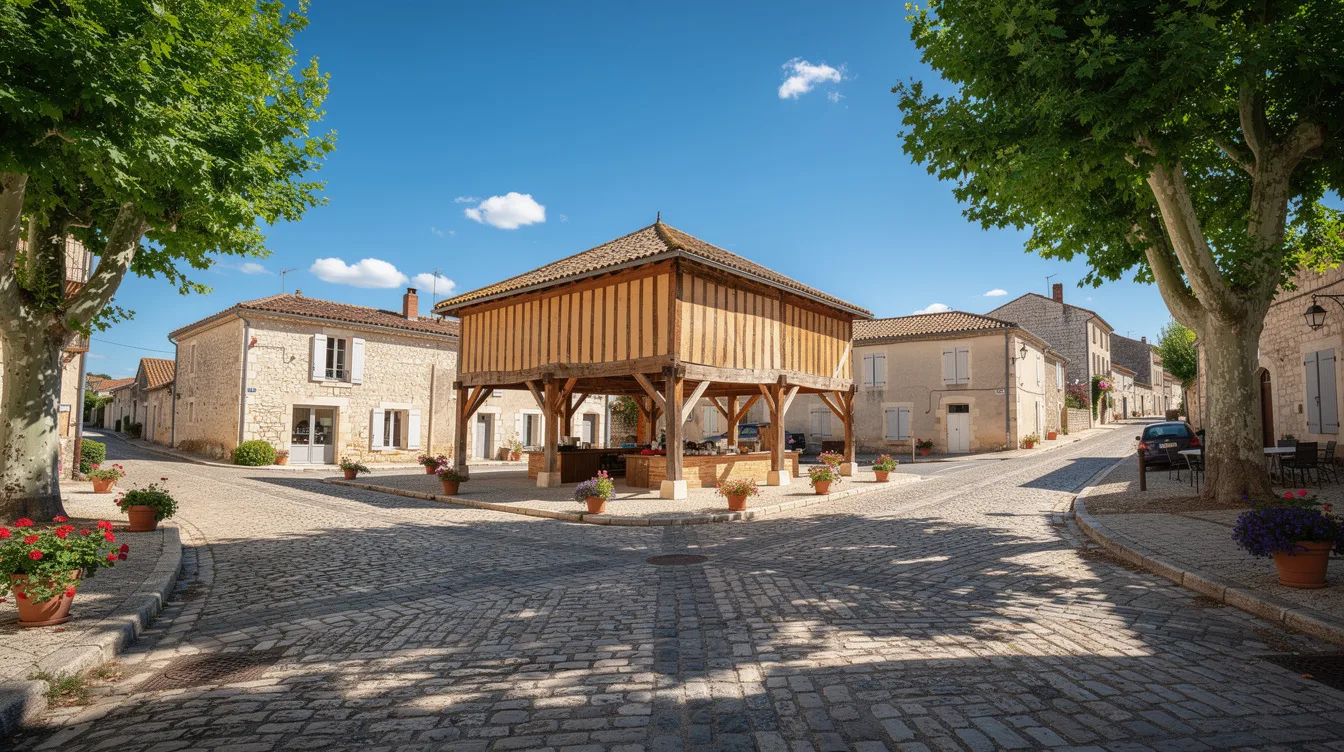
Villeréal makes its case in one glance: eight streets meet at right angles around a central square, where a timber-framed market hall still holds the center. You can read the village’s plan before you know a word of its history.
This is a French bastide in Lot-et-Garonne, about 21.7 miles south of Bergerac and 37.3 miles north of Agen. It’s compact enough to explore on foot, but its geometric order gives even a short walk a satisfying sense of discovery.
And the title’s promise is literal. The eight principal streets run into the square, so every turn seems to return you to the hall and its wooden pillars.
The hall explains Villeréal in one stop
At the middle of the square stands the market hall, a roomy structure with an unusual upper floor of half-timbering and cob. Its exterior stairs lead upward, while it keeps the square visually connected.
But don’t rush past it as if it were just a photo stop. The building is the village’s organizing idea, and its timber and pale infill make the surrounding streets feel deliberately drawn toward it.
You’ll notice arcades around the square, though the available historical account raises a useful wrinkle: they may not have belonged to the original design. The exterior stairs matter here because they suggest upper rooms were accessed from outside once those arcades existed.
That uncertainty makes the place more interesting, not less. Villeréal is orderly, but it hasn’t been frozen into a diagram. You can look at one market building and see both a planned medieval town and later adjustments.
And if you arrive on a Saturday, the square has a reason to be active. Saturday market day was fixed by a charter dated April 20, 1288, a schedule with unusually long staying power.
Eight streets, one very deliberate grid
Villeréal was built as a bastide between 1265 and 1269. A bastide was a newly planned medieval town, and here the regular grid puts the market square at the center rather than treating it as an afterthought.
The eight main streets meet at right angles around that square. Because the routes are so clear, you can wander without the usual worry of losing your bearings in an old French village.
But this isn’t a grand urban grid scaled for boulevards. The pleasure is in its human size: timber-framed houses, stone-fronted buildings, and the frequent reappearance of the hall at the end of a view.
You don’t need a formal route. Start beneath the hall, choose one of the streets leading away from it, then let the next right-angle turn pull you back toward the center.
And the place has more than a handsome plan. The legal status of the bastide was set by contract in 1269, giving the settlement a defined civic structure soon after its construction.
A village shaped by long, complicated history
Villeréal spent 1279-1453 under English occupation, according to the historical record. That is a long stretch of time, and it adds weight to the square’s practical purpose as a place where community rules and trade met.
But the experience today needn’t become a history lecture. You’ll feel the past most clearly in the way the central square still directs movement, commerce, and attention through the village.
The nearby church has a massive, defensive appearance, which gives the square a harder edge beside the hall’s exposed timber. Soft wood and solid stone sit close together here, and the contrast keeps the center from feeling overly polished.
And Villeréal is part of Les Plus Beaux Villages de France. That designation can bring expectations, yet the village’s strongest feature is not a single grand monument. It is the relationship between streets, square, and market hall.
For you, that means the visit works best at walking pace. Look upward at the upper story, then outward along the straight streets, and let the repeated lines explain why this little place was planned so carefully.
Make it a stop, then keep exploring
Villeréal sits in the Lot-et-Garonne department of Nouvelle-Aquitaine, on the edge of Périgord. It has about 1,282 residents, so this is a village stop rather than a destination built around nonstop sightseeing.
But it can anchor a wider bastide drive. Monflanquin, Monpazier, Beaumont-du-Périgord, and Castillonnès are nearby, while the Haut-Agenais countryside and Dropt Valley suit walks, cycling, and routes between heritage villages.
The trade-off is simple: the supplied information gives no seasonal shortcut and no promise of a perfect moment. Go for the market hall and the grid, then give yourself enough unstructured time to follow the streets.
And before you leave, return to the square once more. The upper timber floor hangs above the market space, and eight straight streets keep bringing the village back to that quiet center.