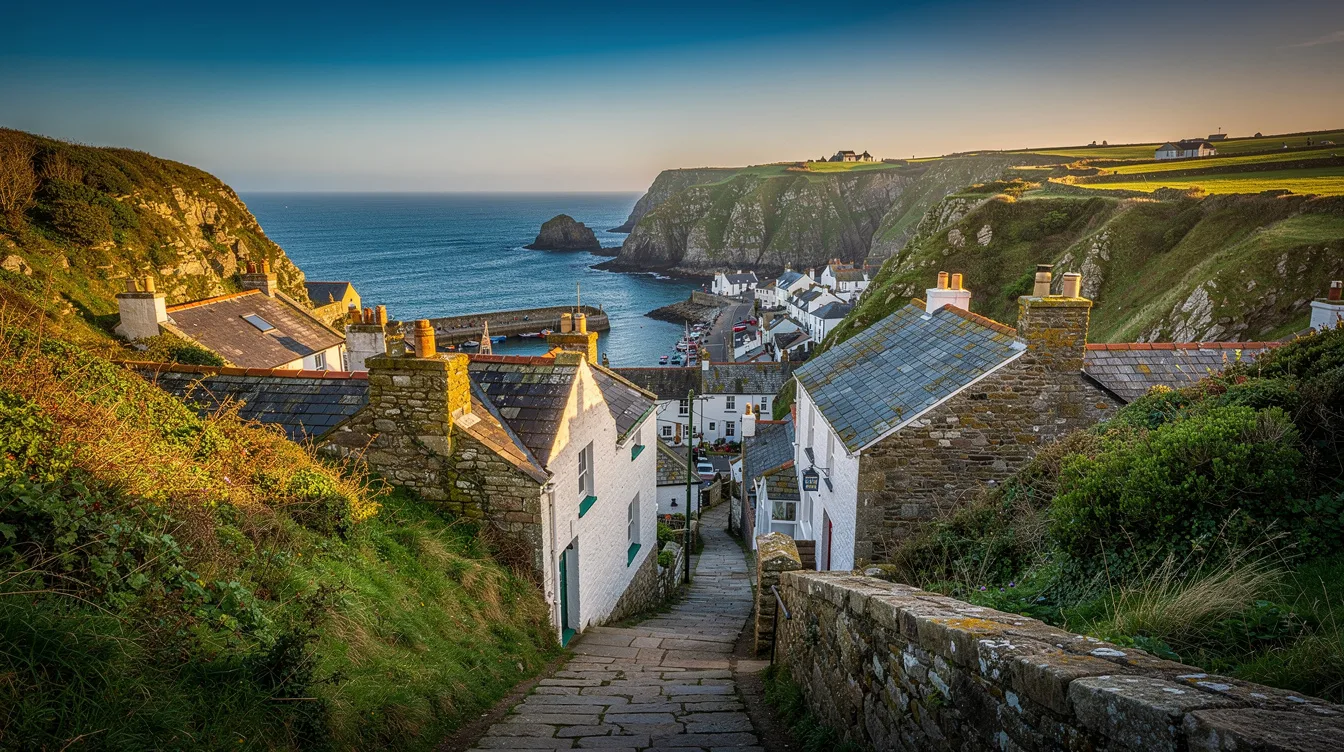
Port Isaac is the English village that became Portwenn in Doc Martin, and its narrowest lane made Guinness history. The show filmed here from 2004 to 2022, turning the small Cornish harbor into a television destination. But the village works better when you look beyond the camera.
And Temple Bar is the place to start. In the 1978 edition of the Guinness Book of Records, the lane was described as the world’s narrowest thoroughfare. You’ll find it among Port Isaac’s steep whitewashed lanes, where walls close around your shoulders and every passing person becomes part of the choreography.
Doc Martin made Portwenn famous, but Port Isaac came first
Port Isaac sits on Cornwall’s north Atlantic coast, in the parish of St Endellion. The village is about 9.9 miles from Wadebridge and Camelford, yet its tight streets make it feel farther from modern traffic than it really is.
And the television connection is impossible to miss. Port Isaac became fictional Portwenn for Doc Martin, with the harbor and village streets appearing throughout the series. If you come expecting a film set, you’ll find one, but you’ll also find a working coastal place with a history that predates television by centuries.
The village grew around a small harbor called The Platt. Its name in Cornish, Porthysek, is generally interpreted as “port of corn,” a reference to coastal trade from the inland farming district. That history gives the waterfront more weight than its postcard appearance suggests.
But this isn’t a museum village. Fishermen still work from The Platt, landing fish, crab, and lobsters. The harbor can feel quiet at one moment, then sharply busy when a boat comes in and people gather near the water.
Temple Bar is a quick squeeze with a real story
And Temple Bar takes less time to walk than it does to explain. Its Guinness distinction is the kind of detail you might dismiss as a novelty, until you stand inside the lane and feel the stone walls narrowing around you.
The passage is also known locally as Squeeze-belly Alley. You can photograph it, but the better experience is moving through slowly, especially when someone approaches from the other direction. There’s no grand view at the end, which is precisely why the lane stays memorable.
Port Isaac’s historic core has around 90 Grade II listed buildings. Their pale walls, dark windows, and steep lanes create a village that looks composed from a distance but feels wonderfully irregular on foot.
But don’t confuse photogenic with effortless. The center is steep, the lanes are narrow, and the village isn’t well suited to cars. Leave your vehicle in the car parks above the village, then allow roughly ten minutes to walk down toward the harbor.
The coast path gives Port Isaac room to breathe
And when the village starts feeling crowded, walk out toward Port Gaverne. The nearby cove and hamlet connect naturally with the coastal paths, so you can trade camera queues for salt air and the sound of water below the cliffs.
The South West Coast Path passes through the area for walkers seeking a longer outing. You can find more route context through the South West Coast Path guide before setting off.
The walk is coastal, not effortless. Wear shoes with a firm grip and expect steep ground, because the same slopes that make Port Isaac dramatic also make casual walking surprisingly demanding. Still, this is where the village makes its strongest case.
But you don’t need a full hiking day. A shorter walk toward Port Gaverne gives you cliffs, sea wind, and a useful escape from the harbor without turning the visit into an endurance test.
When should you visit Port Isaac?
And the best time is outside the summer rush, when the village’s small scale becomes an advantage. Visit in the off-season, or arrive early in the morning and return in the late afternoon, when the lanes are easier to enter and the harbor feels less staged.
You should expect crowds during peak summer and limited parking near the center. That trade-off is real: Port Isaac is easier to photograph then, but harder to inhabit. The quietest hours let you hear footsteps on stone and gulls over the water.
For a wider Cornwall trip, the village makes a practical base for exploring Port Gaverne, Padstow, Tintagel, and Polzeath by car. The nearest main railway station is Bodmin Parkway, about 40 minutes away by car, so public transportation requires more planning.
Can you visit Port Isaac without a car?
Yes, but a car is more convenient for exploring beyond the village. From the nearest station, the final journey takes planning, while the streets themselves are best handled on foot.
And that is Port Isaac’s best contradiction. It’s famous enough to draw television fans, yet small enough that one cramped lane and a turn of the harbor can still change the mood. By late afternoon, the sea wind moves through Temple Bar, and the village finally sounds like itself.