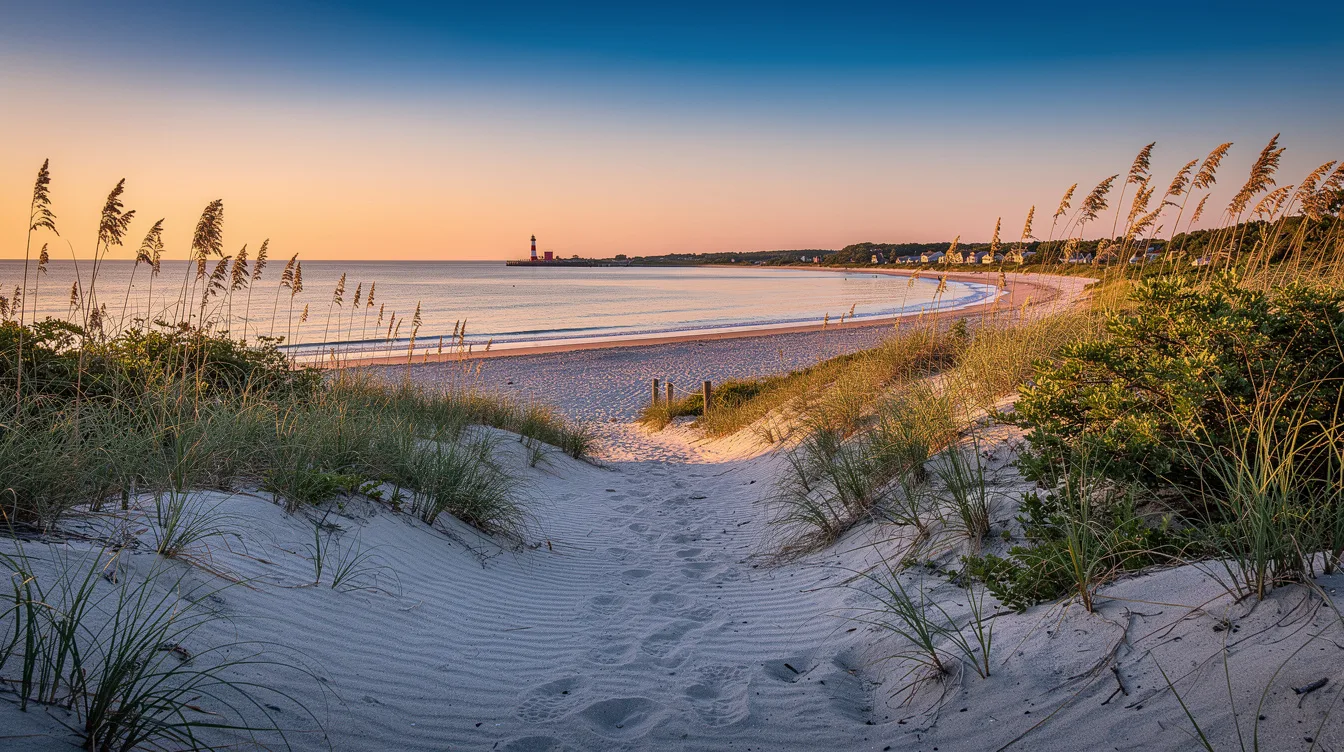
Lewes began in 1631 as Zwaanendael, the first permanent European colony in what became Delaware. That origin explains its proud nickname, “The First Town in The First State,” and it gives this small bay town more historical weight than its relaxed waterfront mood suggests.
You won’t find a grand colonial city here. You’ll find a place of about 3,303 residents, where beach days, boats, and old stories share the same compact stretch of coast.
A 1631 beginning still shapes the town
The date, 1631, is the reason to come with your curiosity switched on. Dutch colonists founded Zwaanendael here, and Lewes later took its current name around 1685, after a town in Sussex, England.
But this isn’t history trapped behind glass. The town’s position on the Delaware Bay made it a port, so the water has always shaped the local rhythm. You can feel that connection in the salt air and the steady movement toward the shore.
Lewes was shelled during the War of 1812, and shipwrecks have occurred offshore. Those facts make the town’s calm present-day waterfront feel slightly less innocent, which is part of its appeal.
And Delaware’s status as the first state to ratify the U.S. Constitution gives the nickname its second half. It’s a neat claim, but Lewes earns it through a real beginning, not a marketing slogan.
Delaware Bay gives Lewes its quieter edge
Delaware Bay sits at Lewes’s doorstep. That geography puts beaches, wetlands, and pine forests close together, so you can shift the mood of a day without leaving the Cape Region.
You should expect a coastal town, not an isolated fishing village. Lewes is near Rehoboth Beach and belongs to a fast-growing part of Delaware, so it has company. But its bayfront identity feels more measured than a full-throttle resort strip.
The town occupies roughly 11-12 square kilometers in total, with water covering about 15-20% of that area. The numbers are modest, and that’s the point: Lewes works best when you let its small scale set the pace.
And the setting has an easy contradiction. It is connected to bigger beach traffic, yet its edges still hold wet ground, pine scent, and open water.
Getting there is part of the coastal experience
Most visitors arrive by car via Delaware Route 1 and U.S. Route 9. Larger airports in Washington, Baltimore, and Philadelphia are roughly 100-120 miles away, while Salisbury is the closest airport at about 40 miles.
That means you should plan on renting a car if you fly. It’s less convenient than stepping out of an airport shuttle, but the drive suits a place whose pleasures are spread between town, bay, and parkland.
The Cape May-Lewes Ferry provides another route, linking southern New Jersey with Lewes year-round for vehicles and passengers. The approach by water is the more memorable choice, because it lets the town appear as a working bay port before it becomes a weekend destination.
But don’t confuse year-round service with a promise of instant spontaneity. Check the current schedule before you build the day around the crossing.
Can you make Lewes a beach trip?
Yes, because beaches, boating, and saltwater fishing drive much of modern Lewes tourism. Yet the better angle is a mixed day: time by the water, then a slower look at a town whose identity began centuries before resort travel.
Cape Henlopen State Park gives Lewes a natural outdoor counterweight. You get shoreline access nearby, but you also get wetlands and pine forests rather than a single-purpose beach scene.
Small town, fuller calendar
Lewes is now largely a resort and retirement community, and tourism supports much of its daily life. That can mean a busier feel around the coast, but it also keeps boats, beach outings, and local gatherings central to the town.
The calendar includes festivals, art shows, book events, concerts, and boat parades. For a town this size, that range can feel unexpectedly urban. And you can choose the mood you want without pretending Lewes is a major city.
The Cape Region is growing quickly, so Lewes isn’t frozen in place. Still, the history gives the town a firmer center than many coastal stops: it has a founding story, a maritime past, and a real relationship with the bay.
By the time the ferry heads back across the water, Lewes is reduced to low shorelines, boat traffic, and the soft gray-blue spread of the bay.