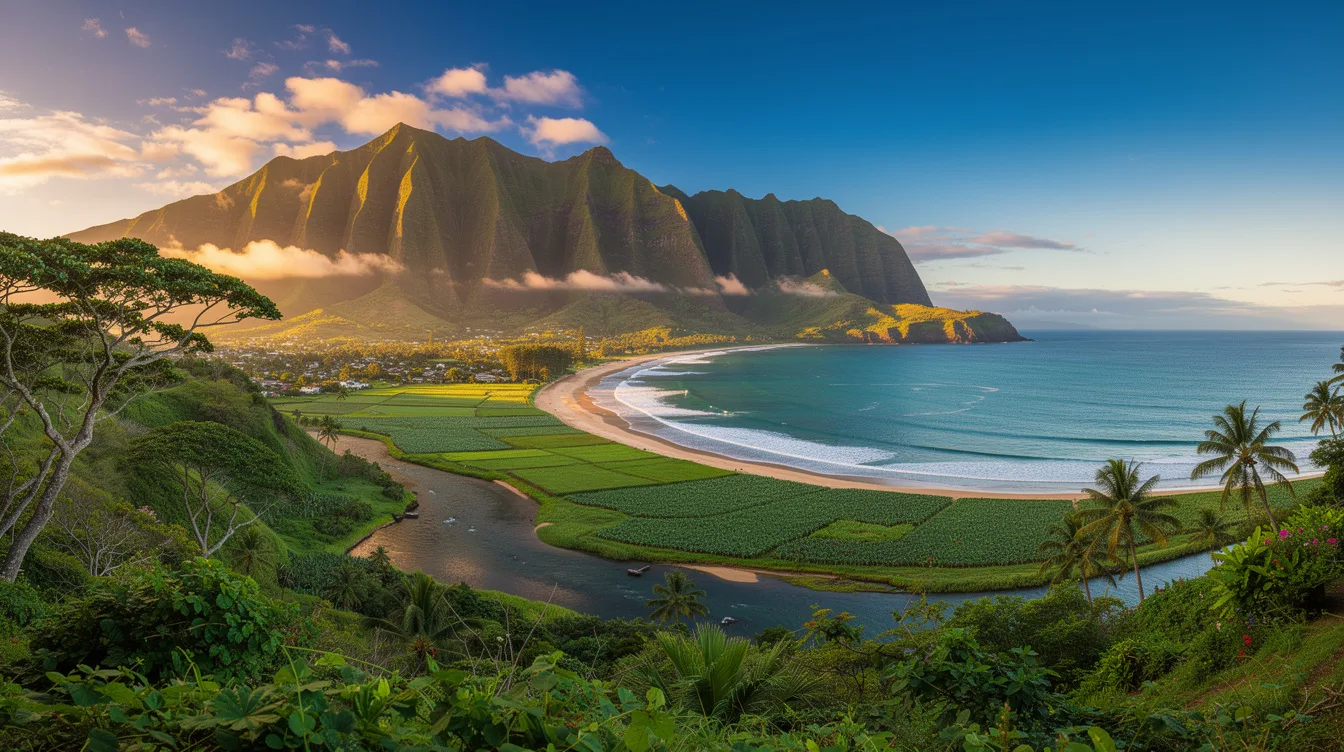
Hanalei is about 35 miles, or roughly 45 minutes, from Līhuʻe Airport. That drive ends at a village on Kauaʻi’s North Shore, at the mouth of the Hanalei River and facing Hanalei Bay.
You’ll pass through Kapaʻa, Kīlauea, and Princeville before the road narrows and the pace changes. The route has several one-lane bridges, so rushing it would miss the point anyway.
A crescent bay with a slower rhythm
Hanalei Bay gives the village its front porch: golden sand, water, and steep green mountains behind it. The name is associated with a “crescent bay,” and the curve makes immediate sense once you’re standing at the shore.
And this is the kind of place that can make you cancel an afternoon plan. You can swim, surf, bodyboard, paddle, or simply walk near Hanalei Pier, depending on the day’s conditions.
But don’t assume the sea behaves the same way year-round. Weather and ocean conditions change by season, so you should assess conditions when you arrive rather than treating the bay as a guaranteed calm-water stop.
The village has cafés, restaurants, galleries, and small shops, yet it still feels more like a community than a standardized beach resort. That balance is Hanalei’s real appeal, though the limited lodging supply can make it an expensive one.
Only 444 residents, and room to breathe
Hanalei had 444 residents in the 2020 census. That tiny number explains why the commercial center feels compact and why a short walk can carry you from a coffee stop toward the beach.
And you won’t find the more urban feel associated with Oʻahu here. Hanalei is relaxed, but it isn’t isolated, because Princeville sits just west of the village with more condos, resorts, and services.
If you want to walk to the beach and village restaurants, stay in Hanalei itself. If you want more lodging choices, Princeville is practical, though it has a different feel from the village streets.
Kapaʻa and Līhuʻe can be more affordable bases. But they are less convenient for North Shore plans, especially when you want to linger near the bay as the light softens and people begin packing up boards.
The river and taro fields tell the longer story
At the village edge, the Hanalei River meets the coast. You can kayak it for a view of the valley and its agricultural setting, a quieter counterpoint to the beach.
And taro has been cultivated locally for more than 1,000 years. That fact gives the valley a weight that a quick shoreline visit can easily miss.
The nearby Hanalei National Wildlife Refuge protects wetland habitat and bird species. But it isn’t open to the public, so it’s something to respect from outside rather than add to an itinerary.
That limit is useful to know before you go. Hanalei rewards slowing down, but it doesn’t turn every green view into a visitor attraction.
The one-lane bridge is your cue to ease up
The Hanalei Bridge crosses the river at the village entrance and has a single lane. It is also one of the area’s most photographed landmarks, although it works first as a reminder to drive patiently.
You’ll need that patience on the approach from Līhuʻe. The stated 45-minute drive assumes good conditions, while narrow roads and one-lane crossings can make a tight schedule feel foolish.
And if Hanalei is your base, the North Shore extends toward Hāʻena, Tunnels Beach, and the Kalalau Trail area. Some sites and parking areas may be regulated or require reservations, so check local conditions just before your trip.
That said, don’t overplan every hour. By the time you reach the bay after the airport drive, the curve of sand, the mountain wall, and the slower traffic make Hanalei feel like a place best met without hurry.