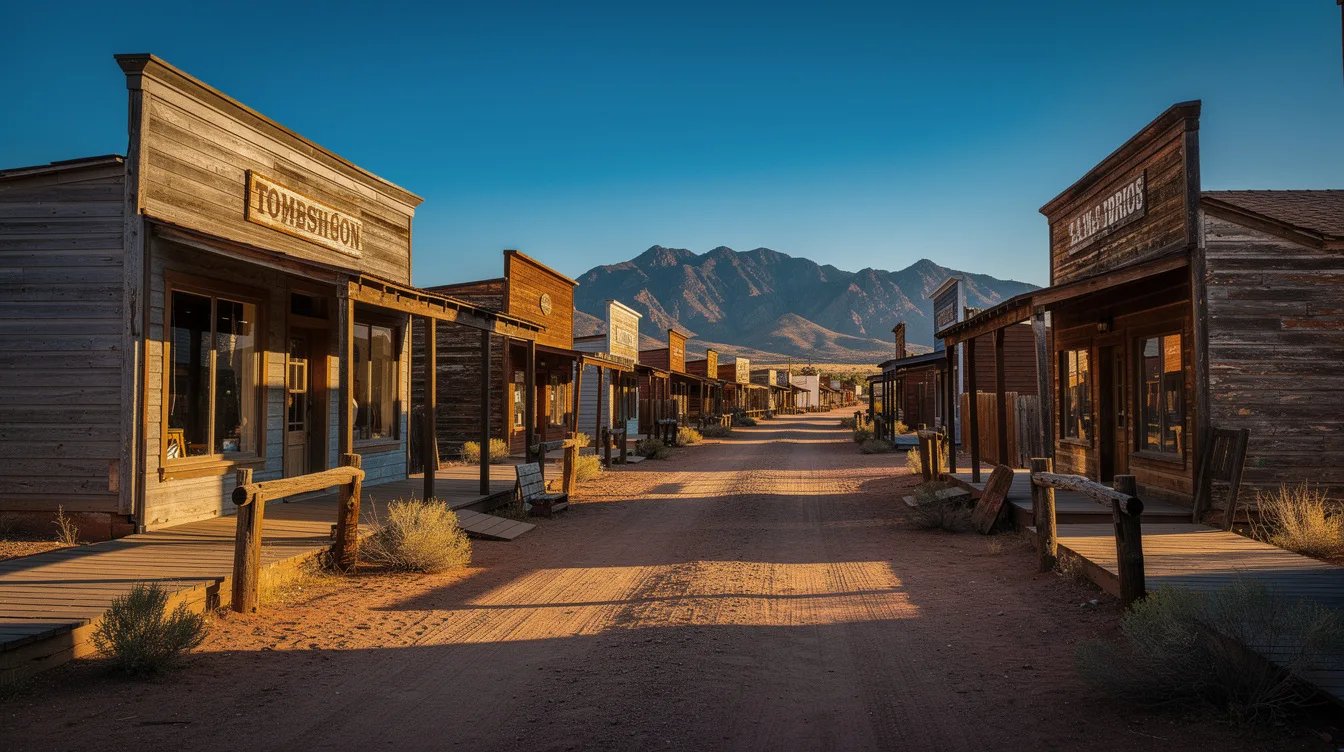
Tombstone is the Arizona town where the 1881 O.K. Corral shootout became a Wild West legend. Hollywood gave the story a larger life, but the real draw is that you can walk the town attached to it.
It is theatrical, and it knows it. But Tombstone is also a former silver-mining town with a historic center recognized as a National Historic Landmark, so the performance has real ground beneath it.
The 1881 story is still the center of town
The shootout at O.K. Corral happened in 1881 and involved a group associated with the Earp brothers and Doc Holliday, along with men associated with the Clanton and McLaury families. That conflict became one of the best-known episodes of the American West.
You do not need to arrive as a history specialist to understand the appeal. The site offers historical reenactments and shows, which make the legend accessible, though the format can feel more staged than solemn.
And that is the honest bargain here. Tombstone turns a violent episode into public history, so you get a clear entry point but not a quiet, untouched historic site.
The town was founded in 1879 after silver was discovered nearby. The mining boom then drew prospectors, merchants, adventurers, and outlaws during the early 1880s, giving the shootout a setting that was already crowded with money and conflict.
Allen Street is lively, but it is not subtle
Allen Street is the main historic street, lined with Western-style facades, saloons, shops, costumed actors, and programmed activity. You will hear boots on the boardwalk and the general buzz of a place built for visitors.
But do not expect an abandoned mining settlement. Souvenir shops and staged scenes are part of the experience, and they are most enjoyable when you stop asking Tombstone to be something it never claims to be.
For me, the town works best as a living argument between commerce and memory. You can buy the costume version of the West, then step into places tied directly to its mining-era history.
The Bird Cage Theatre was once a saloon, theater, and gambling venue. Its presence gives Allen Street a useful counterweight to the outdoor entertainment, because it points back to the town’s rougher early identity.
The historic Tombstone Epitaph, founded in 1880, remains tied to local identity as well. That continuity matters more than another painted facade, since it connects the tourist town to an institution from the boom years.
Two stops put the legend in a wider frame
Start at Boothill Graveyard if you want the story to feel less polished. It is a historic cemetery connected to the mining era and frontier figures, and the mood is naturally quieter than the activity on Allen Street.
Then go to Tombstone Courthouse State Historic Park. The former courthouse was built in 1882 and is now a museum devoted to local history, which helps place the famous gunfight among the town’s broader civic and mining past.
Can you see Tombstone in a half day?
Yes, though a full day gives you more breathing room. A practical order is the courthouse and graveyard in the morning, followed by Allen Street, O.K. Corral, and the Bird Cage Theatre later in the day.
And that sequence makes sense because the quieter sites establish context before the shows take over. If you begin with reenactments, the town can read like a set before you have seen what it remembers.
The drive from Tucson is straightforward
Tombstone sits in Cochise County in southeastern Arizona, about 68.4 miles southeast of Tucson. You reach it via Arizona State Route 80, generally passing through Benson on a drive of roughly 1.5 to 2 hours.
You should treat the journey as part of a southeastern Arizona road trip, not as a quick city detour. Tombstone also pairs naturally with Benson, Bisbee, Sierra Vista, and other Cochise County stops named in local travel planning.
But give the heat its due. Summers are hot, sunny, and dry, while winters are cooler than Arizona’s lower desert areas, so your comfort will shape the day more than any official “best season.”
The permanent population was 1,308 residents in the 2020 census. Tourism is central to the town’s economy, which explains why its past is so visible and why the main street rarely pretends to be ordinary.
Go for the story, then allow for the stagecraft
Tombstone is worth your time if you like Western history and mining towns with an unapologetically public face. You will get interpretive spectacle, but you will also get a town genuinely connected to the event that made its name.
Its official nickname is “The Town Too Tough to Die.” By late afternoon, when the dry air softens and Allen Street keeps moving under its old-style facades, that stubborn self-image feels like the whole point.